

Dash Cam Battery Drain Issues and Solutions: The Ultimate Guide to Parking Mode Safety
Bleat
Battery failure accounts for up to 50% of all roadside service calls every year. It is the leading cause of vehicle breakdowns globally. For many, the fear of a dead battery outweighs the desire for constant surveillance. You want your Bleat 4k car dashcamera to stay vigilant, but you also need your engine to turn over every morning. This conflict shouldn't exist for the modern, tech-forward driver.
We understand that navigating dash cam battery drain issues and solutions can feel complex. You shouldn't have to worry about inconsistent recording or confusing hardwire kit settings. We promise to help you master the balance between total vehicle security and battery reliability through expert power management. It is time to upgrade your peace of mind with a setup that actually works.
This guide provides a deep dive into adjustable voltage cutoff levels, the benefits of dedicated battery packs, and smart recording modes. You will gain the confidence to choose the right power source and protect your vehicle warranty. Let's optimize your surveillance system for peak performance and zero downtime.
Key Takeaways
- Identify the mechanics of parasitic draw and how optimized "Parking Mode" triggers prevent unnecessary energy consumption.
- Compare hardwire kits, OBD-II adapters, and external packs to implement the most effective dash cam battery drain issues and solutions for your vehicle.
- Master Low Voltage Cut-off (LVC) configurations to safeguard your starter battery against permanent deep discharge damage.
- Discover why LiFePO4 external battery packs represent the gold standard for safe, high-heat 24/7 surveillance.
- Leverage the intelligent power-saving architecture of the Bleat 4K car dashcamera for a seamless balance of security and reliability.
The Science of Standby Power: Why Dash Cams Drain Car Batteries
Every modern vehicle maintains a baseline electrical current while parked. This is known as parasitic draw. It keeps your keyless entry active and your alarm system alert. Integrating a dash cam into this ecosystem adds a new layer of energy demand. Understanding dash cam battery drain issues and solutions begins with recognizing that your camera is essentially a compact computer. Like any computer, it requires a steady flow of wattage to function.
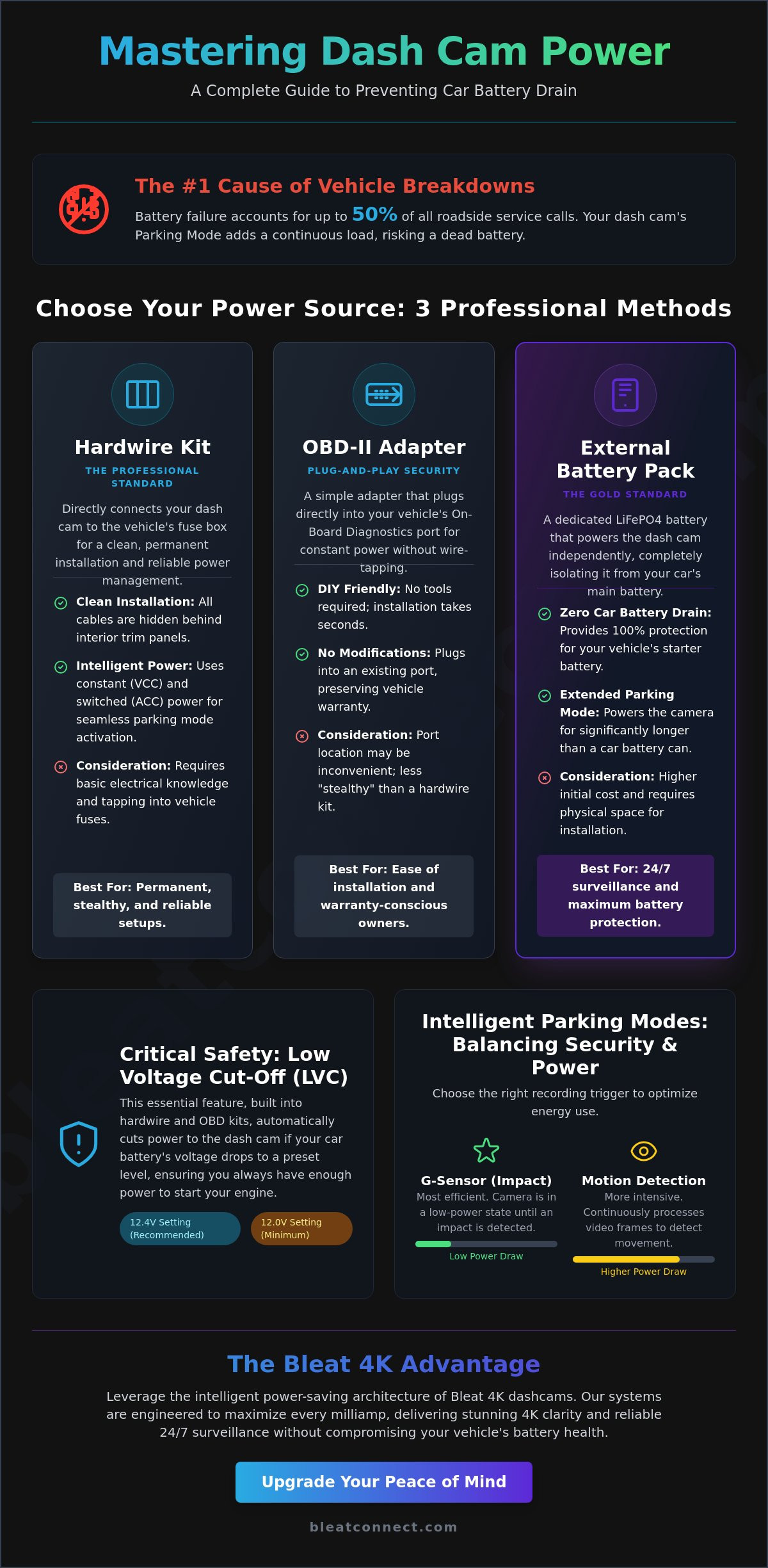
Parking Mode is the primary driver of this energy consumption. It operates through different triggers. G-sensor recording is the most efficient, as the camera remains in a low-power state until it detects a physical impact. Motion detection is more intensive. It requires the image sensor and processor to remain active to analyze every frame for movement. This constant processing ensures you never miss a hit-and-run, but it places a continuous load on the vehicle's lead-acid battery. Choosing the right Dashcam power sources is critical to managing this balance.
Ambient temperature also plays a decisive role in reliability. Extreme cold slows the chemical reactions inside a battery, reducing its ability to hold a charge. Conversely, high heat can accelerate internal degradation. When your car is parked for extended periods in these conditions, the margin for error narrows significantly.
4K Resolution and Power Consumption
High-performance optics require high-performance power. A Bleat 4K car dashcamera processes over 8 million pixels per frame. This is four times the data of a standard 1080p unit. The advanced processors used in 4K models demand more current to handle these massive data streams, even in standby modes. Additionally, writing high-bitrate 4K video to an SD card requires more energy during the save cycle. While a basic camera might use minimal power, a flagship Bleat 4K system utilizes its intelligent architecture to maximize every milliamp without sacrificing image clarity.
Understanding Your Car's Battery Health
Your vehicle's battery health is the foundation of any surveillance setup. If your battery is more than three years old, its capacity is likely diminished. You should check your battery's Cold Cranking Amps (CCA) rating; this determines how much power is available to start the engine in tough conditions. Modern vehicles equipped with Start-Stop technology typically use AGM batteries. These are designed for more frequent cycling but still face limits when supporting 24/7 recording. Identifying a weak battery early prevents the frustration of a car that won't start after a long night of recording.
Powering Your Dash Cam: Hardwire vs. OBD-II vs. Battery Packs
Choosing the right power source is the most critical decision for any surveillance setup. While many entry-level users rely on the 12V cigarette lighter, this method is often insufficient for 24/7 protection. Most modern vehicles cut power to the accessory socket the moment the ignition turns off. If your socket remains active, it lacks the intelligence to stop drawing power before your battery dies. It's a blunt instrument for a problem that requires surgical precision.
Effective dash cam battery drain issues and solutions revolve around three primary professional methods. Each offers a different balance of installation ease and power reliability. By selecting the correct interface, you can effectively manage the parasitic loss in vehicles while ensuring your camera never misses a critical moment. Let's look at how these systems integrate with your car's electrical architecture.
The Hardwire Kit: The Professional Standard
Hardwiring is the industry benchmark for a reason. It uses a three-wire configuration: Ground, ACC (Switched), and VCC (Constant). The Ground connects to the vehicle chassis, while the ACC wire detects when the engine is running. The VCC wire draws a steady stream of energy for parking mode. This setup provides the cleanest aesthetic for a Bleat 4k car dashcamera, hiding all cables behind the interior trim. It is the most reliable way to bridge the gap between your fuse box and your high-performance optics.
OBD-II Power Adapters: Plug-and-Play Security
If you prefer a DIY approach without tapping into the fuse box, the OBD-II port is your best ally. These adapters plug directly into the diagnostic port found under the dashboard. They provide constant power and often include a physical switch to toggle between 'Parking' and 'Driving' modes. While incredibly convenient, some luxury vehicle brands have specific pin configurations that may limit functionality. Always verify compatibility before committing to an OBD-II solution to ensure seamless communication with your car's computer.
For those seeking the ultimate in protection, dedicated LiFePO4 battery packs represent the peak of power management. These external units charge while you drive and power the camera exclusively when parked. This completely isolates the dash cam from your car's starter battery, eliminating any risk of a dead car. While more expensive, they offer the longest recording times and the highest level of safety for modern, tech-heavy vehicles.
Critical Safety: Setting Low Voltage Cut-Off (LVC) Correcty
Low Voltage Cut-off (LVC) is the ultimate fail-safe for your vehicle's electrical system. It acts as an intelligent sentry, constantly monitoring the remaining energy in your starter battery. Without this protection, your dash cam would continue to draw power until the battery reaches a state of "Deep Discharge." This isn't just a temporary inconvenience. Dropping below critical voltage levels causes permanent chemical damage to the lead plates inside your battery, significantly shortening its lifespan. Effective dash cam battery drain issues and solutions start with a properly configured LVC threshold.
Most hardwire kits offer a default setting of 11.8V. For a modern battery in a temperate climate, this might be sufficient. However, a fully charged 12V battery should measure approximately 12.7V. By the time it hits 11.8V, it is effectively 100% discharged. For older vehicles or cars with high-compression engines, 11.8V is often insufficient to turn the starter motor. We recommend a more conservative setting of 12.2V or 12.4V. This ensures you maintain a healthy buffer of energy to guarantee a reliable start every single morning. Understanding What is parasitic battery drain helps you visualize why this buffer is so vital.
Adjusting these settings is straightforward on modern hardware. Most professional kits utilize physical dip switches on the LVC module. Higher-end systems, like the Bleat 4K car dashcamera ecosystem, allow you to manage these thresholds directly through a smartphone app. This digital control offers the precision needed to balance security and vehicle reliability.
Seasonal Voltage Adjustments
Temperature dictates how your battery performs. In winter, chemical activity slows down, and your engine requires significantly more amperage to crank. You should increase your LVC threshold during colder months to preserve more capacity. Summer presents a different challenge. Excessive heat increases the rate of internal self-discharge. Monitoring your battery health across seasons is an essential part of total power management.
Common Hardwire Kit Failures
Hardware isn't always perfect. Some low-quality LVC modules can suffer from "vampire draw," where the circuit itself continues to consume power even after it has technically shut down the camera. To ensure your setup is functioning correctly, follow these steps:
- Use a digital multimeter to check the voltage at your fuse tap while the car is off.
- Verify that the camera actually powers down when the battery hits your chosen threshold.
- Inspect the LVC module for excessive heat, which can indicate a failing component.
Testing your setup early provides peace of mind and protects your investment from unexpected failures.
Advanced Mitigation: External Battery Packs and Intelligent Recording
For drivers who demand uncompromising 24/7 security, standard hardwiring is often just the beginning. While a hardwire kit protects your battery from total depletion, it still relies on the vehicle's starter battery for energy. Dedicated dash cam battery packs represent the ultimate tier of dash cam battery drain issues and solutions. These external units act as a dedicated reservoir. They charge rapidly while you drive and take over the entire power load the moment you park. This completely isolates your camera from the car's electrical system, ensuring your engine always has the 12.7V it needs to ignite.
Safety is paramount in automotive environments. Most consumer electronics use standard Lithium-ion batteries, which are susceptible to thermal runaway in high-heat conditions. Professional dash cam packs utilize Lithium Iron Phosphate (LiFePO4) technology. LiFePO4 cells are engineered for extreme durability. They can withstand the intense cabin temperatures of a car parked in direct sunlight without the risk of fire or swelling. Additionally, they offer significantly higher duty cycles, often lasting for years of daily charge and discharge cycles without losing capacity. Secure your vehicle with the Bleat 4k car dashcamera for elite power management and thermal stability.
When to Invest in a Dedicated Battery Pack
If your vehicle remains stationary for more than 48 hours at a time, a battery pack is no longer optional; it is essential. Modern luxury vehicles are equipped with highly sensitive Electronic Control Units (ECUs) that may trigger "increased battery discharge" warnings if they detect even a minor parasitic draw. A dedicated pack bypasses these sensors entirely. These compact units are designed for discreet installation. You can easily tuck them under the passenger seat or inside the glovebox, maintaining a factory-clean interior aesthetic while doubling or tripling your parking recording time.
Software-Level Power Savings
Intelligent recording settings are your second line of defense. You can significantly extend your surveillance window by optimizing how the camera processes data. Time-lapse mode is a powerful tool. It records at a lower frame rate, reducing the workload on the 4K processor and lowering current draw. For the absolute minimum power consumption, select 'G-Sensor only' mode. In this state, the camera remains in a deep sleep, waking only when it detects a physical impact. Disabling non-essential features like Wi-Fi broadcasting and GPS logging during stationary periods further preserves every precious milliamp. This multi-layered approach ensures your protection never compromises your mobility.
Reliable Protection: Why Bleat 4K Dashcams Excel in Power Management
Bleat has redefined the standard for high-performance vehicle surveillance. While many industry discussions suggest that all high-resolution systems suffer from the same energy inefficiencies, our proprietary engineering proves otherwise. We've developed a system that prioritizes both high-fidelity evidence and long-term battery health. This is the definitive answer to dash cam battery drain issues and solutions for the modern traveler. Our intelligent power-saving architecture ensures that your vehicle remains a fortress without compromising its ability to start.
Our proprietary power-saving chipset is the core of this innovation. Unlike generic units that run at full capacity regardless of the environment, the Bleat 4k car dashcamera utilizes dynamic frequency scaling. In parking mode, the processor intelligently reduces its clock speed while keeping the optics ready for instant activation. This results in a significant reduction in current draw compared to legacy 4K systems. You get the benefit of 8 million pixels of clarity with the energy footprint of a much smaller device. It's a tech-forward approach to a safer, more connected lifestyle.
Bleat's Smart Hardwire Integration
The Bleat hardware kit is engineered for seamless integration with your vehicle's complex electronics. Our LVC module features high-precision voltage sensing with a strict tolerance of +/- 0.1V. This precision eliminates the risk of "vampire draw" that plagues lower-quality alternatives. Additionally, our 4K sensor is specifically optimized for low-light recording. It captures exceptional detail in near-total darkness while utilizing a low-power state that preserves your battery's Cold Cranking Amps. Installation is simplified across a broad range of vehicle makes, ensuring a professional, factory-clean finish every time.
The Bleat app provides real-time control over your security settings. From your smartphone, you can adjust G-sensor sensitivity or set custom voltage thresholds to match your battery's age and health. This digital ecosystem allows you to monitor your setup and receive alerts, ensuring you are never caught off guard. We've removed the guesswork from power management, replacing confusion with authoritative data and user-friendly controls.
The Bleat Guarantee for Modern Travelers
National road safety requires tools that are as reliable as they are advanced. Bleat ensures you remain connected and protected without compromise. We combine high-fidelity 4K footage with battery-safe technology to give you total peace of mind. Your journey deserves a companion that is vigilant, intelligent, and always ready. Don't settle for inconsistent recording or the fear of a dead battery. Secure your vehicle today with the Bleat 4K Car Dashcamera and experience the peak of automotive security technology.
Secure Your Journey with Intelligent Power Management
Mastering dash cam battery drain issues and solutions is the bridge between 24/7 surveillance and total vehicle reliability. You now have the expertise to configure precise Low Voltage Cut-off thresholds and select the ideal power source for your specific driving habits. Whether you opt for a seamless hardwire installation or a dedicated LiFePO4 battery pack, your vehicle remains protected without sacrificing its ability to start every morning. This technical balance ensures your peace of mind is never a gamble.
Bleat delivers the ultimate combination of high-fidelity evidence and electrical safety for the modern traveler. Our systems feature intelligent Low Voltage Cut-off technology and market-leading 4K sensor efficiency to maximize every milliamp. We provide comprehensive national support and reliable tech solutions that integrate perfectly with your digital lifestyle. It is time to stop worrying about your battery health and start focusing on the road ahead. Your vehicle is a vital investment. Protect it with the tech-savvy, forward-thinking companion it deserves.
Upgrade your vehicle security with the Bleat 4K Dashcamera
Frequently Asked Questions
Can a dash cam really drain my car battery overnight?
Yes, a dash cam can deplete your battery if it lacks an intelligent low-voltage cutoff or is connected to an "always-on" power source. While a healthy battery sits at 12.7V, a continuous parasitic draw can quickly drop it below the 11.8V required to start your engine. This is why understanding dash cam battery drain issues and solutions is vital for anyone using parking mode. Without a fail-safe, you risk a dead battery by morning.
What is the best voltage cutoff for a dash cam hardwire kit?
The safest voltage cutoff setting is typically 12.2V or 12.4V to ensure a reliable engine start in all conditions. While many hardwire kits offer a default 11.8V setting, this represents a 100% discharged state for many lead-acid batteries. Setting a higher threshold provides a necessary energy buffer. This is especially critical during winter months when cold cranking requires significantly more amperage from your vehicle's electrical system.
Is it better to use a hardwire kit or an OBD-II power cable?
Hardwire kits are the professional standard because they offer a permanent, hidden installation and precise control over power signals. They use a three-wire system to distinguish between ignition and parking states. OBD-II cables provide a convenient plug-and-play alternative for DIY users. While OBD-II is faster to install, it may not integrate as seamlessly with the complex power management systems found in certain luxury vehicle brands.
How long can a dash cam run on a car battery in parking mode?
A standard car battery can typically power a dash cam for 12 to 48 hours depending on the camera's energy consumption. High-performance 4K sensors require more current for image processing, which can shorten this window. Factors like battery age, ambient temperature, and your specific parking mode settings also play a role. For surveillance lasting several days, a dedicated external battery pack is the only reliable solution.
Will installing a dash cam hardwire kit void my car warranty?
Installing a hardwire kit generally doesn't void your vehicle warranty if you use non-destructive methods like fuse taps. These taps allow you to draw power without cutting or splicing the factory wiring harness. The Magnuson-Moss Warranty Act protects consumers in many regions, stating that a manufacturer cannot void a warranty unless the aftermarket part caused a specific failure. Always use high-quality hardware to maintain your vehicle's electrical integrity.
Do I need a special battery for my dash cam to record while parked?
You don't strictly need a special battery, but using a dedicated LiFePO4 battery pack is the most advanced way to manage dash cam battery drain issues and solutions. These external packs charge while you drive and power the camera exclusively when the engine is off. This setup completely isolates the dash cam from your starter battery. It eliminates the risk of being stranded while providing much longer recording times.
How do I know if my dash cam is draining my battery?
The most obvious sign is a sluggish engine crank or a dashboard warning regarding "increased battery discharge." You can also verify drain by using a digital multimeter to check your battery voltage after the car has been parked for several hours. If your battery consistently reads below 12.0V, your dash cam is likely drawing too much power. Adjusting your low-voltage cutoff to a more conservative setting usually resolves this issue.
What is the difference between motion detection and time-lapse parking mode?
Motion detection keeps the camera in a standby state, triggering a full-frame recording only when the sensor identifies movement. This is excellent for capturing specific incidents but consumes more power during the "analysis" phase. Time-lapse mode records a continuous stream at a very low frame rate, such as one frame per second. It is often more energy-efficient for long-term monitoring and allows you to review hours of footage in just a few minutes.