

Using Dash Cam Footage for Vandalism Claims in India: The 2026 Essential Guide
Bleat
Imagine walking to your car in Pune only to find a deep scratch across the door or a shattered side mirror. It's a gut-punch that thousands of Indian car owners face every year. Pune alone recorded 121 cases of vehicle vandalism in 17 months, yet many victims still struggle with the process of using dash cam footage for vandalism claims in India. You've likely felt the frustration of police indifference or an insurance company rejecting your claim because there's "no proof" of the incident. It's unfair to pay for someone else's malice, and we agree that your vehicle deserves a tech-forward shield that never sleeps.
This 2026 guide provides the essential steps to turn your recordings into undeniable electronic evidence under the Bharatiya Sakshya Adhiniyam, 2023. You'll learn how to navigate mandatory FIRs, IRDAI's 30-day settlement rules, and why high-resolution sensors are the key to successful vandal identification. Whether you're parking in a crowded Delhi-NCR street or a quiet lane, you'll discover how to leverage smart hardware like the Bleat 4K dashcamera to protect your investment. We'll show you how to move from a rejected claim to a guaranteed payout with total confidence.
Key Takeaways
- Overcome "no-fault" claim rejections by documenting intentional damage like key scratches and tire slashing with irrefutable digital proof.
- Master the process of using dash cam footage for vandalism claims in India by leveraging 24/7 Parking Mode and G-Sensor triggers.
- Follow a precise step-by-step guide on preserving electronic evidence immediately after an incident to ensure rapid insurance approval.
- Navigate the legal admissibility of electronic records under the Indian Evidence Act to make your video recordings undeniable in court.
- Enhance your vehicle's defense with Bleat 4K Ultra HD technology to capture high-resolution details and clear faces in low-light environments.
The Reality of Vehicle Vandalism in India and Insurance Challenges
Vandalism isn't just a minor nuisance; it's a direct attack on your asset's value. In Indian urban centers, vehicle damage often goes beyond accidental bumps. Intentional acts like deep key scratches, slashed tires, and snapped side mirrors are rising. Pune Police recorded 121 cases of vehicle vandalism in the 17 months leading up to August 2025. Despite these numbers, the Indian insurance ecosystem remains skeptical. While comprehensive motor insurance technically covers vandalism, the path to a payout is riddled with obstacles. Insurers often view unexplained damage as "self-inflicted" or the result of negligence. This skepticism turns a simple claim into a frustrating battle of words.
The shift from eyewitness dependence to digital-first evidence is the only way to secure your investment. Relying on a bystander to testify is unrealistic in 2026. Most vandals strike when nobody is watching. This is why using dash cam footage for vandalism claims in India has become the gold standard for savvy car owners. High-definition video eliminates the "he-said-she-said" dynamic during surveyor inspections. It provides a timestamped, visual narrative that forces insurers to acknowledge the external cause of damage. Without this digital shield, you're left absorbing the cost or losing your hard-earned No Claim Bonus (NCB).
Common Vandalism Scenarios on Indian Roads
Parking lot disputes are a primary trigger for intentional damage. A minor disagreement over a parking spot can lead to a keyed door or a broken wiper. Theft attempts also fall under this umbrella. Even if a criminal fails to steal the car, the resulting smashed windows or damaged locks are expensive to fix. Public gatherings or roadside parking in high-traffic areas like Delhi-NCR often result in unprovoked damage from agitated crowds or local gangs. These incidents happen in seconds, leaving owners with massive repair bills and zero leads.
The Burden of Proof in Indian Insurance Claims
In the eyes of an insurance surveyor, every scratch is a potential fraud. The burden of proof lies entirely with the vehicle owner. If you can't identify the perpetrator or provide a specific time of occurrence, surveyors may classify the incident as wear and tear or owner negligence. This classification protects the insurer's bottom line but hurts yours. Missing evidence doesn't just mean paying the mandatory deductible; it means your NCB resets to zero, increasing your premium for years.
Legally, your defense rests on the Indian Evidence Act, 1872, and the updated Bharatiya Sakshya Adhiniyam, 2023. These laws allow for electronic records to be admitted as primary evidence. By using dash cam footage for vandalism claims in India, you provide the "silent witness" required to validate your story. A clear 4K recording of a vandal's face or their license plate transforms a suspicious claim into an undeniable fact, ensuring your insurance company honors the policy they sold you.
How Dashcam Technology Detects and Records Vandalism
Modern dashcams are no longer just passive recorders for road accidents. They've evolved into 24/7 security hubs that protect your vehicle while you're away. To succeed in using dash cam footage for vandalism claims in India, your device must feature a robust Parking Mode. This feature acts as the brain of your security system, allowing the camera to remain vigilant even when the ignition is off. It bridges the gap between a simple drive-recorder and a comprehensive surveillance tool that insurance surveyors can't ignore.
Reliability in the Indian climate is a major factor for continuous protection. Standard lithium batteries often fail or swell under the extreme heat of a parked car in cities like Chennai or Ahmedabad. You should prioritize hardware equipped with supercapacitors, which handle thermal stress far better. For 24/7 surveillance, hardwiring is non-negotiable. A hardwire kit connects the camera directly to your car's fuse box, providing a steady power stream without draining your primary battery. This ensures your Bleat 4K car dashcamera stays active through the night, capturing every interaction around your vehicle.
G-Sensor and Impact Detection
The G-sensor, or accelerometer, is your first line of defense against physical aggression. It detects the sudden jolt of a door being kicked or a window being shattered. When a threshold is met, the camera automatically triggers an "Emergency Recording." These files are "locked," meaning the system won't overwrite them during its standard loop recording process. You can adjust the sensitivity settings to ensure the camera doesn't trigger for a passing heavy truck but remains sharp enough to catch a vandal's strike. This locked footage provides the definitive timestamp required by insurers to validate the exact moment of damage.
Advanced Motion and Radar Detection
Proactive security is better than reactive evidence. Advanced motion detection uses the camera's lens to monitor pixels for movement, while radar detection uses proximity sensors to "feel" objects approaching. Radar is particularly effective in India's busy streets because it ignores environmental noise like falling leaves or rain, focusing only on human-sized threats. While there is an Uncertain Legality of Dashcams in India regarding public privacy, having a clear view of a vandal approaching your door is vital for identification.
Motion detection optimizes storage by only recording when activity is detected, ensuring your memory card isn't filled with hours of empty footage. Dual-channel setups provide 360-degree security, capturing vandals who might try to hide in your car's blind spots or scratch the rear panels.
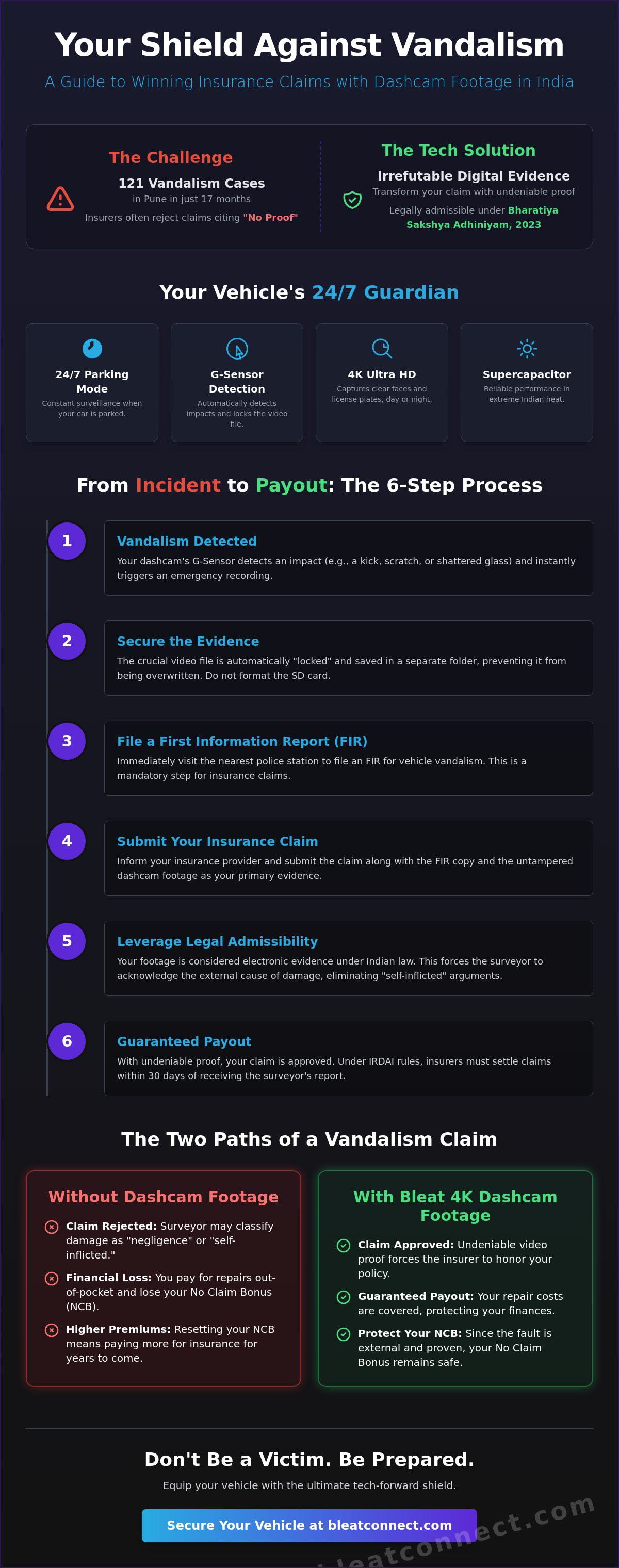
Step-by-Step Guide to Filing a Vandalism Claim with Video
Discovering damage to your vehicle is stressful. Your first instinct might be to clean the broken glass or wipe away the dust, but you must stop. Treat the area as a crime scene. Moving the vehicle or altering the damage can give surveyors a reason to doubt your claim. Using dash cam footage for vandalism claims in India requires a synchronized approach between physical proof and digital records. Follow these steps to ensure your claim isn't rejected.
- Do not move the car from its parked position.
- Photograph the damage from multiple angles before touching anything.
- Power down the dashcam or remove the SD card to prevent loop recording from overwriting the event.
Securing the Evidence
Modern tech allows for instant data preservation. Most premium units, including the Bleat 4K car dashcamera, offer high-speed WiFi connectivity. Download the relevant clips directly to your smartphone using the dedicated app. Check the timestamp immediately. If the time and date on the video don't match the incident report, its legal validity weakens. Store the original SD card in a static-free case. It serves as your primary evidence if the insurer requests a forensic check of the file's metadata.
Navigating the Indian FIR Process
In India, an FIR is a mandatory requirement for vandalism insurance claims. Visit your local police station within 24 hours of discovering the damage. When drafting your complaint, explicitly mention that you possess high-definition video evidence of the act. Don't just tell the officer; ensure they record the existence of the video in the case diary. This creates a permanent legal record. A police-verified video clip is a powerful tool that forces insurance companies to adhere to the IRDAI mandated 30-day claim settlement deadline.
Once you have the FIR, use your insurer's mobile app to upload the digital files. Most 2026 insurance platforms support direct video uploads for faster processing. When the surveyor arrives for the on-site inspection, have the footage ready on a tablet or smartphone. Seeing the vandal in 4K resolution often ends the investigation on the spot. It eliminates the need for long, drawn-out disputes and secures your payout with total confidence.
Legal Admissibility of Dashcam Footage in India
The legal landscape in India has shifted toward a digital-first approach. Under the Bharatiya Sakshya Adhiniyam, 2023, electronic records hold the same weight as physical documents. This transition is a game-changer for car owners. When you're using dash cam footage for vandalism claims in India, you aren't just showing a video; you're presenting a legally recognized record. Courts and insurance tribunals now prioritize this data because it's objective and untainted by human memory bias. It provides a level of certainty that eyewitness testimony simply can't match in a high-stakes insurance dispute.
One critical requirement often overlooked is the Section 65B certificate. This is a mandatory declaration mandated by the Indian Evidence Act for any electronic evidence presented in a legal setting. It essentially certifies that the device was functioning correctly and the footage hasn't been tampered with. Without this certificate, even the clearest 4K video might be challenged by an insurer's legal team. Ensuring your files remain unedited from the moment of capture is vital for maintaining this chain of custody and securing your claim payout.
The IT Act and Digital Evidence
Dashcam footage is classified as a valid electronic record under the Information Technology Act. For your evidence to stand, it must be authentic. Any sign of editing, cropping, or filtering can lead to immediate disqualification during an insurance survey or court hearing. High-resolution 4K footage is preferred by legal experts because it provides the granular detail needed for face and plate recognition. Lower resolutions often blur under zoom, making it impossible to prove the vandal's identity beyond a reasonable doubt in a crowded Indian street.
Privacy and Road Safety Regulations
Privacy concerns often arise when recording in public, but Indian law generally permits filming in public spaces where there is no reasonable expectation of privacy. On public roads, your dashcam serves as a safety tool rather than a surveillance intrusion. To stay on the right side of the law, ensure your camera is mounted securely and doesn't block your view of the road. Ethical recording practices, such as not sharing footage of unrelated individuals on social media, also help avoid potential civil disputes.
Dashcams are legal to operate on Indian public roads provided the installation doesn't obstruct the driver's vision or interfere with the vehicle's safe operation.
By following these legal guidelines, you turn your dashcam from a simple gadget into a powerful judicial tool. Don't leave your legal defense to chance. Secure your vehicle with Bleat 4K technology and ensure your evidence is always court-ready.
Securing Your Vehicle with Bleat 4K Dashcam Technology
Choosing the right hardware is the final step in mastering the process of using dash cam footage for vandalism claims in India. While basic cameras might capture a blurry shape, successful insurance payouts require forensic-level detail. The Bleat 4K car dashcamera is engineered to bridge this gap. It provides the high-resolution clarity needed to identify vandals even in the challenging environments of Indian urban centers. When you present 4K evidence to a surveyor, you're moving beyond speculation into the realm of undeniable fact. It's about protecting your investment with the most advanced technology available today.
Nighttime is when your vehicle is most vulnerable. Most competitors rely on cloud storage that fails in deep basement parkings where 4G and 5G signals disappear. We prioritize reliable local storage, supporting up to 512GB to ensure your evidence is safe regardless of network connectivity. Our superior night vision, powered by the Sony STARVIS2 image sensor, captures clear facial features and license plates in near-total darkness. This addresses the critical gap in night-time vandalism protection that standard cameras ignore. You don't just record the event; you identify the perpetrator with total precision.
Indian summers are brutal on electronics. Standard dashcams often fail when cabin temperatures soar to 50 degrees Celsius. Our hardware is built for this climate, utilizing high-heat resistant components and supercapacitors instead of volatile lithium batteries. This ensures your device remains active and functional throughout the hottest months. When an incident occurs, the user-friendly Bleat app allows for rapid evidence sharing. You can download, trim, and send footage to authorities or insurers in seconds, ensuring you meet the 24-hour reporting window for most vandalism claims.
Bleat 4K: The Ultimate Vandalism Deterrent
The mere presence of a visible, high-tech camera acts as a powerful psychological deterrent. Our wide-angle lenses provide a 360-degree perimeter check, covering the entire hood and side panels where key scratches often occur. Intelligent emergency locking ensures that any G-sensor trigger immediately protects the footage from being overwritten. This seamless loop recording system means you never have to worry about missing the exact moment of impact. It's a "set and forget" security solution that's always ready when you need it most.
Why Bleat is the Indian Market Leader
We've tailored our ecosystem specifically for Indian road conditions and parking challenges. From the 3.16-inch IPS screen for instant playback to our proprietary hardware integration, every feature serves a protective purpose. We offer direct-to-consumer support and a reliable hardware warranty that provides peace of mind long after the purchase. Don't settle for inferior protection that might fail when you need it most. Invest in the Bleat 4K car dashcamera for the best in-car protection and the most effective way of using dash cam footage for vandalism claims in India. Your journey deserves a tech-savvy protector that never blinks.
Master Your Vehicle's Digital Defense
The days of relying on unreliable eyewitnesses or fighting a losing battle with insurance surveyors are over. You now have the roadmap to transform a frustrating act of vandalism into a seamless claim process. By combining 4K Ultra HD resolution with a solid understanding of the Indian Evidence Act, you ensure your vehicle's safety is backed by undeniable proof. It's about taking control of the narrative and protecting your hard-earned No Claim Bonus with technology that never sleeps.
Successfully using dash cam footage for vandalism claims in India is no longer just a smart choice; it's an essential strategy for every modern car owner. Whether you're navigating the complexities of an FIR or presenting evidence on-site, your digital witness provides the clarity needed for a 30-day settlement. You've seen how the right hardware survives the Indian climate and captures the details that matter most in low-light parking scenarios.
Trusted by thousands of Indian drivers, our technology offers the Advanced Parking Mode with G-Sensor you need to stay protected 24/7. Protect your vehicle with the Bleat 4K Dashcam today and enjoy the ultimate peace of mind every time you park. Your journey is safer when you're backed by the market leader in automotive security.
Frequently Asked Questions
Is it legal to use a dashcam for insurance claims in India?
Yes, dashcam footage is fully legal and admissible as electronic evidence in India. Under the Bharatiya Sakshya Adhiniyam, 2023, digital records carry the same weight as physical documents in court. Most major Indian insurers now encourage using dash cam footage for vandalism claims in India to eliminate fraudulent reports and speed up the settlement process. You just need to ensure the file is authentic and untampered.
Does a dashcam record when the car is parked and the engine is off?
A dashcam only records while parked if it features a dedicated Parking Mode. Devices like the Bleat 4K car dashcamera use this mode to stay in a low-power standby state, waking up instantly when the G-sensor detects an impact. For this to work without the engine running, your camera must be connected to a constant power source, such as a hardwire kit or an external power bank.
Will my car battery drain if I use a dashcam for 24/7 vandalism monitoring?
Your battery won't drain if you use a high-quality hardwire kit with a built-in low-voltage cutoff. This technology monitors your car battery's health and automatically shuts down the camera if the voltage drops below a safe level, usually 11.8V or 12V. This ensures your vehicle always has enough power to start while providing maximum surveillance for using dash cam footage for vandalism claims in India.
How do I submit dashcam video to my insurance company?
You can submit the footage directly through your insurer's mobile app or web portal during the claim filing process. Most modern insurance platforms in 2026 support MP4 or MOV file uploads. If an on-site surveyor is assigned, it's best to have the clip ready on your smartphone or a tablet for immediate review. Providing this digital proof early can help you meet the IRDAI's 30-day settlement mandate.
What resolution is best for identifying vandals at night?
4K Ultra HD is the best resolution for capturing clear details in low-light environments. Higher resolution provides a denser pixel count, which is vital when you need to zoom in on a vandal's face or a getaway vehicle's license plate. When combined with an advanced sensor like the Sony STARVIS2, 4K cameras can turn grainy, dark shadows into sharp, actionable evidence that police can actually use.
Can dashcam footage help if someone scratches my car in a mall parking lot?
Yes, a dashcam is often the only way to identify perpetrators in crowded mall basements. Since mall security cameras often have blind spots, your own dual-channel system acts as a personal 360-degree guard. It captures anyone passing between vehicles who might intentionally key your door or snap a mirror. This footage proves the damage was external and not caused by your own driving negligence.
Do I need a special SD card for 4K dashcam recording?
You must use a high-endurance microSD card with a U3 or V30 speed rating for 4K recording. Standard cards can't handle the rapid data write speeds required for Ultra HD video and will likely fail or corrupt your files. High-endurance cards are specifically built for the constant loop recording cycles and extreme temperature fluctuations common inside parked cars in the Indian climate.
Will using a hardwire kit for my dashcam void my car warranty?
Using a hardwire kit generally does not void your vehicle warranty if you use fuse taps. This method is non-invasive because it plugs into existing fuse slots without cutting or splicing any original wires. Most Indian dealerships and service centers accept this "plug-and-play" installation. It's a safe, professional way to ensure your car stays protected without compromising your manufacturer's electrical warranty.