

4K Dash Cam vs 1080p for Indian Roads: Is the Upgrade Essential in 2026?
Bleat
In the high-stakes chaos of a Delhi hit-and-run, a 1080p recording often leaves you with nothing but a pixelated smudge where a license plate should be. You've likely felt the frustration of squinting at grainy night footage that fails to protect your interests. When deciding between a 4k dash cam vs 1080p for Indian roads, the choice isn't about cinematic quality; it's about capturing readable evidence that stands up to police and insurance scrutiny in 2026.
We agree that your safety shouldn't be compromised by outdated hardware. This guide promises to show you why a high-resolution upgrade is a functional necessity for the modern Indian traveler. You'll see how the Bleat 4k car dashcamera handles 45°C temperatures, manages massive data files, and meets the strict requirements of the Digital Personal Data Protection Act of 2023. Discover how to transform blurry shapes into clear, actionable data for total peace of mind on the road.
Key Takeaways
- Understand why 8.3 million pixels provide the forensic detail needed to cut through Indian dust and smog for undeniable evidence.
- Evaluate the 4k dash cam vs 1080p for Indian roads debate to see why digital zooming makes 4K a requirement for readable license plates.
- Identify the critical hardware differences, like supercapacitors, that prevent device failure and fire hazards in 60°C cabin heat.
- Learn how H.265 (HEVC) compression allows you to store massive 4K files efficiently without sacrificing forensic clarity on standard SD cards.
- Explore how proprietary night vision technology in the Bleat 4k car dashcamera neutralizes high-glare urban environments for 24/7 protection.
The Indian Road Challenge: Why Resolution Matters More Here
Indian traffic is a relentless stream of visual data. On a typical Mumbai or Delhi artery, your camera must track motorcycles, rickshaws, and cars simultaneously within a single frame. While standard dash cam resolutions like 1080p were once the benchmark, they often fail under the sheer density of Indian road events. In 2026, the choice between a 4k dash cam vs 1080p for Indian roads is decided by the need for forensic clarity. When multiple vehicles move at varying speeds, lower-resolution sensors produce motion blur that renders footage useless for police or insurance claims.
Environmental factors add another layer of difficulty for drivers. Dust, smog, and heavy monsoon rain significantly reduce visibility and contrast. A higher native resolution provides the raw pixel data needed to resolve shapes through this atmospheric noise. Legally, your footage carries immense weight. Under the Digital Personal Data Protection Act (DPDP Act) of 2023, dashcam recordings are considered personal data. To use them as evidence in Indian courts, you need high-quality, authentic files that clearly identify the parties involved. A blurry shape won't secure an FIR; a readable plate will.
License Plate Visibility: The 10-Meter Rule
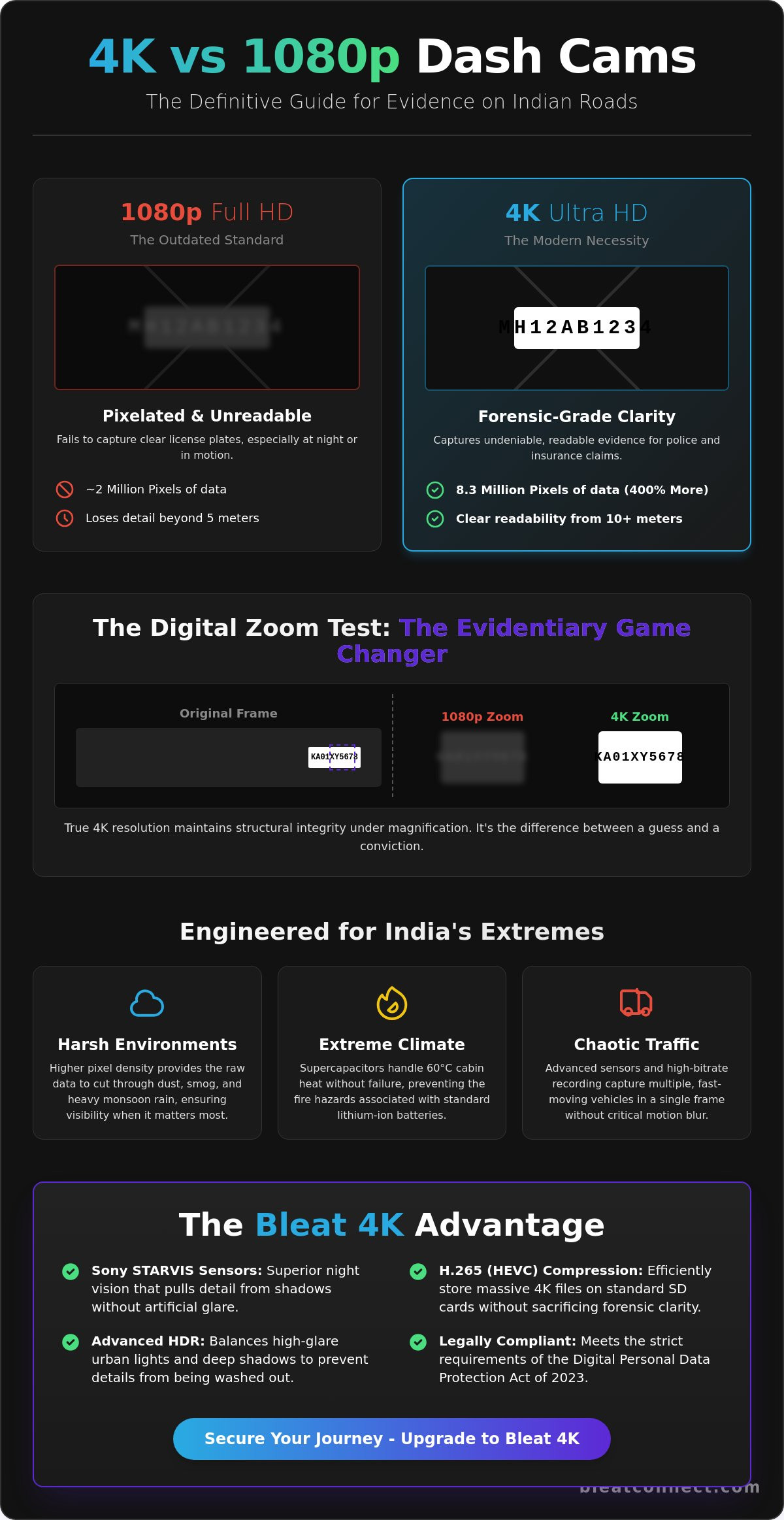
In moving traffic, 1080p sensors usually lose critical detail beyond a 5-meter radius. This is a major liability on Indian highways where "hit and run" incidents often involve vehicles quickly accelerating away. Standard 1080p footage pixelates when you try to zoom in on a distant plate. Non-standardized Indian license plate fonts make this even harder for budget sensors to read. Upgrading to a 4K system allows for a 4x digital crop. This means you can zoom into the frame during post-incident analysis and still maintain the legibility of the plate number from 10 meters or more.
Visual Noise in Urban Environments
Indian cities present a nightmare of lighting extremes. You often face high-beam glare from oncoming traffic on unlit backstreets, followed by the harsh glow of LED billboards at major intersections. A 4K sensor captures more light data, which is essential for managing these complex environments. The Bleat 4k car dashcamera utilizes advanced High Dynamic Range (HDR) to balance bright sunlight and deep shadows, such as those found under flyovers. This ensures that the "visual noise" of the city doesn't wash out the details of a pedestrian or a sudden obstacle, providing a protective digital shield for your journey.
4K vs 1080p: Technical Breakdown for the Practical Driver
Choosing between a 4k dash cam vs 1080p for Indian roads comes down to raw data density. A standard 1080p sensor captures roughly 2 million pixels per frame. In contrast, a true 4K sensor captures 8.3 million pixels. This isn't just a marginal gain. It's a 400% increase in the information available for your protection. When you consider the economic loss from road traffic injuries in India, having high-fidelity evidence isn't a luxury. It's a financial and legal safeguard. However, don't be fooled by "Interpolated 4K." Budget brands often use software to stretch 1080p images into a 4K file. This adds zero detail and only wastes storage space. You need native 4K hardware to see the difference.
Sensor size dictates how much light your camera "sees." A larger 4K sensor performs better in low-light conditions by reducing digital noise. You might also face a choice between 60fps at 1080p or 30fps at 4K. While 60fps looks smoother to the eye, 30fps at 4K is superior for capturing static details like license plates on a moving vehicle. Sharpness is the priority for evidence. If you want the best of both worlds, the Bleat 4k car dashcamera integrates high-bitrate recording to ensure every frame is crisp, even at high speeds.
Digital Zoom: The Evidentiary Game Changer
Digital zoom is the ultimate test of your camera. In an accident investigation, you'll likely need to "pixel peep" to identify a face or a registration number. When you zoom into a 1080p recording, the image quickly degrades into what looks like a blurry watercolor painting. The edges smear. The text disappears. True 4K resolution is the standard for high-speed hit-and-run identification because it maintains structural integrity even under heavy magnification. It's the difference between a guess and a conviction.
The Role of Sony Starvis Sensors in 2026
Hardware matters more than marketing labels. In 2026, Sony Starvis sensors remain the industry gold standard for dashcam optics. These sensors are specifically designed for low-light surveillance. They enhance 4K night vision by pulling detail from the shadows without the artificial "halo" effect caused by cheap software sharpening. Hardware clarity ensures that high-glare environments, like Indian highways with poorly adjusted headlights, don't wash out your footage. It’s about capturing the truth, not just a bright picture.
Durability and Reliability in the Indian Climate
Parked cars in the peak of an Indian summer are literal ovens. When ambient temperatures hit 45°C, interior cabin heat can easily exceed 60°C within minutes. This extreme environment is the ultimate stress test for dashboard electronics. While basic 1080p units run cooler, the high-speed processing required for a 4k dash cam vs 1080p for Indian roads generates significant internal heat. Without specialized thermal management, a 4K camera will shut down or "throttle" exactly when you need it most. Protecting your vehicle requires hardware that doesn't just record, but survives.
Build quality isn't just about aesthetics; it's about survival. High-end units utilize heat-resistant polycarbonate or ventilated metal housings to dissipate energy. Metal acts as a radiator, pulling heat away from the sensitive 4K sensor. However, the internal power source remains the most common failure point. Standard Lithium-ion batteries are a genuine fire hazard in India. They swell under pressure, leak, and lose their ability to hold a charge after just one season of exposure to the sun. When evaluating build quality, look for these thermal-ready features:
- Reinforced polycarbonate shells for superior UV and warp resistance.
- Passive cooling vents designed to exhaust processor heat during long drives.
- High-grade thermal pads that bridge the gap between the sensor and the outer housing.
Supercapacitor Technology: A Non-Negotiable Feature
Supercapacitors represent the gold standard for Indian driving conditions. Unlike traditional batteries, they use an electrical field to store a small charge. This makes them immune to the chemical degradation and swelling caused by intense heat. Their primary function is to ensure a "Last File Save." In a severe collision where the vehicle's power is cut, the capacitor provides enough energy to finalize and protect the current recording. Bleat prioritizes capacitor-based power across its 4K lineup to ensure your evidence is never corrupted by a sudden power loss or thermal surge.
Mounting and Vibration Resistance
Indian roads demand physical resilience. Constant vibration from potholes and uneven surfaces can cause "windshield wobble" in poorly designed mounts. Heat-softened adhesives often fail, causing the camera to drop and potentially break. You need low-profile, high-bond mounts that keep the lens steady. This stability is crucial because the superior image clarity of 4K sensors allows for more effective software-based stabilization. By capturing more detail in every frame, the camera can better compensate for road-induced jitters, delivering a smooth and professional recording even on the roughest terrain.
Managing the 4K Data Load: Storage and Connectivity
High resolution generates massive amounts of data. This is often the biggest hurdle for those comparing a 4k dash cam vs 1080p for Indian roads. In 2026, storage is no longer a bottleneck if you use the right compression. Older cameras used H.264, which bloated file sizes and filled cards too quickly. Modern hardware utilizes H.265 (HEVC). This codec is a game changer. It reduces file sizes by nearly 50% while preserving the pixel-perfect clarity required for insurance claims. You get the forensic detail of 4K without needing to swap SD cards every hour.
A 128GB card now comfortably holds approximately 7 hours of 4K footage. In the high-density traffic of urban India, you don't need days of archives. You need the last few hours of your journey. Loop recording ensures the camera never stops; it simply overwrites the oldest unprotected files. Meanwhile, G-sensor technology locks specific clips during a collision or sudden braking. This prevents the most critical evidence from being lost during your commute. It’s a smart, automated system designed for total digital well-being.
Choosing the Right SD Card for India
Not all storage is equal. For 4K bitrates, U3 or V30 rated MicroSD cards are non-negotiable. These cards maintain the high write speeds necessary to prevent dropped frames or corrupted files. In the Indian climate, you must use "High Endurance" cards. Standard cards aren't built for the 60°C cabin temperatures or the thousands of overwrite cycles typical of a dashcam's life. A generic card is a single point of failure that could cost you your evidence when you need it most. Stick to reputable, high-speed storage to match your high-speed hardware.
- U3/V30 Rating: Ensures consistent 4K write speeds without buffering.
- High Endurance: Specifically designed to handle constant data overwriting in extreme heat.
- 128GB+ Capacity: Provides an optimal buffer for loop recording cycles.
App Connectivity and Quick Downloads
Transferring a 4K video file over a slow connection is a recipe for frustration. Most budget cameras rely on 2.4GHz Wi-Fi, which can take minutes to move a single clip. For the modern Indian traveler, 5GHz Wi-Fi is the essential standard. It offers significantly faster transfer speeds, allowing you to show evidence to a police officer or insurance agent on the spot. Speed is safety in a roadside dispute.
Seamless file management is the core of the Bleat ecosystem. Our proprietary hardware integration ensures that your phone connects instantly to the device without complex pairing rituals or dropped signals. If you're ready for a device that manages your data as intelligently as it records it, upgrade to the Bleat 4k car dashcamera today. It’s the ultimate companion for a safer and more connected lifestyle.
Bleat 4K: Engineered for the Modern Indian Journey
Indian roads don't offer second chances. When the sun sets and high-beam glare from oncoming trucks blinds your vision, you need more than just a camera. You need a protector. Bleat has claimed market leadership by engineering solutions specifically for these regional challenges. Our proprietary night vision tuning is designed to neutralize the extreme light contrast found in Indian urban centers. While others struggle with "halo" effects and light bleeding, we deliver crisp, actionable data that serves as your digital witness.
Durability is our core identity. We provide national coverage through market-leading heat management systems. From the humid coasts of Kerala to the scorching plains of Rajasthan, our hardware remains operational. We utilize a combination of ventilated metal housings and high-performance supercapacitors to ensure your device never fails during a critical moment. This is why the debate of 4k dash cam vs 1080p for Indian roads ends with Bleat. We don't just sell electronics; we provide essential upgrades for a safer and more connected lifestyle.
Bleat 4K Dashcam Performance Profile: Native 4K Ultra HD | Sony Starvis Sensor Integration | H.265 Smart Compression | 5GHz High-Speed Wi-Fi | Supercapacitor Power Cell | Advanced HDR Glare Reduction | High-Endurance Thermal Housing.
Why Bleat is the Tech-Forward Choice
We position ourselves as your tech-savvy companion for every journey. Our philosophy bridges the gap between complex hardware specifications and real-world safety benefits. You don't need to be an engineer to appreciate the security of a 4K file that catches a hit-and-run offender's plate from 15 meters away. The Bleat 4k car dashcamera is an intelligent investment in your digital well-being. It's a polished, professional solution for the modern traveler who refuses to settle for "good enough" when "absolute clarity" is available.
The Verdict: Is the 4K Premium Worth It?
In 2026, the answer is a definitive yes. While 1080p remains a budget-friendly option for basic monitoring, it lacks the resolution required for future-proof protection. Indian road density is increasing. Legal requirements for evidence are becoming stricter. Investing in 4K resolution today ensures your vehicle is equipped for the challenges of tomorrow. When evaluating a 4k dash cam vs 1080p for Indian roads, remember that the cost of one missed license plate far exceeds the price of a hardware upgrade.
Don't leave your safety to chance. We invite you to secure your journey with Bleat’s advanced 4K lineup. Explore our ecosystem of intelligent protection today and experience the confidence of total road awareness. Your journey deserves the highest standard of technological excellence.
Secure Your Digital Legacy on the Road
The landscape of Indian driving has evolved. In 2026, relying on standard resolution is a gamble you don't need to take. When you compare a 4k dash cam vs 1080p for Indian roads, the winner is clear. 4K provides the 8.3 million pixels required to turn a blurry hit-and-run into a closed case. You've seen how native resolution overcomes smog while heat-resistant supercapacitors ensure your device survives the harshest summers. Protecting your journey requires hardware that's as resilient as it is intelligent. It's about more than just video; it's about owning the truth in every frame.
It's time to future-proof your vehicle with market-leading technology. The Bleat 4K Dashcam delivers everything you need for absolute peace of mind. Featuring a premium Sony Starvis 4K Sensor, a heat-resistant supercapacitor, and 5GHz high-speed Wi-Fi, it's the essential companion for the modern traveler. Don't settle for "good enough" when your safety is on the line. Upgrade to the Bleat 4K Dashcam for Ultimate Road Safety and drive with the confidence of a tech-savvy protector. Your journey is worth the highest standard of excellence.
Frequently Asked Questions
Is 4K dashcam footage significantly better than 1080p for insurance claims in India?
Yes, 4K resolution provides four times the pixel density of 1080p. This is a critical advantage for insurance claims where you must zoom in on a distant license plate or a driver's face. In the specific context of a 4k dash cam vs 1080p for Indian roads, the higher resolution ensures that digital cropping doesn't result in a pixelated mess. Clearer evidence leads to faster claim processing and fewer disputes with authorities.
Do 4K dashcams overheat more easily in the Indian summer?
4K processors do generate more internal heat, but high-end units are engineered specifically for the Indian climate. While budget models might throttle or shut down, devices like the Bleat 4k car dashcamera use supercapacitors and ventilated housings to stay operational in 60°C cabin heat. Choosing a model with a metal chassis helps dissipate energy more effectively than cheap plastic alternatives found in basic 1080p units.
What is the minimum SD card size recommended for a 4K dashcam?
We recommend a minimum of a 128GB High Endurance MicroSD card for any 4K system. Because 4K files are significantly larger than 1080p files, smaller cards will reach their overwrite limit much faster, which can shorten the card's lifespan. Always ensure the card carries a U3 or V30 rating to handle the high-bitrate data stream without causing recording errors or file corruption.
Can I use a 1080p dashcam if I only drive in the city?
You can use 1080p, but it's not the ideal choice for the high-glare environments of Indian cities. Urban driving involves tight spaces and constant movement where 4K resolution captures the finer details of side-swipes or pedestrian interactions. If you want a tech-forward protector for your daily commute, the extra clarity of 4K is a significant safety upgrade even at low city speeds.
Does a 4K dashcam require a special app to view videos?
Most modern 4K units use a dedicated smartphone app for seamless file management and playback. These apps are optimized to handle H.265 compression and high-speed transfers over 5GHz Wi-Fi. While you can view files on a PC by removing the SD card, using the official app is the fastest way to share evidence with police or insurance agents at the scene of an incident.
Is it difficult to install a 4K dashcam in my car myself?
Installation is a straightforward process that most car owners can complete in under thirty minutes. Most units use a simple adhesive mount and draw power through the 12V cigarette lighter port. While we don't offer professional installation services, the provided kits are designed for a clean, DIY setup. You can easily tuck the cables into the car's trim for a professional look without using specialized tools.
How does 4K resolution perform during heavy monsoon rain?
Higher resolution is a massive advantage during the monsoon season. The extra pixels help the sensor distinguish between a vehicle and the visual noise of heavy rain or road spray. When combined with advanced HDR, a 4K sensor maintains contrast on wet, reflective surfaces. This ensures your safety isn't compromised by poor weather conditions that often blur 1080p footage.
Will a 4K dashcam drain my car battery when parked?
A dashcam won't drain your battery if it's installed correctly. Most 4K systems include a low-voltage cutoff feature when hardwired, which automatically stops drawing power if the car battery drops below a safe level. If you're using a standard 12V plug, the camera typically shuts down when you turn off the ignition. This preserves your battery while ensuring the device is ready for your next journey.