

The Ultimate Guide to Choosing a Dash Cam for Off-Road Driving in 2026
Bleat
Your standard city dashcam is a liability the moment your tires leave the tarmac. While a basic camera works for the daily commute, the vibration and dust of the Indian wilderness will turn most consumer electronics into paperweights. You need more than just a lens; you need a tactical survival tool that captures every rugged detail without failing when the terrain gets tough.
We understand the frustration of finding your trail footage blurred by vibration or your memory card filled with locked "emergency" files caused by every minor bump. Choosing a dash cam for off-road driving requires a focus on specialized hardware like supercapacitors for 48°C cabin heat and intelligent G-sensor management. This guide will show you how to secure crisp 4K footage and reliable incident recording that stays protected even in the most demanding conditions. We will explore the critical features of 2026 technology, including vibration-dampening mounts and OBD-based power solutions that keep your vehicle warranty safe.
Key Takeaways
- Identify the specific vibration-dampening hardware required for a dash cam for off-road driving to eliminate blurred footage on bumpy trails.
- Discover why supercapacitors are mandatory for survival in the Indian sun, resisting cabin temperatures that exceed 48°C.
- Learn how 4K resolution provides a tactical advantage by allowing you to crop into fine details like license plates through thick dust and mud.
- Understand the benefits of OBD-based power connections for remote expeditions, ensuring continuous recording without risking your vehicle’s warranty.
- Explore the proprietary hardware integration of the Bleat 4K system, engineered for maximum stability in high-G off-road environments.
Why Standard Dashcams Fail During Off-Road Driving
Standard dashcams are designed for the predictable asphalt of city bypasses, not the punishing terrain of extreme off-road trails or remote wilderness. An authentic dash cam for off-road driving isn't just a recording device; it's a ruggedized optical sensor engineered for high-G environments. Most consumer-grade cameras are built with thin plastic housings and delicate internal ribbons that simply cannot withstand the persistent mechanical stress of a 4x4 expedition. When you leave the pavement, the technical requirements for your gear shift from convenience to survival.
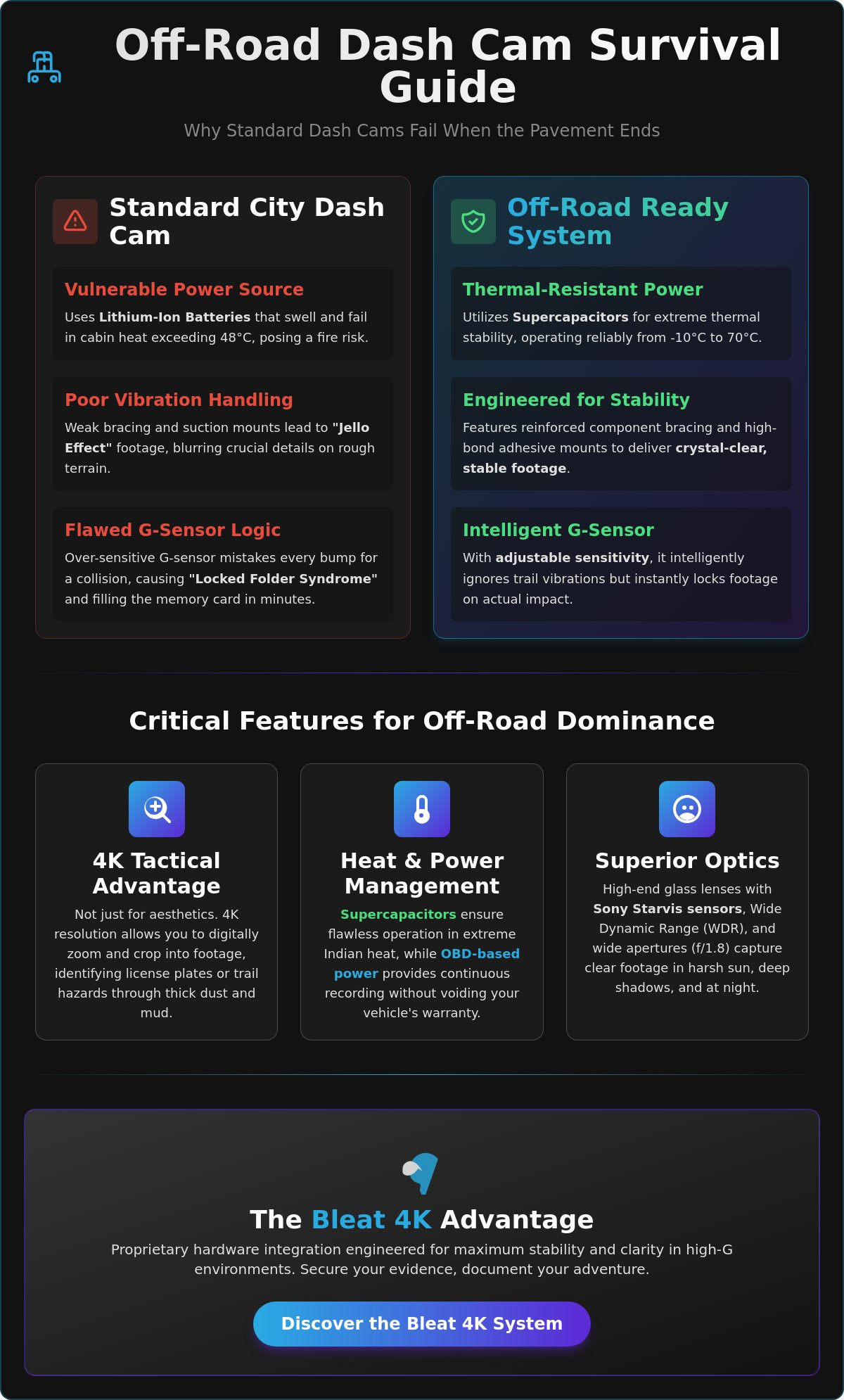
The "Vibration Trap" is the first hurdle. While Dashcam technology has advanced rapidly, budget 1080p sensors still rely on weak internal bracing. On a washboard road, these micro-vibrations translate into a constant high-frequency shake that the camera's processor can't filter out. This results in "jello effect" footage where the landscape appears to warp and melt, making it impossible to identify trail obstacles or vehicle details. Beyond the visuals, heat and dust act as silent killers. In many hot climates, cabin temperatures often exceed 48°C during the summer. Standard lithium batteries in cheap cameras can swell or even explode under these thermal loads, while fine silt from unpaved tracks penetrates unsealed casings to choke the internal circuitry.
The Physics of Trail Vibration
Constant shaking causes rolling shutter artifacts in cameras with slow sensor readout speeds. This means the top of your frame is recorded milliseconds before the bottom, creating a distorted image during heavy jarring. To combat this, ruggedized cameras utilize reinforced internal component bracing to keep the lens and sensor perfectly aligned. Mounting choice is equally critical. While suction cups are fine for smooth roads, they often fail during extreme vertical movement. High-bond adhesive mounts are the professional choice for off-roaders because they provide a rigid connection to the glass, significantly reducing the amplitude of vibrations reaching the sensor.
G-Sensor Calibration Challenges
Most dashcams feature a G-sensor designed to detect a collision and lock the current video file. On unpaved, rugged trails, a standard G-sensor interprets every deep pothole or rocky ledge as a major accident. This triggers "Locked Folder" syndrome, where the camera fills your SD card with protected files that won't be overwritten. Within an hour of driving, your storage is full, and the camera stops recording new footage. Having adjustable sensitivity is the most important software feature for off-roaders. It allows the device to ignore the vertical bounce of the trail while remaining ready to trigger during an actual high-impact event.
Essential Hardware Specs for Rugged Terrain
High-performance off-roading demands more than just a standard camera lens. To survive the trail, a dash cam for off-road driving must feature a premium optical sensor, such as the Sony Starvis series. These sensors utilize back-illuminated pixel technology to maximize light intake, which is critical when you're navigating deep forest canopies or dusty mountain passes at twilight. High-end glass lenses resist the warping that occurs with cheap plastic optics, ensuring your "Digital Zoom" remains clear enough to identify trail hazards or vehicle details. While federal regulations for off-road vehicles often focus on mechanical safety, your digital safety depends on the hardware's ability to handle extreme light contrast.
Wide Dynamic Range (WDR) is another mandatory feature. Off-road environments are notorious for harsh lighting, where a blinding desert sun meets deep shadows under rock overhangs. WDR technology balances these exposure levels in real-time, preventing the "white-out" effect that ruins footage. For night-time trail navigation, look for a lens aperture of f/1.8 or lower. A wider aperture allows more light to hit the sensor, providing the clarity needed to spot ruts and obstacles that your headlights might miss. If you want a system that integrates these high-end optics seamlessly, consider the Bleat 4k car dashcamera for professional-grade trail documentation.
Thermal Resilience and Power Management
Supercapacitors are non-negotiable for the Indian climate. Unlike lithium batteries, which can swell or fail when cabin temperatures exceed 48°C, supercapacitors are built for extreme thermal stability. High heat often causes processors to throttle, which reduces video bitrate and leads to choppy recording. A ruggedized device must maintain a consistent operating temperature range of -10°C to 70°C to ensure reliable performance during peak national summers. This hardware choice ensures your camera stays powered long enough to save the final file even if the vehicle's power is suddenly cut during a high-impact event.
The Wide-Angle Lens Debate
In 2025, a 170-degree field of view captured 40% of the Indian market share for a reason. On narrow trails, side-impacts from low-hanging branches or sudden wildlife crossings often happen at the periphery of your vision. A standard 120-degree lens misses these details entirely. While wider lenses introduce slight "fisheye" distortion, the tactical advantage of seeing what's happening in your blind spots outweighs the aesthetic trade-off. Capturing the full width of the trail ensures that every hazard, from mud splatter to jagged rock walls, is documented with precision.
4K Resolution: Tactical Advantage vs. Pure Aesthetics
Don't treat 4K as a luxury reserved for cinematic vlogs. In a dash cam for off-road driving, high resolution is a functional necessity that serves as your primary evidence collector. When you're miles away from the nearest village on unlit rural routes, your camera is often the only witness to a trail incident. 4K provides four times the pixel density of standard HD. This creates a massive "Digital Zoom" advantage. You can crop into a specific section of the video during post-incident analysis to read a distant trail marker or a license plate obscured by thick dust clouds and mud splatter. 1080p sensors often turn these fine details into a pixelated mess, rendering the footage useless for insurance or legal purposes.
Capturing this level of detail requires more than just a high pixel count. It demands high-speed data management. High resolution creates a heavy data stream that will overwhelm standard memory cards. To ensure your 4K footage doesn't stutter or corrupt, you must use U3 or V30 rated SD cards. These cards provide the write speeds necessary to handle the high bitrate of professional-grade sensors. Furthermore, 4K sensors generally feature larger individual pixels or advanced processing that captures more light. This is a critical safety factor when navigating the pitch-black conditions of the Indian wilderness at night.
Frame Rates and Motion Clarity
High-speed sections on gravel tracks require exceptional motion clarity. While 60fps offers smoother playback, 4K at 30fps is usually the superior choice for evidence gathering. The higher pixel count ensures that individual frames remain sharp even when the vehicle is jarring violently. A high-performance image processor is the secret here. It works to reduce motion blur during rapid shifts in terrain, ensuring that every frame of your expedition remains a crisp, usable record of your journey.
Storage Requirements for 4K Content
Recording in 4K generates massive files that can quickly exhaust your storage. An 8-hour off-road expedition can easily exceed 100GB of data. Modern systems like the Bleat 4k car dashcamera utilize H.265 (HEVC) compression. This technology maintains professional video quality while reducing file sizes by nearly 50% compared to older formats. Always invest in high-endurance SD cards designed for thousands of write cycles. These cards are built to survive the constant loop recording that 4K video demands, preventing card failure in remote locations where replacements are impossible to find.
Installation and Power for Remote Expeditions
Powering your gear in the wild is a balancing act. While standard dashcams rely on a simple 12V cigarette lighter plug, a serious off-road setup requires a dedicated power solution to ensure continuous protection. A dash cam for off-road driving must remain active even when the engine is off, especially at remote campsites where vehicle tampering or wildlife encounters are risks. Relying on a basic plug is a mistake. It leaves your vehicle vulnerable the moment you turn the key. Instead, tactical power management ensures your device is a 24/7 sentry for your rig.
Cable management is equally vital during high-intensity maneuvers. Loose wires are more than an eyesore; they are a snagging hazard. During rough trail sections, cabin vibrations can shake cables loose or cause them to interfere with gear shifters and specialized off-road controls. Secure routing behind the A-pillar and roof lining is mandatory. Additionally, don't overlook audio recording. While often disabled in city driving, capturing the mechanical sounds of your vehicle can signal early transmission whine or suspension stress before a total failure occurs in the middle of nowhere. Secure your vehicle’s warranty and your trail footage by choosing the Bleat 4k car dashcamera with its advanced OBD-based power integration.
Hardwire Kits and Low-Voltage Protection
A hardwire kit is the only way to safely run "Parking Mode" during multi-day expeditions. These kits include a low-voltage cutoff that automatically disconnects the camera if your starter battery drops below a certain threshold. This prevents you from being stranded with a dead battery in a remote location. Time-lapse parking mode is the preferred setting here. It captures one frame per second, providing a high-speed overview of the night while consuming minimal power and storage space. While some enthusiasts attempt a DIY installation, modern Indian vehicles with complex ECUs often benefit from the plug-and-play OBD solutions pioneered by Bleat, which avoid wire cutting and preserve factory warranties.
GPS and Telemetry Integration
GPS logging turns your video into a rich data map. When offline navigation apps fail or trail markers are missing, your dashcam’s recorded coordinates allow you to retrace your path with pinpoint accuracy. This data is vital for search and rescue or simply sharing a new trail discovery with the community. Speed stamps and G-force telemetry also provide an objective record of your driving. This helps prove you were operating at a safe speed during a trail incident or insurance claim. Modern systems allow you to overlay this telemetry directly onto your 4K footage, creating a professional record of your expedition’s technical challenges.
The Bleat 4K Advantage: Engineered for the Indian Wilderness
Bleat holds market dominance in high-resolution automotive protection across the region. While imported brands offer generic solutions, we provide a dash cam for off-road driving specifically tuned for the chaos of Indian trails. Our proprietary hardware integration ensures superior vibration resistance. This prevents the sensor misalignment common in lesser devices during high-G maneuvers. We don't just sell electronics. We provide an essential companion for the modern traveler. Our ethos as a tech-savvy protector means your gear works as hard as your vehicle does.
Reliability is our core promise. Most off-roaders fear the lack of support when buying high-tech gear from international resellers. Bleat offers national support and a robust warranty network across India. Whether you're climbing the Spiti Valley or crossing the Rann of Kutch, you have peace of mind. You're backed by local experts who understand the unique demands of our geography. This is professional-grade security built for those who refuse to stay on the pavement.
Bleat 4K Feature Spotlight
The Bleat 4k car dashcamera is packed with tactical specifications designed for the trail. Our engineering team focuses on the details that matter when you're miles from civilization. Key highlights include:
- 170-Degree Ultra-Wide Lens: Captures the full expanse of the trail, covering significantly more area than standard optics to document side-impacts.
- Intelligent G-Sensor Calibration: Sophisticated algorithms distinguish between a rocky ledge and a real collision, preventing "Locked Folder" syndrome.
- High-Heat Resilience: Built with premium supercapacitors to survive cabin temperatures exceeding 48°C without processor throttling or failure.
- Seamless Loop Recording: Ensures you never miss a second of the action by managing storage with maximum efficiency.
Join the Bleat Community
Upgrading to a Bleat system is an invitation to a safer and more connected off-road lifestyle. Our seamless mobile app integration allows for instant trail sharing. You can download 4K footage directly to your smartphone to showcase your latest expedition or send coordinates to fellow travelers. It's time to move beyond basic recording and embrace an intelligent ecosystem designed for the rugged path ahead. Don't settle for city gear when you're tackling the wilderness.
Secure your next adventure with the Bleat 4K Dashcam.
Dominate the Terrain with Professional Protection
Off-road expeditions demand gear that matches the resilience of your vehicle. A standard city camera isn't built to survive the high-G vibrations or the 48°C cabin heat of the Indian summer. As we've explored, a specialized dash cam for off-road driving must feature supercapacitor technology and 4K Ultra-HD resolution to act as a true tactical sensor. These aren't just aesthetic upgrades; they're essential tools for trail documentation and incident protection in remote terrains where every detail matters.
Bleat maintains market leadership in India by providing proprietary hardware that integrates seamlessly with your vehicle. You get the clarity of 4K Ultra-HD and the resilience of high-heat supercapacitors without compromising your factory warranty through complex wiring. Don't leave your trail records to chance when you're miles from the nearest paved road. It's time to upgrade your digital defense with technology engineered for the wilderness.
Upgrade your rig with the Bleat 4K Dashcam today.
Your next adventure deserves the protection of a brand that understands the unique challenges of the Indian landscape. Get out there and capture every rugged mile with absolute confidence.
Frequently Asked Questions
Do I need a special dash cam for off-roading, or can I use a standard one?
You definitely need a specialized dash cam for off-road driving because standard consumer electronics lack the internal bracing required for high-G environments. Standard units often use lithium batteries that swell in Indian heat and plastic mounts that snap on rocky trails. A ruggedized camera like the Bleat 4K is built with supercapacitors and reinforced circuitry to handle these specific mechanical stresses.
Will the vibration of off-roading damage my dash cam over time?
Constant mechanical vibration will eventually destroy a standard dashcam by loosening internal ribbon cables and sensor alignments. Ruggedized models prevent this through proprietary hardware integration and reinforced component housings. Choosing a device engineered for the Indian wilderness ensures that your optical sensor remains perfectly aligned even after hundreds of kilometers of washboard roads and river crossings.
How do I stop my dash cam from locking files every time I hit a bump?
You can stop "Locked Folder" syndrome by lowering the G-sensor sensitivity in your camera settings. On unpaved roads, every pothole triggers a standard sensor to protect the current file, which quickly fills your SD card and stops new recording. Look for a device with multi-level calibration so it ignores trail bounce but stays ready to record actual high-impact collisions.
Is 4K resolution really necessary for trail driving?
4K resolution is a tactical requirement rather than a luxury for serious off-roaders. The higher pixel density allows you to crop into footage to identify trail hazards, distant license plates, or mechanical failures through thick dust and mud. While 1080p might suffice for city traffic, the complex textures of the wilderness require the clarity that only a high-bitrate 4K sensor provides.
Can a dash cam survive the extreme heat inside a car in India?
A dashcam can only survive the Indian climate if it uses supercapacitors instead of lithium-ion batteries. Cabin temperatures in India frequently exceed 48°C, which causes standard batteries to leak or explode. Supercapacitors are designed for extreme thermal stability, allowing the device to operate reliably in a temperature range of -10°C to 70°C without processor throttling or file corruption.
What is the best way to mount a dash cam for off-road use?
High-bond adhesive mounts are the most reliable choice for off-road use. Suction cups often lose their vacuum seal during extreme temperature shifts or intense vertical jarring. A rigid adhesive mount minimizes the amplitude of vibrations reaching the sensor, resulting in smoother footage and a permanent bond that won't fail when you're navigating steep inclines or rocky descents.
Does a dash cam record when the engine is off at a campsite?
Your camera will record with the engine off if it's installed using a hardwire kit or an OBD-based power connection. This enables "Parking Mode," which uses low-voltage protection to monitor your rig without draining the starter battery. It's an essential feature for overnight security at remote campsites where you need a 24/7 sentry to capture movement or impacts.
What type of SD card is best for 4K off-road recording?
You must use U3 or V30 rated high-endurance SD cards for 4K recording. These cards provide the sustained write speeds needed to handle large video files without stuttering. Standard cards will fail quickly under the constant loop recording cycle of a dash cam for off-road driving. Investing in high-endurance storage ensures your device remains reliable throughout a long expedition in remote locations.