

Preventing Dash Cam Theft: How to Secure Your Car Camera in 2026
Bleat
In 2025, a vehicle was stolen every 48 seconds in the United States. While you likely installed a camera to protect your investment, a bulky unit suctioned to your windshield often acts as a beacon for a smash and grab. It is a cruel irony that the device meant to record a crime can become the primary motivation for one. Effectively preventing dash cam theft from car requires a shift in strategy from mere recording to total visual disappearance.
You deserve the peace of mind that comes with high resolution surveillance without the constant fear of a broken window. We will show you how to achieve a professional, invisible setup using the latest 2026 hardware standards. You will learn to leverage compact designs like the Bleat 4k car dashcamera, utilize Sony STARVIS 2 sensors for superior low light clarity, and master discrete wiring techniques. This guide breaks down the specific hardware choices and tactical placement methods that turn your camera into a hidden sentinel. We are moving beyond basic mounting to ensure your vehicle remains protected and your technology stays exactly where it belongs.
Key Takeaways
- Master the "Mirror Shadow" installation technique to eliminate high-visibility silhouettes and stop your security tech from becoming a target.
- Understand why preventing dash cam theft from car starts with a hardwired power connection rather than a visible cigarette lighter cable.
- Learn to configure software stealth settings, such as disabling status LEDs and screen-on timers, to keep your surveillance active but undetected.
- Implement the "Curbside Strategy" for parking to leverage natural sightlines and shield your hardware from opportunistic passersby.
- Upgrade to low-profile hardware like the Bleat 4k car dashcamera to combine elite 4K recording with a discrete, wedge-shaped footprint.
The Dash Cam Theft Paradox: Why Security Tech Becomes a Target
Dash cams are designed to be silent witnesses; however, they often end up as the primary target. This is the dash cam theft paradox. A device installed to capture a motor vehicle theft shouldn't be the reason your window gets smashed. Thieves operate on a simple calculation: speed versus reward. Most smash and grab incidents last less than 60 seconds. A visible dash cam represents a quick, high-value score that is easy to flip on the secondary market. Effective strategies for preventing dash cam theft from car focus on stealth over intimidation. You're not just losing a camera; you're inviting an intruder into your private space.
Suction cup mounts are the biggest red flag. They signal to a thief that the device is easily detachable and likely expensive. It's a neon sign for "valuable tech inside." Beyond the camera itself, hanging wires create a "bait effect." If a thief sees a power cable snaking down your dashboard, they assume you have other electronics tucked away. They'll break in just to check the center console or glovebox. Successfully preventing dash cam theft from car requires neutralizing these visual cues before they catch a predator's eye. While some believe a camera acts as a deterrent, the reality in 2026 is that the hardware's street value often outweighs the risk of being filmed by an obvious device.
High-Value Targets in 2026
As we move through 2026, 4K resolution has become the industry standard. High-end hardware like the Bleat 4k car dashcamera offers incredible detail, making it a prized item for resale. Thieves look for specific markers: 4K Ultra-HD sensors | Sony STARVIS 2 optics | Compact wedge designs. These features suggest premium tech that's easy to sell. Dash cam theft is an opportunistic crime driven by visible hardware. If a criminal can't see the lens from the sidewalk, they won't take the risk of a loud entry.
The True Cost of Equipment Theft
The price of the camera is only the beginning of your loss. Replacing a side window often costs more than the device itself, especially with modern acoustic glass or integrated sensors. You also lose the critical evidence of the crime. If the thief takes the camera, they take the footage of their own face and the entry point. Insurance companies often view visible electronics as a liability, potentially complicating claims if you didn't take reasonable care to secure the vehicle. It's about protecting your data, your glass, and your peace of mind.
Stealth Installation: 5 Steps to Make Your Dash Cam Invisible
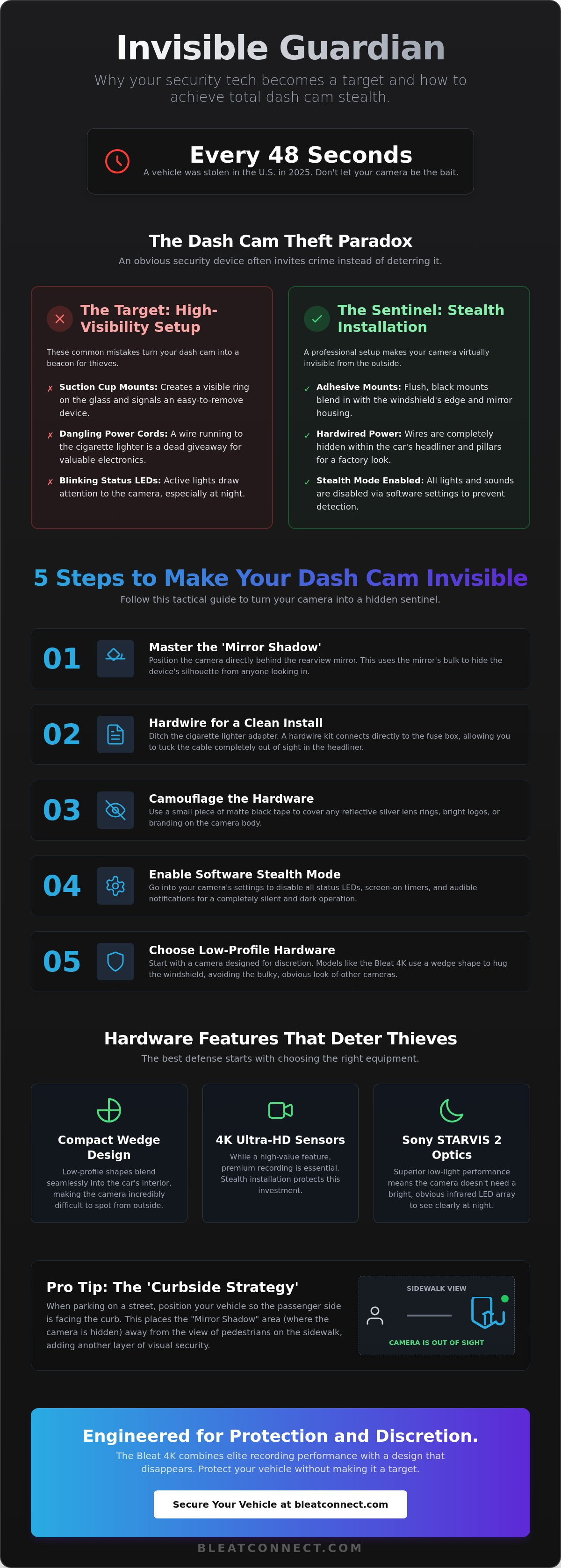
Visibility is your greatest vulnerability. The first rule of preventing dash cam theft from car is simple: if they can't see it, they won't steal it. Most users rely on factory settings and default mounts, which practically advertise the tech to passersby. True security requires a tactical approach to installation that mimics factory-fitted equipment. Following basic vehicle theft prevention tips is a start, but securing high-end electronics requires technical precision. You need to eliminate the visual "footprint" that opportunistic thieves look for during a quick scout.
Start by ditching transparent suction cups. These are prone to falling in high heat and create a highly visible ring on the glass. Switch to black 3M adhesive mounts that sit flush against the windshield. Next, address the "silver ring" problem. Many premium lenses feature a metallic trim that catches the light; cover this with a small strip of matte black "black-out" tape. You should also cover any bright brand logos or status LEDs that blink while the car is parked. Finally, move away from cigarette lighter power sources. These cables are impossible to hide and signal that there's valuable tech inside. For a truly discrete setup, choose the Bleat 4k car dashcamera, which is engineered with a low-profile wedge design to disappear into your car's interior lines.
Mastering the 'Mirror Shadow' Placement
Position your camera directly behind the rearview mirror from the perspective of a person standing outside. This "Mirror Shadow" technique uses the mirror's existing mass to hide the camera's body. Always check your field of view (FOV) via the mobile app before finalizing the adhesive. Ensure the lens has a clear path but remains tucked high enough to stay out of the driver's direct line of sight. Be careful not to block the car's built-in ADAS sensors or rain sensors usually located in the mirror housing.
Professional Cable Management
Clean wiring is the difference between a "target" and a "stealth" installation. Use plastic pry tools to tuck the power cable into the headliner and route it down the A-pillar. Never let wires hang or sag over time; use small zip ties to secure the cable to existing looms behind the trim. If your car has side-curtain airbags, ensure the wire runs behind the airbag module so it doesn't interfere with deployment. This creates a factory-fitted look that suggests the camera is a permanent, non-removable part of the vehicle's safety system.
Hardware Features that Deter Opportunistic Thieves
Superior security starts with hardware selection. While installation tactics are vital, the physical design of your device is the first line of defense in preventing dash cam theft from car. Most thieves look for the obvious: dangling wires, glossy plastics, and bulky mounts that signal high-value electronics. If your camera looks like a factory-installed sensor, it's far less likely to be targeted during a quick street scout. You need hardware that prioritizes a "low-observable" profile without sacrificing 4K clarity.
Wedge-shaped cameras are the 2026 industry gold standard for discretion. Unlike traditional "hanging" cameras that swing from a mount and catch glare, wedge designs sit flush against the glass. This eliminates the "silhouette" effect that thieves look for when scouting a row of parked cars. Law enforcement agencies frequently emphasize hiding accessories, as seen in these San Jose Police Department vehicle security tips. A flush-mounted device blends into the black ceramic frit (the dotted pattern) of your windshield, making it nearly invisible from the sidewalk.
Choosing a matte finish over glossy or metallic accents is a technical necessity. Glossy surfaces reflect streetlights and moonlight, creating a bright spot on your windshield that draws the eye. High-performance units now favor stealth aesthetics to blend into the dark plastic of modern rearview mirror housings. You should also consider whether a fixed or detachable mount fits your lifestyle. If you frequently park in high-risk zones, a magnetic quick-release allows you to pocket the tech in seconds. Use this checklist for evaluating stealth hardware:
- Matte Black Finish: Absorbs light rather than reflecting it into the street.
- Wedge Form Factor: Minimizes the external silhouette and sits tight to the glass.
- Internal GPS: Removes the need for external, visible modules on the dashboard.
- Flush Mounts: Eliminates the gap between the glass and the lens for a factory look.
Discreet Design Standards
Discreet design is a core engineering principle for modern security. The Bleat 4k car dashcamera utilizes a streamlined body to reduce its visual profile significantly compared to bulky competitors. By using an integrated mount that sits flush against the glass, it avoids the "over-engineered" look of massive suction brackets. This design philosophy ensures the camera remains part of the car's architecture rather than an obvious add-on. It's an essential upgrade for any driver who values both high-end 4K footage and total anonymity.
Digital Deterrents
Digital stealth is just as important as physical concealment. Light leakage from an active screen at night is a major security risk that invites break-ins. You should always configure auto-screen timeout settings to keep the cabin dark while recording. Adopting a "Silent Guardian" approach means disabling start-up beeps and audible alerts that might alert a thief they're being recorded. Proper LED management is a critical software setting for preventing dash cam theft from car, as it ensures your device remains a silent sentinel without broadcasting its location through blinking indicator lights.
Behavioral Best Practices for Parking and Security
Even the most advanced stealth installation requires tactical behavioral support. Your parking habits are the final barrier in preventing dash cam theft from car. While many guides suggest simply parking in well-lit areas, this can actually backlight your interior, making your tech more visible to a trained eye. You need a strategy that leverages environmental factors to mask your equipment. Security is a lifestyle, not just a hardware choice. It requires constant situational awareness every time you turn off the ignition.
The "Curbside Strategy" is a simple but effective maneuver. When parking on a busy street, position your car so the windshield faces the moving traffic rather than the sidewalk. Pedestrians are the primary threat for opportunistic smash and grabs. By keeping the camera lens away from the foot traffic side, you drastically reduce the chance of a thief spotting the hardware during a casual walk-by. In high-risk zones like public garages or valet stands, the risk profile shifts. Valets see your interior up close; in these cases, a detachable mount is your best friend. Simply slide the unit off and store it in a locked glovebox before handing over the keys.
Window tinting offers a significant security boost, provided you stay within local legal limits. Effective January 1, 2026, California's rules for dash cam placement have been updated, making it even more critical to balance legal mounting with visual privacy. A subtle tint near the top of the windshield can help hide the mirror area where most cameras reside. Pair this with a high-quality sunshade when parked for long periods. A sunshade is a low-tech, high-impact solution that completely blocks the view of your dashboard and mirror, removing the temptation for a thief to peek inside. Secure your vehicle with the industry's most discreet hardware. Upgrade to the Bleat 4k car dashcamera for a low-profile security solution that stays out of sight.
Strategic Parking Habits
Nose-in versus reverse-in parking should be a calculated decision based on where your cameras are mounted. If you only have a front-facing unit, parking nose-in toward a wall or a dark corner can effectively hide the device. Utilize natural shadows from buildings or trees to mask the interior of your cabin. Avoid parking directly under bright streetlights if your camera has any reflective surfaces. The goal is to keep the cabin as dark and uninviting as possible to anyone peering through the glass.
Secondary Deterrents
Psychological warfare is an effective secondary defense. Small window decals stating "24/7 Cloud Recording" or "GPS Tracked" can act as a powerful deterrent, even if the camera itself is hidden. These stickers suggest that the footage is already off-site, making the theft of the physical hardware pointless. However, these deterrents only work if you maintain a clean cabin. If a thief sees a laptop bag or a phone charger, they'll break in anyway and likely discover your dash cam in the process. Clear all clutter to ensure your car looks like a low-reward target.
Bleat 4K: Engineered for Protection and Discretion
Superior security requires hardware that works as hard as your installation tactics. While previous sections detailed the "Mirror Shadow" technique and behavioral habits, the hardware itself remains the final line of defense. The Bleat 4k car dashcamera is the result of precision engineering designed specifically for total vehicle integration. It's a high-performance sentinel that prioritizes anonymity. Effectively preventing dash cam theft from car starts with a device that refuses to be seen. We've eliminated the bulk of traditional cameras to ensure your protection never becomes a liability.
The backbone of this system is the Bleat hardwire kit. It provides the consistent power necessary for 24/7 parking monitoring without the messy, visible cables of a cigarette lighter adapter. This kit enables the "Silent Guardian" mode, allowing the camera to remain active while the ignition is off. By using a direct fuse box connection, you maintain a factory-fitted look that suggests the camera is a permanent, non-removable safety component. This level of integration is essential for modern travelers who demand both elite 4K recording and a secure, "set and forget" experience.
Why Bleat Hardware Wins on Stealth
Our design philosophy centers on the "invisible" profile. The Bleat 4K features a matte-black finish that absorbs ambient light, preventing the lens from catching the eye of a thief at night. Our proprietary mounting system is engineered to minimize the gap between the lens and the glass, significantly reducing the external silhouette. This streamlined body allows for seamless mirror integration, making the unit nearly indistinguishable from a standard rain sensor or ADAS housing. We've also simplified the wiring interface, allowing for a clean DIY stealth installation that hides every millimeter of cable behind your car's interior trim.
Advanced Protection Features
Discretion doesn't mean a lack of power. The Bleat 4K utilizes the Sony STARVIS 2 sensor to deliver superior night vision, capturing facial features and license plates in near-total darkness. This ensures you identify perpetrators even in the most challenging low-light environments. The high-performance G-Sensor acts as an intelligent tripwire; it detects impact or vibration and automatically locks the current footage. This prevents critical evidence from being overwritten during a theft event. You can instantly review this footage via the Bleat mobile app, giving you immediate access to the data you need for insurance or law enforcement. Secure your vehicle with the Bleat 4K Dashcam and experience the peak of automotive security technology.
Secure Your Journey with Invisible Intelligence
True security is the result of technical precision and tactical awareness. You've learned that preventing dash cam theft from car requires more than just recording; it demands total visual integration. By moving away from bulky suction mounts and embracing the "Mirror Shadow" technique, you turn your device into a silent sentinel. Combining these stealth installation methods with disciplined parking habits ensures your technology protects your vehicle without inviting unwanted attention. It's about outsmarting the opportunist before they even reach your window.
Elevate your vehicle's defense with hardware designed for the modern road. The Bleat 4K offers market-leading discreet design paired with 4K Ultra-HD resolution. Our advanced G-sensor technology provides critical impact detection, while our national support and warranty ensure long-term reliability. Don't let your security tech become a target. Upgrade to the Stealthy Bleat 4K Dashcam Today and enjoy the confidence of elite, invisible protection. Your car is an investment; keep it safe with the authority in digital well-being.
Frequently Asked Questions
Is it legal to hide my dash cam behind my rearview mirror?
Yes, hiding a dash cam behind the rearview mirror is legal in all 50 states, provided it doesn't obstruct the driver's view. Effective January 1, 2026, California's updated regulations specify exact dimensions for windshield mounting. Always ensure the lens sits within the "Mirror Shadow" to stay compliant while remaining invisible from the exterior. Check your local state statutes regarding the specific square inches of allowed obstruction to avoid fines.
Do thieves actually target dash cams, or are they looking for laptops and phones?
Thieves actively target dash cams because 4K hardware has a high resale value on the secondary market. While laptops and phones are traditional targets, a visible camera suggests a tech-heavy interior worth investigating. Effectively preventing dash cam theft from car means removing the visual incentive for a smash and grab. If a criminal sees a premium lens, they see a quick score that is often easier to flip than a password-locked smartphone.
Should I remove my dash cam every time I park my car?
You don't need to remove your camera every time if you use a professional stealth installation. Constant removal can wear down mounts and lead to visible cables. However, if you're parking in a high-risk zone, a magnetic quick-release mount allows you to stow the device in seconds. For daily commuting, a flush-mounted wedge design is usually sufficient to bypass a thief's casual glance without the hassle of daily removal.
Does a dash cam drain my car battery if I leave it plugged in?
A dash cam won't drain your battery if you use a dedicated hardwire kit with an integrated voltage cut-off. These kits monitor your car's battery levels and automatically shut down the camera if the voltage drops below a safe threshold. This ensures you have enough power to start your engine while still benefiting from 24/7 parking mode surveillance. Avoid leaving cameras plugged into "always-on" cigarette lighter sockets without smart power management.
Will window tinting interfere with my dash cam's night vision?
High-quality window tinting has a negligible impact on recording quality if your hardware uses advanced sensors. The Sony STARVIS 2 sensors found in the Bleat 4K are specifically engineered to compensate for low-light conditions and tinted glass. While a dark tint might slightly reduce the maximum range at night, the security benefit of hiding the camera usually outweighs the minor loss in light transmission. Always keep the glass clean to prevent internal reflections.
Can a thief delete the footage if they steal the dash cam?
A thief can delete footage if they steal the physical device and the SD card inside. This is why cloud connectivity is a vital upgrade for modern security. High-end models automatically upload impact-triggered clips to a secure server, ensuring you have the evidence even if the hardware is gone. Without cloud storage, your primary defense is the stealth installation methods discussed earlier, which prevent the thief from noticing the camera in the first place.
Are wireless dash cams harder to steal than wired ones?
No, "wireless" dash cams are not significantly harder to steal because they still require a power cable. Most wireless claims refer to Wi-Fi data transfer rather than a lack of physical wiring. A truly battery-powered camera is often bulkier and more visible, making it a bigger target. The most secure setup remains a hardwired, low-profile camera where the power source is integrated into the vehicle's fuse box, leaving no visible wires to pull.
How do I hide the wires if I don't want to hardwire the camera?
You can hide wires without hardwiring by using plastic trim tools to tuck the cable into the headliner and along the weather stripping. Start from the camera and work your way toward the A-pillar, ensuring the wire is pushed deep into the gaps between the interior panels. Use small adhesive cable clips to secure any exposed runs near the floor mats. This creates a clean, professional look that helps in preventing dash cam theft from car by removing visual clutter.