

Dual Channel Dash Cam vs Single Channel: The Ultimate 2026 Safety Guide
Bleat
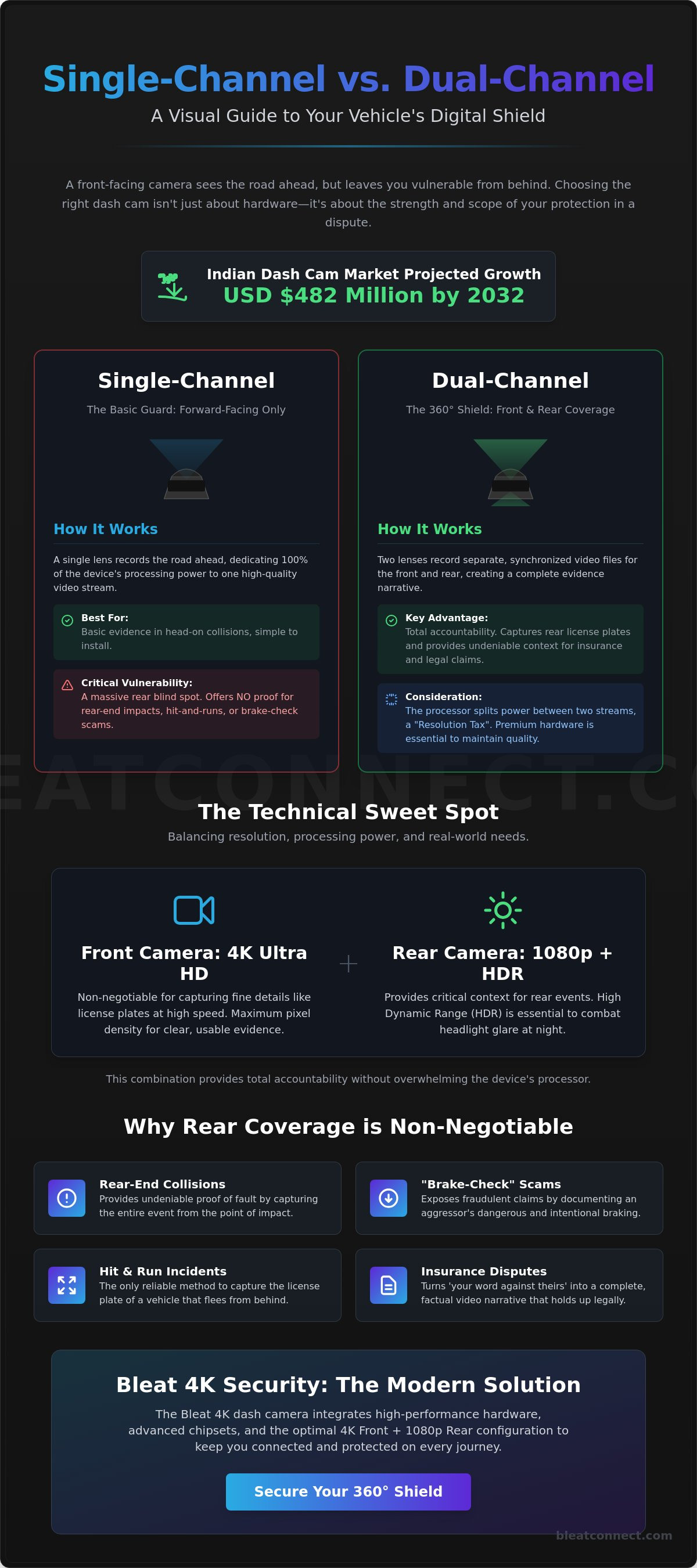
Your front-facing camera sees the road, but it cannot see the distracted driver behind you seconds before they slam into your bumper. In 2026, relying on a single lens is like locking your front door while leaving the back wide open. When deciding between a dual channel dash cam vs single channel, you aren't just comparing hardware; you're choosing the strength of your digital shield. With the Indian dash cam market projected to reach USD 482 million by 2032, modern drivers are quickly moving beyond basic setups to ensure total road accountability.
It's stressful to face insurance disputes when it's just your word against theirs. You want protection that holds up in court, but confusing specs like Sony STARVIS 2 sensors and supercapacitors often get in the way. This guide eliminates the noise. You'll discover exactly how these systems differ in resolution, bitrate, and battery impact. We provide the technical clarity you need to choose a system that offers 360-degree security and absolute peace of mind for every journey.
Key Takeaways
- Master the distinction between single and dual-channel streams to build a comprehensive digital defense for your vehicle.
- Compare the dual channel dash cam vs single channel architecture to see how splitting processing power affects your 4K video evidence.
- Uncover why rear coverage is the ultimate deterrent against "brake-check" scams and fraudulent insurance claims on complex roads.
- Evaluate the long-term ROI of 360-degree protection, weighing initial setup against the security of total vehicle monitoring.
- Discover how the Bleat 4k car dashcamera delivers high-performance hardware integration to keep you connected and protected at every turn.
Defining the Standard: What are Single and Dual Channel Dash Cams?
Understanding the architecture of your vehicle's security starts with a single word: channel. In digital recording, a "channel" refers to an independent video stream captured by a dedicated sensor and processed by the camera's internal chipset. When you compare a dual channel dash cam vs single channel setup, you are deciding between a partial view and a comprehensive safety perimeter. In the context of What are Dash Cams?, the number of channels defines the scope of your legal and physical protection on the road.
A single-channel system is the traditional baseline for road monitoring. It utilizes one lens mounted to the windshield to record the road ahead. In contrast, a dual-channel system provides synchronized front and rear recording. This creates a 360-degree context by adding a second lens, usually mounted on the rear window. While some drivers consider "Internal" or "Cabin" cameras as a second channel, these are a distinct category. Cabin cameras focus on the driver and passengers, making them essential for rideshare professionals but different from the external-facing rear cameras used for accident evidence.
The Mechanics of Single Channel Systems
Single-channel units are designed to maximize the field of view (FOV) for the front windshield, often covering 140 to 170 degrees. They are the ideal choice for basic evidence in head-on collisions or highway cruising incidents. These systems are straightforward to install and place the entire processing power of the chipset onto a single video file. However, they have a glaring vulnerability: the rear blind spot. If a vehicle strikes you from behind or a "hit and run" occurs at your tailgate, a single-lens system offers no visual proof of the perpetrator. You are left relying on witness statements, which are often unreliable in high-speed environments.
The Dual Channel Advantage
Choosing a dual channel dash cam vs single channel system provides a massive technical leap in accountability. These systems record two separate video files with perfectly synchronized timestamps. The main processor manages two high-bitrate streams simultaneously, ensuring that the footage from the back of the car is just as legally viable as the front. This rear coverage is the only reliable way to capture the license plate numbers of fleeing vehicles after a rear-end impact. By documenting the moments before, during, and after a collision from both ends of the vehicle, you create a complete narrative that insurance adjusters and legal authorities cannot ignore. It transforms your dash cam from a simple gadget into a professional-grade forensic tool.
The Technical Breakdown: Resolution, Bitrate, and Processing Power
High-definition recording is the backbone of modern road safety. In 2026, 4K (Ultra HD) is the undisputed gold standard for front-facing lenses. It provides the extreme pixel density required to crop into a frame and identify a driver or a small registration mark. However, adding a rear lens introduces what experts call the "Resolution Tax." When you evaluate a dual channel dash cam vs single channel system, you must consider how the internal processor handles this increased load. A single-channel device dedicates 100% of its bitrate and processing power to one stream. A dual-system must split those resources, which can lead to compression artifacts if the hardware isn't premium.
Professional-grade hardware uses high-end image sensors, such as the Sony STARVIS 2 series, to maintain clarity in challenging light. According to Consumer Reports testing, sensor quality often outweighs raw resolution numbers when it comes to producing usable evidence. Bitrate is the "glue" that keeps your image from falling apart. If the bitrate is too low, your rear footage becomes a pixelated mess during fast motion. If you want the ultimate in technical performance, the Bleat 4k car dashcamera utilizes advanced chipsets to keep both streams sharp and stutter-free, even at high speeds.
4K Front + 1080p Rear: The Sweet Spot
Most drivers find that a 4K front and 1080p rear configuration offers the most efficient balance. This setup captures critical details ahead while providing the necessary context for what happens behind your vehicle. The rear camera specifically needs High Dynamic Range (HDR) to combat the blinding glare from following headlights at night. 4K resolution is non-negotiable for reading high-speed license plates. By prioritizing the front lens while maintaining a clear 1080p rear feed, you ensure total accountability without overwhelming your device's processor.
Storage and SD Card Requirements
Dual recording effectively doubles the write-cycles on your microSD card. This constant data flow generates significant heat and physical wear. You must use Class 10/U3 rated cards for dual 4K systems to avoid write errors or corrupted files. These high-performance cards ensure loop recording efficiency remains high, preventing gaps in your digital history. Because a dual-channel system fills storage twice as fast, look for devices that offer efficient H.265 compression to maximize the number of hours saved before the oldest footage is overwritten.
Real-World Scenarios: Why Rear Coverage is Essential on Indian Roads
Indian roads present unique challenges that test even the most advanced safety tech. When evaluating a dual channel dash cam vs single channel setup, you must consider the prevalence of "brake-check" scams. This extortion tactic involves a driver cutting into your lane and slamming their brakes to force a collision. Without a rear lens, you can't prove they were tailgating or driving aggressively before the impact. A dual-channel system captures the entire sequence, turning a potential legal nightmare into a clear-cut case of fraud.
Rear-end collisions are often automatically blamed on the following driver. However, nuanced evidence can prove otherwise. If a vehicle reverses into you at a traffic light, a front-only camera might only show your car shaking from the impact. A rear camera documents the other vehicle's movement, providing the vital context needed to clear your name. It's about having an undisputed record of the truth.
Hit-and-run incidents remain a major concern in high-density urban areas. An escaping vehicle often speeds away before you can react. A rear-facing lens captures the registration plate and vehicle make instantly. Combined with parking mode, this provides 360-degree protection even when your car is stationary. You gain a silent sentry that monitors for vandals or clumsy parkers who graze your bumper and flee while you're away from the vehicle.
Navigating Bumper-to-Bumper Traffic
City driving involves constant lane-cutting and aggressive maneuvers. Two-wheelers often zip through blind spots, leading to side-swipes that originate from the rear quarters. A dual-channel system records these movements with precision, ensuring no incident goes undocumented. There is also a psychological advantage to consider. A visible rear camera often discourages tailgaters from staying too close; it acts as a digital deterrent that enhances your safety bubble on the highway.
The Legal Edge in Insurance Claims
Insurance adjusters prioritize objective data over verbal accounts. Dual-channel footage speeds up the claim settlement process by removing all ambiguity regarding fault. It provides traffic police with the "full context" of an accident, showing both the cause and the effect in synchronized time. The "Proof Problem" occurs when front-only footage fails to show the specific aggressive behavior or mechanical failure of the vehicle behind you that actually triggered the rear impact. By closing this evidence gap, you ensure total road accountability and protect your no-claims bonus.
The Decision Matrix: When to Upgrade and When to Save
Choosing between a dual channel dash cam vs single channel system is a strategic investment in your digital well-being. Many drivers fall for the trap of buying the cheapest available option, but this often leads to higher long-term costs. A single-channel unit saves money today. However, a single rear-end collision without evidence can lead to massive insurance hikes and lost no-claims bonuses. You must weigh the initial hardware cost against the long-term protection of your financial interests.
Installation complexity is a practical factor in this matrix. Single-channel cameras are typically plug-and-play, connecting directly to the 12V socket. Dual-channel systems require routing a dedicated cable to the rear window. While this takes more effort, it creates a 360-degree shield that is essential for premium vehicles. If you own a high-value car, a dual-channel setup is a necessary upgrade to protect your asset from every possible angle. It ensures that your vehicle's security matches its market value.
Your driving frequency also dictates the right choice. Weekend drivers who stick to familiar, low-traffic routes might find a front-facing lens sufficient for basic needs. Daily commuters face a different reality. Navigating peak-hour traffic increases the statistical likelihood of side-swipes and tailgating incidents. For these road warriors, a dual-channel system is the only way to maintain total accountability during every kilometer of the journey.
Choosing Based on Driving Environment
Urban commuters deal with constant lane-cutting and unpredictable maneuvers. Dual coverage is mandatory in city chaos to track aggressive two-wheelers that often disappear into your blind spots. Highway travelers need high-speed rear tracking to document erratic drivers long before they reach your bumper. If you frequently drive at night, you must evaluate low-light performance on both channels. High-quality sensors ensure that license plates remain legible even under the harsh glare of trailing high beams.
The "Future-Proof" Checklist
Ensure your chosen system meets these high-tech standards to stay relevant through 2026 and beyond:
- Integrated GPS: This provides vital speed and location data that is often required for legal disputes.
- Intuitive App Interface: Managing and downloading dual-file feeds should be seamless and rapid.
- Supercapacitor Technology: This is critical for surviving the extreme heat of Indian summers without the risk of battery swelling.
- High-Speed Wi-Fi: Faster data transfer is necessary for viewing large 4K files on your smartphone instantly.
Don't settle for partial protection when you can secure the industry-leading Bleat 4k car dashcamera for total road accountability.
Bleat 4K Security: Advanced Dual-Channel Protection for Modern Journeys
The Bleat 4k car dashcamera stands as our flagship 360-degree shield for the modern driver. In the debate of dual channel dash cam vs single channel, the hardware's ability to manage data is what separates a gadget from a life-saving tool. We've engineered our system to act as a tech-forward companion that simplifies road accountability. It's about total control. While single-channel units leave your rear exposed, our dual-system architecture ensures that every angle is covered by a high-performance digital sentry.
Managing two high-bitrate video streams can be a technical headache with generic brands. The Bleat App solves this by providing a unified interface where front and rear feeds are presented in a synchronized timeline. You don't have to hunt through separate folders or swap SD cards to find the matching rear footage for a front-end event. This seamless integration allows you to download, edit, and share evidence directly from your smartphone in seconds. It's an essential upgrade for a connected lifestyle where efficiency is paramount.
Our proprietary G-Sensor technology adds an extra layer of intelligent protection. It instantly locks critical footage during an impact or sudden maneuver, ensuring that your evidence is never overwritten by loop recording. This hardware is built for the diverse Indian climate. We utilize advanced thermal management to ensure the system operates reliably during peak summer heat. It's a robust solution designed for long-term durability and unwavering performance.
Superior Image Fidelity
Generic dual systems often sacrifice resolution on the rear lens to save on processing power. Bleat's 4K sensor maintains high-speed clarity, outperforming standard 1080p dual systems by a significant margin. We've included enhanced night vision for the rear lens to combat the "light wash" from trailing vehicles. Our optical engineering provides wide-angle coverage that captures multiple lanes of traffic without the distracting "fish-eye" distortion found in lower-end models. You get a clear, natural perspective that holds up under legal scrutiny.
The Bleat Ownership Experience
We provide a clear, easy installation path for our national customers, ensuring your system is up and running without technical friction. Our commitment to leadership means we provide regular firmware updates that improve incident detection and app connectivity. This ensures your vehicle remains protected by the latest advancements in road monitoring technology. Explore the full specifications on the Bleat 4k car dashcamera product page to see how we define the new standard for road safety.
Secure Your Journey with 360-Degree Intelligence
Road safety in 2026 is about more than just a front-row seat to the drive. It's about total vehicle protection. You've seen how rear-end coverage eliminates the "Proof Problem" in insurance disputes and how 4K resolution transforms blurry shapes into courtroom-ready evidence. When you weigh a dual channel dash cam vs single channel system, you're deciding between partial awareness and complete road accountability. A single lens is a baseline; a dual-channel system is a professional-grade shield.
Bleat provides the ultimate hardware integration for the modern traveler. Our systems deliver Bleat 4K Ultra HD Clarity combined with Smart App Integration to keep you connected and protected. With our National Support & Warranty, you gain a reliable partner for every kilometer. Don't leave your rear blind spot to chance. Secure your peace of mind and enhance your digital well-being with technology that never blinks.
Upgrade to the Bleat 4K Dual-Channel Shield Today and drive with the confidence of a market leader.
Frequently Asked Questions
Is a dual channel dash cam worth the extra money?
Yes, a dual-channel system is worth the investment because it offers total road accountability. While a front lens captures head-on incidents, a rear lens documents tailgating and hit-and-run attempts. In the dual channel dash cam vs single channel comparison, the extra cost is a one-time insurance against fraudulent claims. It protects your no-claims bonus and provides the full context of any road dispute.
Can I add a rear camera to my single channel dash cam later?
Most single-channel dash cams cannot be upgraded with a rear camera later because they lack the necessary input ports and processing chipsets. A dual-channel unit is built specifically to handle two simultaneous video streams. If you start with a single lens, you'll likely need to replace the entire system to gain rear coverage. Choosing the right architecture from the start ensures your vehicle's security is future-proof.
Does a dual channel dash cam drain my car battery faster?
A dual-channel system draws more power than a single-lens setup, but it won't drain your battery if installed correctly with a hardwire kit. These kits include low-voltage protection that automatically shuts off the camera before your car battery gets too low. Using a supercapacitor-based system, like those found in Bleat products, also ensures better heat resistance and power management during parking mode.
Is it difficult to install a rear dash cam in a hatchback?
Installing a rear camera in a hatchback is straightforward but requires careful cable routing through the weather-sealed rubber grommets. This ensures the cable doesn't get pinched when the boot opens and prevents water from entering the cabin. Most users find that tucking the wires under the headliner provides a clean, professional look. It's a simple DIY task that completes your 360-degree digital shield.
How much storage space does a 4K dual channel dash cam need?
A 4K dual-channel system requires a high-capacity microSD card, preferably 128GB or 256GB, to handle the massive data flow. Because these systems record two high-bitrate files simultaneously, they fill up storage twice as fast as single-lens units. You must use U3 or V30 rated cards to ensure the write speeds can keep up with the 4K stream without corrupting your vital evidence.
Do dual channel dash cams record audio from both cameras?
Audio is typically recorded only by the main front unit, not the rear camera. The internal microphone on the primary device captures cabin sounds and external noise, which is synchronized across both video files. When you review your footage, you'll hear the audio regardless of which camera angle you are viewing. This provides a complete sensory record of events without needing a second microphone.
Can I use a dual channel dash cam for insurance claims in India?
Yes, dash cam footage is legally admissible evidence for insurance claims and legal disputes in India as of 2026. Authorities and insurance adjusters increasingly rely on this digital proof to settle claims faster and identify fault accurately. In the debate of dual channel dash cam vs single channel, having rear footage is often the deciding factor in proving you were not responsible for a rear-end collision.