

Dash Cam for Company Car Policy: The Ultimate 2026 Implementation Guide & Template
Bleat
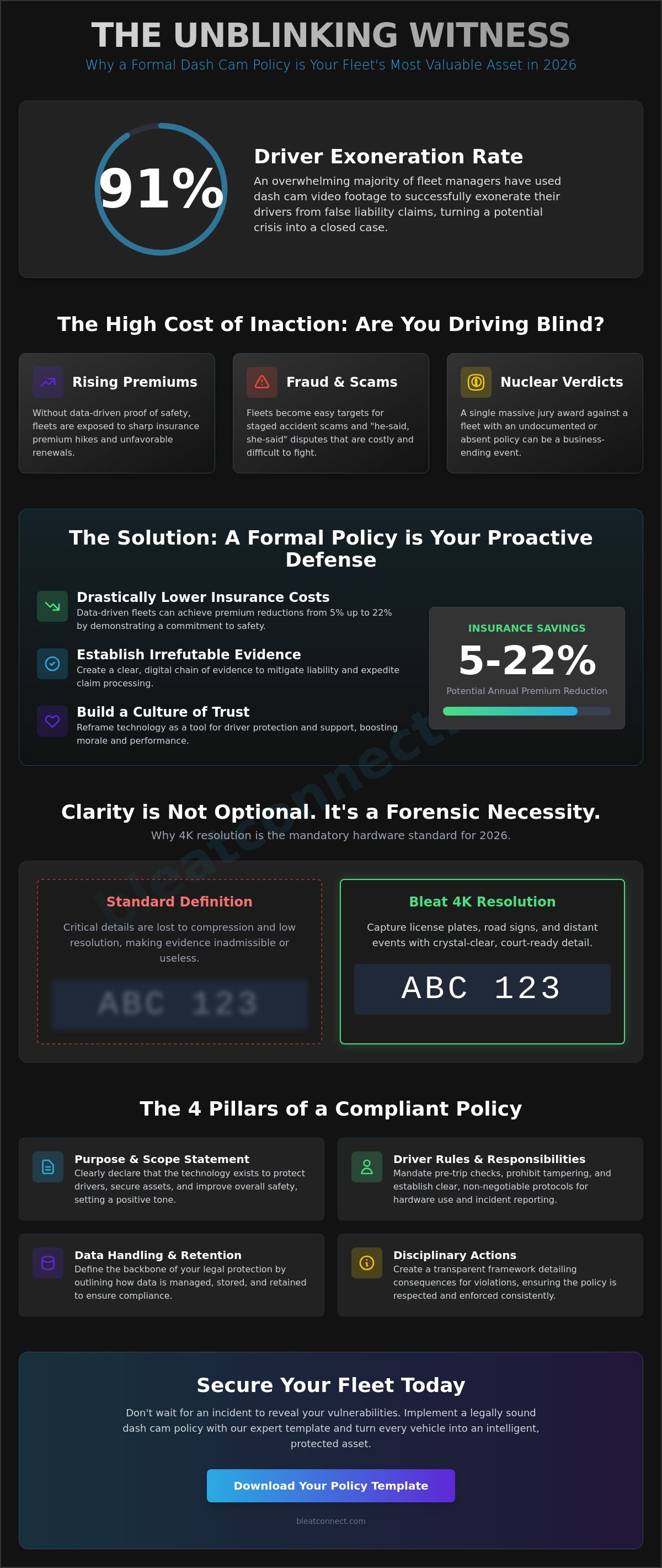
Did you know that 91% of fleet managers have successfully used video footage to exonerate their drivers from false liability claims? It's a powerful figure that refutes the "Big Brother" stigma. You likely feel the pressure of rising insurance premiums and the constant threat of staged accident scams. Protecting your fleet is no longer just about safe driving. It's about having the digital receipts to prove it. Implementing a robust dash cam for company car policy is the definitive move to secure your business assets and your team's professional reputation.
We provide a legally sound policy template designed to help lower insurance costs by up to 22% while boosting driver buy-in. You'll learn how to master the complex legal landscape of 2026, from 12-state audio consent laws to the new FMCSA Motus registration requirements. From technical hardware requirements like the high-resolution Bleat 4k car dashcamera to managing biometric data under BIPA, this guide covers every operational detail you need for a safer, more connected fleet. Let's turn your vehicles into intelligent, protected assets that work for you.
Key Takeaways
- Mitigate liability in complex "he-said, she-said" road incidents by establishing a clear chain of digital evidence.
- Define the core components of your dash cam for company car policy to align driver responsibilities with business safety goals.
- Navigate 2026 legal frameworks regarding workplace monitoring and implement compliant notice protocols for every vehicle.
- Identify why 4K resolution is now a mandatory hardware standard for capturing critical forensic details like license plates.
- Execute a seamless rollout using our step-by-step risk assessment and professional policy template.
Why Your Business Requires a Formal Dash Cam Policy in 2026
The modern road is a high-stakes environment where every mile driven is a potential liability. Leaving your business reputation to chance isn't an option. Without a formal dash cam for company car policy, you're essentially operating in the dark. A "he-said, she-said" dispute after an accident can drag on for months, draining resources and morale. Video evidence changes the equation instantly. It provides immediate clarity, standardizes evidence collection, and ensures rapid claim processing. It's about total operational transparency and claiming your authority on the road.
A documented policy does more than just record footage. It creates a direct correlation between safety and profitability. Insurers in 2026 prioritize data-driven fleets. Companies that demonstrate lower risk through dash cam and telematics data can see insurance premiums reduced by 5% to 22%. By standardizing how your team uses hardware like the Bleat 4k car dashcamera, you turn every vehicle into a protected asset. This isn't just a suggestion; it's a market-leading strategy for 2026.
The Cost of Inaction: Unprotected Fleets
Small and medium businesses are often one "nuclear verdict" away from total closure. These massive jury awards against corporate fleets are rising sharply. If your driver is involved in a collision and you lack a documented policy, you're legally vulnerable. Verbal agreements about camera use fail in court because they lack the weight required to protect your assets. An unprotected fleet is a financial time bomb. This Dashcam technology overview highlights how these devices have evolved into essential legal tools. Don't wait for a lawsuit to realize your handshake deals aren't enough to satisfy a judge or an insurance adjuster.
Reframing Surveillance as Driver Support
Modern fleet management isn't about "Big Brother" monitoring. It's about elite protection. A clear dash cam for company car policy reframes the camera as a digital witness for the driver. It protects them from road rage, false accusations, and staged accidents. Statistics show that 91% of fleet managers have used dash cam footage for driver exoneration. This builds a culture of trust rather than a culture of fear. Use the footage for positive reinforcement. Reward your safest drivers based on real data. When your team knows you have their back with high-resolution hardware, they perform better. They aren't being watched; they are being defended by a tech-forward partner passionate about their digital well-being.
Core Components of a Compliant Company Car Camera Policy
A successful dash cam for company car policy begins with a sharp, well-defined Purpose Statement. This isn't just legal boilerplate. It's a strategic declaration that the technology exists to protect both the driver and the business assets. By aligning your policy with safety goals, you create a framework for elite accountability. Supervisors play a critical role in this ecosystem. They don't just watch footage; they manage risk by reviewing "G-sensor" alerts and identifying patterns of distracted driving. This proactive management style mirrors the high standards of safety initiatives like the Employer Pull Notice Program, which emphasizes the employer's duty to monitor and improve driver safety records.
Disciplinary actions must be transparent and consistent. Your policy should clearly state that tampering with equipment is a serious violation. This includes unauthorized removal of SD cards or intentionally obscuring the camera's view. When everyone understands the rules, the technology stops being a source of friction and becomes a tool for professional growth. If you're ready to secure your fleet with industry-leading optics, consider integrating the Bleat 4k car dashcamera for unmatched forensic detail on every trip.
Driver Rules and Maintenance Protocols
Drivers are the frontline guardians of your fleet's digital evidence. Your policy must mandate a pre-trip inspection to confirm the Bleat 4k car dashcamera is powered on and recording. This ensures that the system is ready before the vehicle even leaves the lot. Prohibitions against blocking lenses or interfering with the hardware are non-negotiable. If a hardware malfunction or a significant G-sensor event occurs, drivers need a direct reporting procedure. This rapid communication allows for immediate troubleshooting, ensuring no critical moments are lost to technical downtime. It's about maintaining a constant state of readiness.
Data Handling and Evidence Retention
Data management is the backbone of legal protection. You must establish a clear retention period, with a 30-day backup considered the gold standard for fleet operations. This timeline allows enough room to identify and secure footage after an incident before loop recording overwrites the data. Protocols for extracting video must be strict. Only authorized personnel, such as safety officers or department heads, should have access to the raw files. This restriction prevents data leaks and protects the privacy of your team. By securing the data chain, you ensure that every frame of high-resolution video remains a credible, untampered asset for insurance or legal review.
Balancing Privacy and Protection: The Legal Framework
Legal compliance isn't a hurdle; it's the foundation of a professional fleet. A high-performing dash cam for company car policy must navigate the friction between operational security and individual privacy rights. In 2026, the legal landscape is clear. You have a right to protect your assets, but transparency is your greatest defense. Visible 'Notice of Recording' stickers are mandatory for every vehicle in your fleet. They serve as immediate legal notice to passengers and third parties that they are entering a monitored environment. This simple step satisfies most notice requirements across various jurisdictions, turning a potential liability into a standardized safety protocol.
Audio recording adds another layer of complexity that requires assertive management. Twelve states, including California, Florida, and Illinois, currently require all-party consent for audio capture. If your fleet operates in these regions, your policy must explicitly address this or disable audio by default to avoid criminal wiretapping charges. Managing third-party footage in public spaces is generally protected, but how you store and access that data determines your risk profile. Elite businesses don't just record; they govern their data with precision to ensure they remain a tech-savvy protector of both the company and the public.
Obtaining Informed Consent from Employees
Trust is built through clear documentation. Every driver should sign a standalone Dash Cam Consent Form during onboarding. This document must clearly define the lawful basis for monitoring: safety, asset protection, and driver exoneration. You aren't just "watching" them; you're providing a digital witness for their protection. Justifiable monitoring is the precise balance between legitimate business safety interests and the individual's reasonable expectation of privacy. By making consent a standard part of the hiring process, you eliminate "Big Brother" concerns and establish a professional safety culture from day one.
Managing In-Cabin vs. External Recording
Choosing between road-facing and dual-channel systems is a strategic decision. While road-facing cameras like the Bleat 3k car dashcamera provide excellent external evidence, in-cabin recording offers critical context during sudden braking or G-sensor events. However, driver-facing lenses carry higher privacy stakes. If your company allows personal use of vehicles, your dash cam for company car policy must include "Privacy Zones." This means allowing drivers to disable or cover the camera during non-working hours. This concession respects their personal time while ensuring the Bleat 4k car dashcamera remains an essential companion during every professional mile.
Setting Hardware Standards: Why 4K Resolution is a Policy Requirement
Elite fleet management requires more than just legal text; it demands forensic precision. A dash cam for company car policy that fails to specify hardware standards is a policy built on sand. When an incident occurs, grainy 1080p footage often fails to capture the license plate of a hit-and-run vehicle or the facial details of a distracted driver. This technical failure transforms a potential exoneration into a legal stalemate. Integrating high-resolution standards ensures that every frame serves as a definitive digital receipt for your business.
4K resolution is the modern benchmark for legal-grade evidence. It provides four times the detail of standard high-definition, allowing for digital zooming without losing clarity. Your policy must also mandate loop recording to prevent data gaps. This ensures the camera never stops during a critical moment. Pair this with G-Sensor technology, which automatically locks files during impact or sudden braking, and you have a system that protects itself. For 24/7 fleet protection, night vision capabilities are non-negotiable, ensuring safety doesn't end when the sun goes down. High-quality hardware turns your dash cam for company car policy from a passive recording tool into an active safety asset.
The Bleat 4K Benchmark for Professional Fleets
The Bleat 4k car dashcamera sets the standard for professional fleets. Its superior sensor captures legal-grade evidence even in high-speed scenarios. Proprietary hardware integration ensures that every unit across your fleet operates with the same level of reliability. Wide-angle lenses are essential here. They capture side-impact incidents that narrower cameras miss, providing a comprehensive context of the road environment. This technical superiority ensures that when you need evidence, it's clear, undeniable, and ready for court.
Storage and Reliability Features
Reliability depends on the components inside the camera. High-endurance SD cards are a policy requirement to handle the constant stress of loop recording. Standard cards often fail under high-write cycles, leading to corrupted files. GPS logging is another critical pillar. It maps speed and location data directly onto the video, verifying driver claims and refuting false speeding accusations. Bleat’s rugged hardware is engineered to survive extreme road conditions, from summer heat to winter freezes. Upgrade your fleet today with the Bleat 4k car dashcamera to ensure your policy is backed by the best technology on the market.
Step-by-Step: Implementing Your Dash Cam Policy
Executing a dash cam for company car policy is a tactical operation that demands precision. You aren't just installing hardware; you're deploying a shield for your business. Start with a rigorous risk assessment of your current fleet. Identify high-risk routes and analyze past insurance claims to pinpoint exactly where your vulnerabilities exist. Once your risks are mapped, draft your policy using a professional framework that aligns with your specific operational goals. This is the stage where you consult with legal counsel to ensure full compliance with 2026 regulations, including biometric data laws and regional audio consent requirements.
- Conduct a Risk Assessment: Evaluate accident history and high-liability zones.
- Draft the Policy: Use our 2026 template to define purpose and protocols.
- Legal Review: Verify national and local compliance with privacy experts.
- Driver Orientation: Host sessions to demonstrate the hardware and explain the benefits.
- Standardize the Fleet: Equip every vehicle with the Bleat 4k car dashcamera for uniform protection.
Orientation is the pivot point for driver buy-in. Host a dedicated session to demonstrate the technology in real-time. Show your team how the Bleat 4k car dashcamera captures legal-grade evidence that can exonerate them from false accusations. Explain the G-sensor functionality and how it automatically protects footage during an impact. When drivers understand that the tech is an essential companion for their journey, resistance fades. Standardization is your final step. Consistency across the fleet ensures that every piece of evidence meets the same elite forensic standard, simplifying maintenance and claim processing.
From Draft to Deployment
Communication determines the success of your dash cam for company car policy. Focus on transparency and protection. Use internal data to show how video evidence has historically saved companies from "nuclear verdicts." To ensure a seamless transition, launch a pilot program with a small group of drivers to gather initial feedback. This allows you to refine your communication strategy before a full-scale rollout. Once deployed, establish a regular audit schedule for both policy compliance and hardware health. A policy that remains unmonitored is a liability. A policy that is audited is a fortress.
Choosing the Right Partner
Scaling a professional fleet requires a partner that thrives in a fast-paced digital environment. Bleat’s direct-to-consumer model eliminates middleman friction, providing the best value for businesses that demand high-performance tech. As a market leader, we provide the innovation and reliability required to inspire total trust in your safety stack. Our proprietary hardware integration ensures that your fleet remains connected and protected at all times. Don't leave your reputation to chance. Secure your fleet with Bleat 4K Dashcams today and claim your authority on the road.
Secure Your Fleet’s Future Today
Mastering your dash cam for company car policy is the ultimate move for any tech-forward business in 2026. You've learned how to navigate the complex legal frameworks of audio consent and biometric data while reframing surveillance as elite driver protection. By setting high hardware standards, you ensure that every mile is backed by forensic-grade clarity. This proactive approach transforms your vehicles into intelligent assets that actively defend your bottom line against false claims and rising premiums.
Implementing these protocols doesn't just lower insurance costs; it builds a culture of accountability and trust. Your fleet deserves the best digital witness available. Secure your business with 4K Ultra-HD evidence and market-leading reliability that is trusted by professionals nationally. It's time to equip your team with the tools they need to stay safe and connected on every journey. This is about more than just recording; it's about claiming your leadership in a digital-first world.
Protect your assets with Bleat 4K Dashcameras
Claim your authority on the road and lead your team into a safer, more connected future. Your journey toward total fleet security starts now.
Frequently Asked Questions
Can a driver turn off the dash cam during their lunch break?
Yes, drivers can typically disable recording during unpaid lunch breaks if your dash cam for company car policy includes specific privacy provisions. It's essential to define these "Privacy Zones" clearly to ensure drivers feel respected during their personal time. However, the policy must mandate that the system is fully operational before the vehicle moves again. This balance protects employee privacy while maintaining the security of your business assets during active work hours.
Is audio recording mandatory for a company car policy?
Audio recording is not mandatory and is often disabled by default to simplify legal compliance. Twelve states require all-party consent for audio capture, making it a high-risk feature for national fleets. Most professional policies prioritize video evidence from a Bleat 4k car dashcamera over audio. If you choose to record sound, you must provide clear notice through interior stickers and obtain explicit written consent from all regular passengers.
How do dash cams affect insurance premiums for small businesses?
Implementing a formal dash cam for company car policy can lead to a premium reduction of 5% to 22% for small businesses. Insurers value the digital receipts provided by high-resolution video because it speeds up claim processing and prevents at-fault errors. By demonstrating a commitment to proactive safety and driver coaching, your business becomes a lower-risk profile. This data-driven approach turns your fleet into a more profitable and protected operation.
What happens if a driver refuses to sign the dash cam consent form?
Refusal to sign a consent form is typically treated as a failure to meet the requirements for operating company equipment. Your policy should clearly state that consent is a prerequisite for driving company-owned vehicles. If a driver refuses, they may be reassigned to non-driving duties or face disciplinary action according to your HR guidelines. Clear communication about how the tech protects the driver often resolves these objections before they escalate.
Does a dash cam policy need to be different for personal-use company cars?
Yes, policies for personal-use vehicles must be more nuanced to protect the driver's off-duty privacy. You should include specific clauses that allow the driver to disable or cover the camera when they aren't on the clock. This ensures that the Bleat 3k car dashcamera doesn't record personal trips or family conversations. Respecting these boundaries is critical for maintaining high driver buy-in and avoiding potential legal challenges regarding continuous monitoring.
What are the storage requirements for dash cam footage in a legal dispute?
While there's no federal mandate, a 30-day backup is the industry best practice for standard footage. If a legal dispute or accident occurs, the relevant footage must be immediately extracted and locked in a secure server. This prevents the loop recording feature from overwriting critical evidence. Your policy should define who has the authority to access this data to maintain a clean chain of custody for court proceedings.
How does the G-sensor help in accident reconstruction?
The G-sensor acts as an automated safety trigger by detecting sudden changes in physical force, such as hard braking or an impact. When the sensor is tripped, it immediately tags the current video file as protected, ensuring it isn't overwritten during standard loop recording. This provides accident reconstructors with the precise forensic data needed to determine speed, force, and timing. It's a critical feature for establishing the facts in complex road incidents.
Can dash cam footage be used for employee disciplinary actions?
Footage can be used for disciplinary actions if your policy explicitly states that video will be reviewed for safety audits and performance coaching. Using video to identify distracted driving or seatbelt violations is a common practice for improving fleet safety culture. However, you must apply these rules consistently across the entire team to avoid claims of unfair targeting. Transparency about how footage is used is the key to maintaining a professional environment.