

Dash Cam Footage for Insurance Claim India: The Ultimate 2026 Guide
Bleat
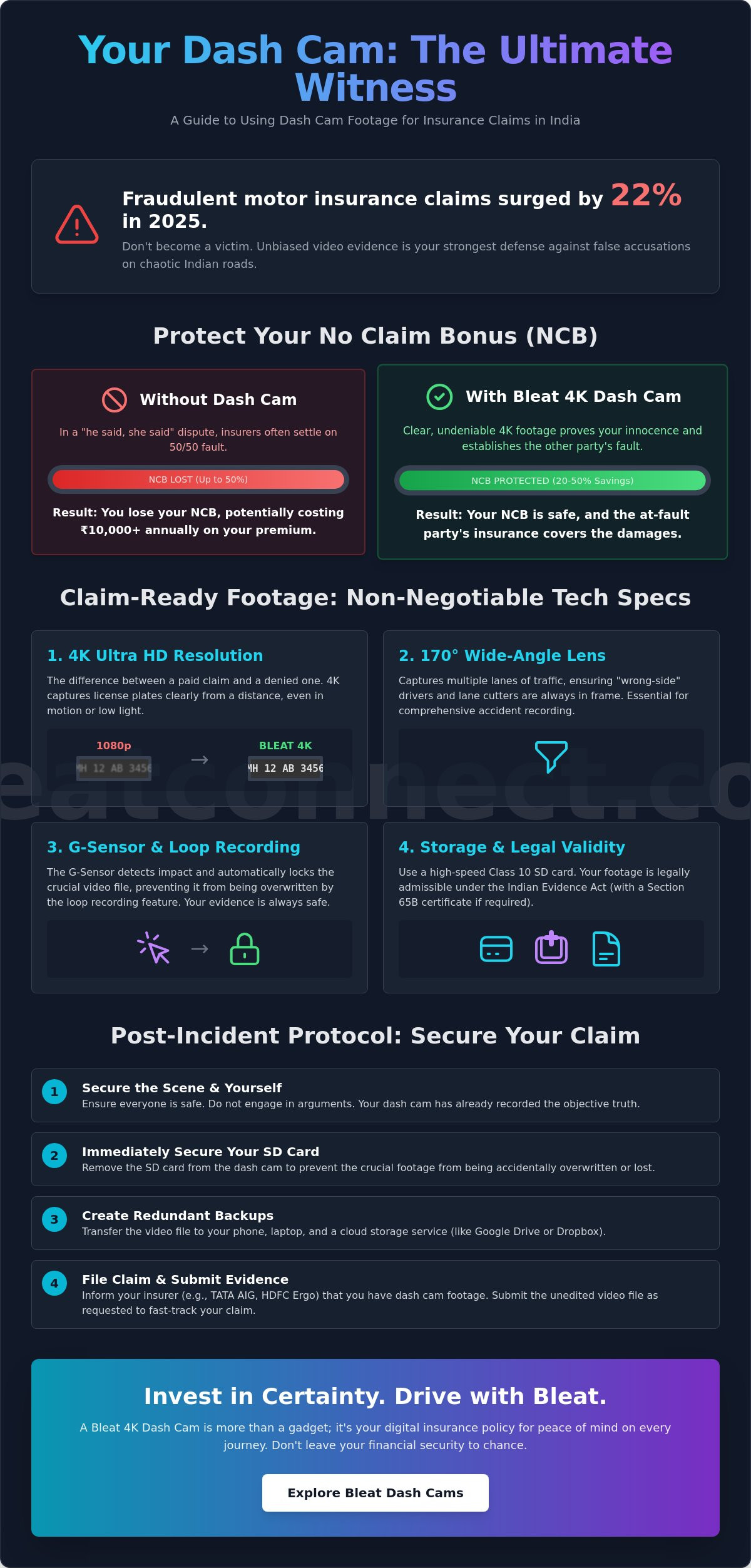
Fraudulent motor insurance claims in India surged by 22% in 2025. This means even if you are a perfect driver, you are at a higher risk than ever of being blamed for an accident you did not cause. You should not have to pay for someone else's mistake or lose your hard-earned No Claim Bonus because of a lack of evidence. We understand the anxiety of facing long settlement periods and confusing traffic laws while trying to prove your innocence on chaotic roads.
This guide ensures you never enter a dispute unarmed. You will learn exactly how to use dash cam footage for insurance claim India to fast-track your payout and provide an unbiased legal witness to insurers like ICICI Lombard and HDFC Ergo. Whether you are recording on a Bleat 4k car dashcamera or a Bleat 3k car dashcamera, your high-resolution footage is your best defense. We will break down the legal admissibility of your videos, the specific technical requirements for 2026, and the step-by-step process to secure your claim with total peace of mind.
Key Takeaways
- Understand the legal standing of dash cam footage under the Indian Evidence Act to ensure your digital evidence is admissible in court.
- Discover the exact process of using dash cam footage for insurance claim India to bypass disputes and protect your hard-earned No Claim Bonus.
- Identify why 4K resolution and advanced Sony sensors are non-negotiable for capturing legible number plates under challenging Indian street lighting.
- Learn the critical protocol for securing your SD card and creating redundant backups immediately following a road incident.
- Avoid common pitfalls like missing timestamps or low-resolution video that lead Indian insurers to reject otherwise valid claim evidence.
Is Dash Cam Footage Legally Valid for Insurance Claims in India?
Indian roads are unpredictable. One moment you're cruising; the next, you're trapped in a "he said, she said" dispute after a minor collision. Using dash cam footage for insurance claim India is your ultimate defense against false accusations. While the Motor Vehicles Act doesn't explicitly mandate these devices, it doesn't prohibit them either. In 2026, a Dashcam serves as your only unbiased witness, providing objective data that eyewitnesses often forget or distort during the heat of the moment.
IRDAI-regulated insurers now recognize digital video as a powerful tool to combat the rising tide of insurance fraud. With fraud accounting for 10-15% of total claims by value, companies like TATA AIG, ACKO, and Digit prioritize clear, unedited video. It speeds up the verification process. It removes the guesswork. Most importantly, it puts you in control of the narrative. If you have the footage, you have the truth.
Digital Evidence and the Indian Legal System
Under the Indian Evidence Act, your recordings are classified as secondary evidence. To make this evidence stick in court or during a high-stakes claim, Section 65B is critical. This section requires an electronic certificate to verify that the footage is authentic and hasn't been tampered with. Having this digital trail simplifies the First Information Report (FIR) process significantly. Instead of arguing with local authorities, you present a timestamped 4K clip from your Bleat 4k car dashcamera. The shift in judicial acceptance means video proof is now often the deciding factor in complex traffic litigation across India.
Protecting Your No Claim Bonus (NCB)
The real financial win lies in protecting your No Claim Bonus. In many Indian road accidents, surveyors often suggest a "50/50" fault settlement because they can't determine the aggressor. This is a trap for the innocent driver. Accepting partial fault wipes out your NCB, which can range from 20% to 50% of your own-damage premium.
Consider the long-term math. If your annual own-damage premium is ₹20,000, a 50% NCB saves you ₹10,000 every single year. Losing that because you couldn't prove the other driver jumped the light is an expensive mistake. Reliable dash cam footage for insurance claim India proves total innocence. It ensures the other party's insurance pays while your hard-earned bonus remains intact. Insurers overwhelmingly prefer this high-fidelity data over unreliable eyewitness accounts that often change under pressure. Secure your financial standing with the precision of a Bleat 4k car dashcamera or Bleat 3k car dashcamera today.
Technical Requirements for "Claim-Ready" Footage
Most drivers believe any camera is sufficient. This is a costly mistake. In 2025, 1080p resolution cameras held 55% of the Indian market, yet they often fail to capture the most vital detail: the license plate. To successfully use dash cam footage for insurance claim India, your resolution must be flawless. High-definition recording is not a luxury. It is a legal necessity. Your footage must be clear enough to stand up to the scrutiny of a surveyor who is looking for any reason to deny your claim.
Clarity is the foundation of any successful claim. Beyond pixels, you need a device that understands the chaos of Indian traffic. Poor street lighting and unpredictable weather demand advanced hardware. A high-performance Bleat 4k car dashcamera ensures that your evidence is undeniable, regardless of the environment. You are not just buying a camera; you are investing in a digital insurance policy that never blinks.
The 4K Advantage in Indian Traffic
Resolution is the difference between a payout and a rejection. 4K resolution provides four times the detail of standard HD, allowing you to zoom in and identify license plates from 20 feet away. This is crucial in hit-and-run scenarios where the offender is speeding away. A 170-degree wide-angle lens is also essential. This field of view, which held a 40% market share in 2025, captures "wrong-side" drivers and lane cutters who might otherwise stay out of frame. Bleat 4K sensor technology specifically targets high-speed motion capture, eliminating the blur that ruins lower-quality recordings during high-impact collisions.
Storage and Loop Recording Essentials
Your hardware is only as good as your storage. Use a Class 10 SD card to handle the massive data flow of 4K video. If your card is too slow, you will suffer from dropped frames, which can make your footage inadmissible. Reliable dash cam footage for insurance claim India also depends on smart loop recording. This feature ensures the camera keeps filming by overwriting the oldest files, but it must work in tandem with a G-sensor. The G-sensor detects the G-force of a crash and automatically locks that specific clip, preventing it from being deleted. Accuracy is the final requirement. Ensure your timestamp is synced perfectly with Indian Standard Time. An incorrect date or time gives insurers an easy excuse to claim the footage is from a different event.
GPS Logging and Incident Proof
GPS logging adds a critical layer of metadata to your files. It provides a digital map of your exact coordinates and, more importantly, your speed. If a surveyor or a police officer claims you were over the speed limit, your GPS data acts as the ultimate rebuttal. This data-rich environment leaves no room for "50/50" fault settlements. By combining 4K visual proof with precise location data, you present a professional, ironclad case to your insurance provider.
Step-by-Step: How to File a Claim Using Dash Cam Evidence
Accidents happen in seconds. The aftermath, however, can drag on for months if you aren't prepared. Knowing how to handle your dash cam footage for insurance claim India determines whether you get a fast settlement or a long legal battle. The moment your vehicle stops, your data management protocol begins. Don't leave your defense to chance. Your dash cam has already done the hard work of recording; now you must ensure that data reaches the right hands.
Immediate action is non-negotiable. While the G-sensor on your Bleat 4k car dashcamera will likely lock the incident file, you should still power down the device and remove the SD card. This prevents any accidental overwriting during the drive home or while the car is being towed. Once you're in a safe location, create at least three copies of the file. Store one on your phone, one in the cloud (like Google Drive or iCloud), and keep the original on the SD card as your primary source of truth.
Preserving the Chain of Evidence
Authenticity is everything in the eyes of an insurer. Never edit, trim, or apply filters to the original footage. Insurers like ICICI Lombard or TATA AIG require the raw, unadulterated file to verify it hasn't been tampered with. Use the Bleat mobile app to export the full 60 seconds surrounding the impact. This provides the necessary context of what happened before and after the collision. Instant cloud backup at the scene is your best defense against physical damage to the camera or card during the crash.
Communicating with Your Insurance Surveyor
When the surveyor arrives, be assertive. Don't just tell them what happened; show them. Point out specific details in your 4K footage that prove your case, such as the exact color of a traffic light or the lane-cutting maneuver of the other driver. If a surveyor seems hesitant to view digital proof, remind them that dash cam footage for insurance claim India is a legally recognized form of evidence in 2026. Document the exact time and method you used to submit your digital files to ensure there's a clear paper trail for your records.
Coordinating with the Police
Your video is a powerful tool when filing a First Information Report (FIR). Police officers often face conflicting stories at accident sites. Presenting clear video evidence from your Bleat 3k car dashcamera cuts through the noise. It provides the police with precise license plate numbers and a timestamped sequence of events. This objective proof often speeds up the police report process, which is a mandatory requirement for most major insurance claims in India. By providing the authorities with undeniable facts, you secure your legal standing from the very start.
Why Indian Insurers Might Reject Your Footage
Insurance companies are businesses. They look for loopholes. Even if you have recorded the incident, your dash cam footage for insurance claim India must meet strict technical audits to be accepted. Surveyors often discard evidence due to simple technical oversights. You don't want to lose your claim because of a "blurry plate" or a missing timestamp. Your evidence must be bulletproof to bypass their scrutiny.
Low resolution is the most common reason for rejection. While 1080p cameras held a 55% market share in 2025, they often fail to capture legible license plate numbers during high-speed motion. If the insurer can't identify the other vehicle, the footage is practically useless for subrogation. Additionally, any suspicion of tampering will lead to an immediate denial. This is why you must never trim or edit the original file. Submit the raw, timestamped data to prove the sequence of events is genuine.
Obstructed views also kill claims. A poorly mounted camera or a dirty windshield can obscure the periphery, hiding the "wrong-side" driver who caused the crash. Ensure your camera is positioned to capture the full 170-degree field of view. To avoid these common pitfalls and secure your settlement, upgrade to professional-grade protection with a high-fidelity system designed for Indian conditions.
The Night Vision Failure
Indian nights are a nightmare for standard sensors. High beams from oncoming traffic often wash out the image, creating a "white-out" effect that hides faces and plates. This is where basic cameras fail. Bleat’s HDR (High Dynamic Range) technology is critical here. It balances extreme light and dark areas, ensuring clarity under poor street lighting. Always test your camera’s low-light performance before you actually need it. If you can't read a plate in your driveway at night, you won't be able to read one during a hit-and-run.
Internal Memory vs. SD Card Failures
Cheap SD cards are a liability. They often corrupt during the high-impact G-force of a collision. If the write-speed is too slow, the most important seconds of the crash might simply be missing. Use only high-end Class 10 cards and format them monthly to prevent write-errors. Furthermore, "Parking Mode" is essential for 2026. Many claims are rejected because the incident happened while the car was stationary and the camera was off. A Bleat 4k car dashcamera with an active G-sensor ensures that even a midnight "dent-and-run" is captured and locked for your insurer.
Remember that timestamp accuracy is a legal requirement. If your camera resets to a default date like "01/01/2020" due to a battery failure, the insurer will claim the footage is from a different event. Regularly check your settings to ensure your device is synced with Indian Standard Time. Consistency is the key to a successful payout.
Bleat 4K: Your Ultimate Insurance Protection on Indian Roads
Securing your vehicle requires more than just a standard policy. It demands a digital witness that captures every detail with surgical precision. The Bleat 4k car dashcamera is engineered to be that witness. When you present dash cam footage for insurance claim India, the quality of your evidence is the only thing standing between a full payout and a rejected file. We provide the hardware that ensures your side of the story is the only one that matters.
Our technology doesn't just record; it protects. By integrating advanced Sony sensors, our cameras deliver superior performance across the diverse Indian landscape. Whether you are navigating the monsoon rains of Mumbai or the dense fog of a Delhi winter, the high-fidelity output remains consistent. This is the complete "Claim-Ready" package, designed to turn the chaos of the road into clear, actionable data for your insurer.
Why Bleat is the Tech-Forward Choice
Clarity is our baseline. Our 4K UHD recording capability ensures that every number plate is readable, even from a distance. This eliminates the "blurry plate" problem that plagues 55% of the market using outdated 1080p sensors. Our 170-degree wide-angle lens captures the entire context of the road, including lane cutters and wrong-side drivers who often cause accidents but escape the frame of lesser cameras.
Durability is equally critical. Indian summers are brutal, with cabin temperatures often exceeding 60 degrees Celsius. Bleat cameras feature a heat-resistant design specifically built to withstand these extremes without warping or losing data. For professional drivers and families alike, this is authoritative protection that never fails when it's needed most. You get built-in GPS and G-sensor technology that automatically locks incident files and logs your exact speed, providing an ironclad defense against false speeding allegations during the claim process.
Join the Bleat Community
Owning a Bleat product means joining a community of modern travelers who prioritize security and innovation. We don't just sell electronics; we provide essential companions for your journey. Our seamless app integration allows for instant evidence sharing. You can download and send dash cam footage for insurance claim India directly to your surveyor or police officer from the side of the road. This rapid response rhythm is what defines the Bleat experience.
Protect your lifestyle with car security that matches your ambition. With national support and hardware you can rely on, we are the forward-thinking companion for every Indian driver. Don't wait for a dispute to realize you're unprotected. Upgrade to Bleat 4K and secure your journey today. Whether you choose the flagship Bleat 4k car dashcamera or the streamlined Bleat 3k car dashcamera, you are choosing market-leading excellence and total legal peace of mind.
Take Control of Your Road Safety and Legal Protection
Driving without a digital witness is a risk you no longer need to take. We've explored how the Indian legal system validates video proof and why protecting your No Claim Bonus is a high-stakes financial priority. Using dash cam footage for insurance claim India isn't just about recording video; it's about providing the undeniable truth in a high-speed environment. You now have the roadmap to handle surveyors, secure evidence, and avoid the technical pitfalls that lead to rejected claims.
Don't wait for an accident to wish you had better resolution. High-performance hardware provides the 4K UHD Resolution and Advanced Night Vision required to capture every detail, even in the dead of night. With Built-in GPS Logging, your speed and location are always on the record. This isn't just an accessory; it's an essential upgrade for your modern lifestyle that ensures you're never left vulnerable to false accusations.
Secure your evidence with the Bleat 4K Dashcamera and drive with the confidence of a market leader. Your journey deserves the highest standard of protection. Enjoy the peace of mind that comes with knowing you're always protected by the best technology available.
Frequently Asked Questions
Is it mandatory to have a dash cam for insurance in India?
No, the Indian government doesn't mandate the use of dash cams in private vehicles as of May 2026. Their use is perfectly legal as long as the device doesn't obstruct the driver's view of the road. While not compulsory, they're rapidly transitioning from a niche accessory to a mainstream safety technology in Tier-1 cities like Delhi-NCR and Bengaluru.
Can dash cam footage reduce my car insurance premium in India?
No major Indian insurance provider offers a direct discount on premiums for installing a dash cam at this time. This is in line with current IRDAI guidelines which haven't yet factored these devices into standard pricing models. Your financial gain comes from using dash cam footage for insurance claim India to protect your No Claim Bonus after an accident.
Does the police accept dash cam video as evidence for road accidents?
Yes, Indian police and judicial authorities accept dash cam footage as valid secondary evidence. It's particularly invaluable when filing a First Information Report (FIR) because it provides unbiased details like timestamps and license plates. With cities like Bengaluru using AI-enabled cameras for 87% of violation detections in early 2025, authorities are highly accustomed to digital proof.
What resolution is best for a dash cam to be used in insurance claims?
4K resolution is the gold standard for insurance claims because it provides the clarity needed to read license plates from a distance. While 1080p cameras held a 55% market share in 2025, they often produce blurry images during high-speed motion. A Bleat 4k car dashcamera ensures your evidence is high-fidelity and undeniable during a surveyor's technical audit.
Will my insurance claim be rejected if the dash cam was not working?
Your claim won't be rejected just because your camera failed to record the incident. You'll simply have to rely on traditional evidence like surveyor reports and eyewitness accounts to prove your case. However, without dash cam footage for insurance claim India, you're at a higher risk of a "50/50" fault determination which can lead to a lost No Claim Bonus.
How do I submit dash cam video to my insurance company?
You can submit your footage through the insurer's official mobile app, digital portal, or by providing the file on a physical drive to the surveyor. Companies like ACKO, Digit, and ICICI Lombard have streamlined processes for accepting digital evidence. Always ensure you provide the raw, unedited file to maintain its legal admissibility as secondary evidence.
Can I use a dash cam to report other people’s traffic violations in India?
Yes, you can use your recorded footage to report traffic violations through various city police apps and social media handles. Many traffic departments in metropolitan areas actively encourage citizens to share video proof of dangerous driving. This helps improve overall road safety and provides the authorities with clear evidence to issue challans for visible offenses.
Is audio recording necessary for an insurance claim?
Audio recording isn't a strict requirement for a successful claim, but it can provide helpful context during a dispute. It captures sounds like turn signals, horns, or verbal exchanges immediately following a collision. While you can disable it for privacy, keeping it active provides a more comprehensive record of the events leading up to the impact.