

Best Dash Cam for Hot Weather Conditions India 2026: The Heat-Safe Guide
Bleat
Would you leave your premium smartphone on a scorching dashboard for six hours during a 50°C May heatwave? Most drivers wouldn't, yet they expect standard cameras to survive those exact conditions. It's a massive risk when your device shuts down in heavy traffic or your SD card corrupts due to thermal stress. Finding the best dash cam for hot weather conditions India is about more than just recording; it's about elite hardware that refuses to quit. You need an assertive, tech-forward protector that handles the heat so you can focus on the drive.
You deserve reliable 24/7 protection and clear 4K footage that doesn't fail when the sun is at its peak. This guide reveals how to identify high-endurance systems that replace volatile lithium batteries with stable supercapacitors. We'll break down the thermal dissipation standards and hardware specs required for the 2026 climate. Discover how to upgrade your lifestyle with a dash cam built for the extreme, ensuring your safety is never compromised by a rising thermometer. It's time to equip your vehicle with the intelligent protection it needs for the modern Indian journey.
Key Takeaways
- Understand why cabin temperatures exceeding ambient heat by 30°C cause standard hardware to fail and stop recording.
- Learn why supercapacitor technology is the non-negotiable power standard for the best dash cam for hot weather conditions India.
- Identify the specific chipset and ventilation designs required to maintain clear 4K footage without thermal throttling.
- Master strategic mounting techniques and sunshade integration to shield your device from direct solar radiation.
- Explore how the Bleat 4k car dashcamera is engineered with advanced thermal dissipation specifically for the Indian summer.
Why Standard Dash Cams Fail in the Indian Summer
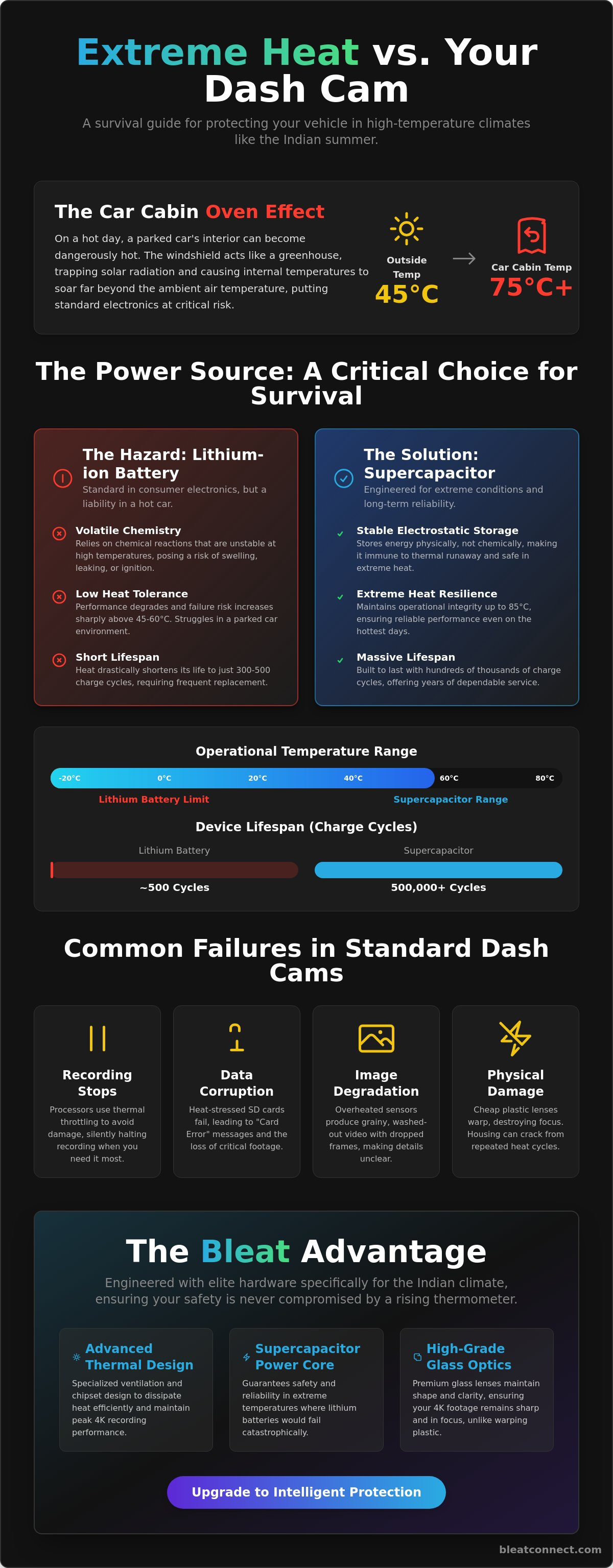
The Indian summer is a relentless test for automotive electronics. When outside temperatures hit 45°C, your car cabin transforms into a high-pressure oven. This greenhouse effect is no joke. Trapped heat radiates through the windshield, pushing internal temperatures up to 30°C higher than the ambient air. For most entry-level electronics, this environment is lethal. If you're searching for the best dash cam for hot weather conditions India, you must understand that standard consumer-grade hardware isn't built for these extremes.
Cheap dash cams rely on thermal throttling to survive. As the processor hits critical temperatures, it slashes its own performance to prevent a total meltdown. This leads to the most frustrating failure: the device simply stops recording in the middle of a drive. You won't know it failed until you need the footage. Even worse, many budget models use lithium-ion batteries. These are volatile. In 70°C cabin heat, lithium batteries can swell, leak, or even ignite. This is why elite hardware manufacturers utilize Supercapacitors instead. They offer a stable, heat-resilient power source that doesn't turn your dashboard into a fire hazard. Reliability isn't an option; it's a requirement.
Low-quality components also suffer from cumulative degradation. Heat cycles cause cheap plastic lenses to warp, permanently ruining your focus. Over time, the constant expansion and contraction create micro-cracks in the housing. This leads to internal component failure and a device that rattles or stops working entirely after just one season.
The Impact of Heat on Image Sensors
High temperatures are the enemy of visual clarity. As an image sensor heats up, it generates digital noise. Your crisp daytime footage suddenly looks grainy and washed out. Heat-stressed processors struggle to handle the massive data flow of high-resolution video, resulting in dropped frames and stuttering playback. To maintain 24/7 reliability, the best dash cam for hot weather conditions India must feature high-grade glass lenses. Unlike plastic, glass maintains its shape and clarity even when the mercury crosses 50°C.
Heat-Related SD Card Failures
Thermal stress doesn't just kill the camera; it destroys your data. SD cards have limited write cycles, and performing these operations at high temperatures accelerates wear. You'll often see the dreaded "Card Error" loop. This happens when the card's controller can no longer manage data blocks due to heat-induced instability. Without a heat-optimized system, your critical accident footage could be corrupted before you ever get the chance to view it. Don't wait for a crisis to discover your storage has failed.
Supercapacitors vs. Batteries: The Science of Heat Survival
Hardware resilience defines the modern driving experience. While standard consumer electronics rely on lithium-ion batteries, high-performance vehicle security demands a different approach. Supercapacitors are high-energy storage units designed for rapid discharge and extreme stability. Unlike lithium batteries that rely on volatile chemical reactions, capacitors store energy electrostatically. This fundamental difference is why they are the cornerstone of the best dash cam for hot weather conditions India. They don't just survive the heat; they thrive in it.
The technical advantage is clear when looking at the Science of Heat Survival. While standard batteries struggle at 45°C, supercapacitors maintain operational integrity up to 85°C. They are immune to the thermal runaway that turns cheap electronics into safety hazards. This makes them essential for modern Indian travelers who prioritize security over short-term savings. You need a device that remains functional when the dashboard temperature crosses the 70°C mark.
Longevity is another critical factor for the tech-savvy owner. A lithium battery might last 300 to 500 charge cycles before it starts to swell or lose capacity. In contrast, a supercapacitor can handle hundreds of thousands of cycles without degrading. It's an investment in hardware that lasts years, not months. There is one trade-off to understand: capacitors hold just enough charge to safely shut down the device. They won't power your camera for hours while the engine is off. For 24/7 monitoring, pairing your device with a professional hardwire kit is the intelligent choice.
Safety Benefits of Capacitor-Based Systems
Capacitor-driven hardware eliminates the most dangerous variable in your cabin: the risk of battery explosion in direct sunlight. These systems are built for reliability. They ensure perfect file finalization, meaning your last video clip is saved securely even if the power is suddenly cut during an impact. With operating ranges extending up to 85°C, these units are the only viable option for the harsh Indian climate.
Why Budget Cameras Still Use Batteries
It's a simple case of cost-cutting. Lithium batteries are significantly cheaper to manufacture than high-grade capacitors. Brands selling these devices are betting you won't notice the compromise until the first summer heatwave kills the unit. This is a false economy. Replacing a failed, budget camera every season is more expensive than investing in professional-grade tech once. Always verify the power source in the technical specifications before purchasing. If you're ready to secure your vehicle with hardware that won't melt, the Bleat 4k car dashcamera offers the elite thermal performance you need.
Critical Features for High-Resolution Thermal Performance
High-resolution recording is a double-edged sword. While 4K provides unmatched visual evidence, it generates massive internal heat. Most budget devices choke under this processing load, leading to stuttering or total shutdown. You need high-performance hardware that manages data without turning into a furnace. Finding the best dash cam for hot weather conditions India requires looking beyond the resolution sticker. It's about how that resolution is maintained when the sun is at its peak. Elite systems prioritize thermal efficiency as much as pixel count.
Airflow is your primary defense against component failure. Premium designs incorporate strategic ventilation ports to allow passive cooling. Without these, the sensor and processor are trapped in a stagnant heat pocket, accelerating hardware fatigue. This is why the physical architecture of the Bleat 4k car dashcamera prioritizes thermal escape routes. It ensures the internal components stay within safe operating limits during long highway drives in May or June. It's a tech-forward approach to a safer lifestyle.
Don't bottleneck your system with standard storage. High-resolution streams require consistent write speeds, especially as temperatures rise. In the 2026 Indian market, only high-endurance SD cards designed for thousands of write-cycles should be used. Heat-resistant storage is the final piece of the reliability puzzle. Pairing a 4K sensor with a cheap SD card is a recipe for data corruption. You need a setup where every link in the chain is built for the extreme.
Thermal Dissipation in 4K Dash Cams
Premium hardware uses internal metal heat sinks to maintain stability. These conductive plates pull heat away from the processor and dissipate it through the housing. It's a passive but essential cooling method. Sophisticated power management software also plays a role, optimizing energy consumption to prevent the device from crossing critical thermal thresholds. Larger camera bodies often excel here. They provide more surface area for heat to escape compared to ultra-compact models that trap thermal energy.
The Role of CPL Filters in Indian Conditions
A Circular Polarizing Lens (CPL) filter is a mandatory upgrade for the Indian summer. It cuts through the thick haze and blinding dashboard reflections that plague summer footage. Beyond clarity, it acts as a shield. It reduces the amount of direct UV radiation entering the lens, protecting the sensitive image sensor from long-term solar damage. This hardware addition ensures number plates remain legible even in the high-contrast light of a 2:00 PM drive. It's an essential companion for the modern traveler.
How to Protect Your Dash Cam During Extreme Heat
Selecting the best dash cam for hot weather conditions India is the first step in a professional security strategy. Proper operation is the second. Even the most resilient hardware needs an intelligent setup to combat 50°C ambient temperatures. You can significantly extend the lifespan of your device by minimizing direct solar exposure and optimizing how the system processes data during the hottest parts of the day. It's about maximizing your investment through smart usage.
Placement is critical. Aim for the "shade zone" directly behind the Internal Rear View Mirror (IRVM). This area often receives less direct sunlight due to the mirror's housing and the dotted ceramic frit found on many modern windshields. When using reflective sunshades, avoid trapping the camera between the shade and the glass. This creates a localized heat pocket that can exceed 80°C. Instead, cut a small notch in your sunshade or position it so the camera remains on the cabin side of the reflective material. This simple adjustment prevents unnecessary thermal stress on the internal sensors.
System maintenance shouldn't be overlooked. Firmware updates aren't just for new features; they often include critical power management optimizations that reduce the thermal footprint of the processor. Pair this with a monthly SD card formatting routine. High temperatures can cause minor file table errors that accumulate over time. Formatting ensures the storage remains fast and efficient, preventing the processor from working harder than necessary to write data. If you're ready to experience this level of engineered reliability, secure your vehicle with the Bleat 4k car dashcamera today.
Safe Parking Mode Strategies
Parking in the Indian sun requires a specialized approach. Use Time Lapse mode instead of traditional motion detection. This keeps the processor at a consistent, low-load state, significantly reducing internal heat generation while the car is stationary. Ensure your hardwire kit is set with a conservative voltage cut-off. Heat can affect car battery performance, and a higher cut-off ensures your vehicle starts every time. These intelligent settings transform your dash cam from a passive observer into a resilient, heat-ready protector.
Physical Protection Tips
Small physical adjustments yield big results. Cracking your windows by just 1cm allows hot air to escape, preventing the greenhouse effect from reaching peak levels. For a more permanent solution, consider high-quality ceramic window tints. These are engineered to block up to 99% of UV rays and a significant portion of Infrared heat. If you're forced to park in an unshaded spot during a record-breaking heatwave, use a quick-release mount to stow the camera in the glovebox until you return. It's about being a forward-thinking companion for your technology.
Choosing the Best Dash Cam for India: The Bleat Advantage
Generic imports often fail because they aren't engineered for the specific thermal profile of the Indian subcontinent. A device designed for a temperate climate will struggle when faced with a Delhi heatwave or a Mumbai monsoon. Finding the best dash cam for hot weather conditions India means choosing hardware built with regional expertise. Bleat leads this space by integrating proprietary thermal management systems into every unit. We don't just sell electronics; we provide an essential upgrade for a safer, more connected lifestyle. Our products are the forward-thinking companions you need for every journey.
The Bleat 4k car dashcamera stands as our flagship for high-heat environments. It utilizes an advanced 4K sensor with superior dynamic range, ensuring that even in the blinding glare of a summer afternoon, every detail remains sharp. This isn't just about resolution. It's about maintaining that resolution when internal temperatures soar. By utilizing supercapacitor technology across our entire Pro range, we've eliminated the primary cause of device failure and safety risks. Reliability is woven into our brand's core identity. You get a tech-savvy protector that refuses to quit when the mercury rises.
Local support is the final pillar of the Bleat advantage. While imported brands leave you stranded with complex international warranty claims, we offer dedicated support for the Indian driver. This provides peace of mind that your investment is protected by a brand that understands local road conditions and climate challenges. It's a commitment to your digital well-being that goes beyond the initial purchase. We've built our reputation on being a reliable expert in the regional market.
Bleat 4K vs. 3K: Finding Your Match
Choosing between our top-tier models depends on your specific driving needs. The Bleat 4k car dashcamera is the ultimate choice for those demanding professional-grade heat resistance and maximum forensic detail. For drivers seeking balanced performance for daily commutes, the Bleat 3k car dashcamera offers exceptional value without compromising on thermal stability. Both models feature:
- Seamless Loop Recording | High-speed WiFi connectivity
- Integrated GPS logging | Supercapacitor power units
- Advanced night vision | Heat-resistant housing
The Bleat Commitment to Safety
Our hardware undergoes rigorous testing in diverse Indian climate conditions, from the humid coasts to the arid plains. This ensures our proprietary hardware integration delivers maximum thermal efficiency in real-world scenarios. We don't rely on theoretical limits; we test for the extreme. Join the community of protected drivers across India who trust Bleat for their vehicle security. Elevate your driving experience with the best dash cam for hot weather conditions India. Your journey deserves the highest standard of technological excellence.
Secure Your Journey Against the Heat
The Indian summer doesn't have to be the end of your vehicle's security system. You now understand that standard batteries are a safety liability and that supercapacitors are the only choice for long-term survival. Real protection comes from hardware that manages 4K processing heat while resisting external cabin temperatures that often exceed 70°C. By prioritizing efficient thermal dissipation and high-endurance storage, you ensure your evidence is captured without fail.
Investing in the best dash cam for hot weather conditions India is an essential move for the modern, tech-savvy traveler. You need a device engineered specifically for our unique regional thermal profile. Don't settle for generic technology that fails when the sun is at its peak. It's time to choose a protector that matches your lifestyle and your demand for innovation.
Upgrade to a heat-resistant Bleat 4K Dash Cam today for the ultimate in supercapacitor-powered stability. Our systems deliver ultra-clear 4K recording and are rigorously tested to withstand 50°C+ Indian road conditions. Drive with the confidence that your safety is backed by market-leading technology. Your journey is worth the upgrade.
Frequently Asked Questions
Can a dash cam explode in a hot car in India?
Models equipped with standard lithium-ion batteries can indeed swell, leak, or explode when cabin temperatures exceed 60°C. This is a significant safety risk in the Indian climate where dashboards often reach 70°C in direct sun. You should prioritize supercapacitor technology to eliminate this danger. These advanced components store energy electrostatically and are immune to the thermal runaway that causes battery-based devices to fail or ignite.
Is a supercapacitor dash cam better than a battery dash cam for summer?
A supercapacitor is significantly better for summer because it withstands a much wider temperature range, often up to 85°C. While batteries degrade rapidly after a single season of heat cycles, capacitors last for years. This makes them the foundation of the best dash cam for hot weather conditions India. They provide the reliable file finalization you need without the risk of chemical degradation or fire hazards common in budget battery units.
How much heat can a dash cam withstand before it stops recording?
Most consumer-grade electronics stop recording when internal sensors hit 60°C to 65°C to prevent permanent damage. However, high-performance systems like the Bleat 4k car dashcamera are engineered with advanced thermal dissipation to operate safely up to 85°C. If your device lacks professional heat sinks or ventilation, it will likely enter a thermal throttling loop and shut down during intense afternoon drives across the Indian plains.
Do I need a special SD card for hot weather dash cam use?
You must use a High-Endurance SD card specifically rated for high-temperature cycles and constant write-rewrites. Standard cards fail quickly because heat increases data corruption risks during the recording process. Look for cards that utilize industrial-grade NAND flash memory. These are designed to maintain data integrity even when the camera's internal temperature spikes, ensuring your critical footage is actually there when you need it most.
Will my dash cam drain my car battery faster in hot weather?
Heat reduces your car battery's overall efficiency and chemical health, making it more susceptible to discharge. While the dash cam's power draw remains consistent, the battery's ability to hold a charge drops in extreme temperatures. Using a hardwire kit with an adjustable voltage cut-off is the intelligent solution. It protects your vehicle's starting power by disconnecting the camera before the battery levels become critical during a heatwave.
Does parking in the shade actually help my dash cam?
Parking in the shade is a simple but effective tactic to reduce the ambient heat load on your electronics. It can lower cabin temperatures by as much as 15°C compared to direct sunlight exposure. This reduction prevents the "heat soak" effect where the camera's internal components reach critical failure points before you even start the engine. It's a smart habit that extends the operational life of your high-resolution sensors.
Can I use a dash cam with a sunshade on my windshield?
You can use a sunshade, but you shouldn't trap the camera between the glass and the reflective material. This creates a localized oven that can destroy the image sensor. The best approach is to cut a small notch in the shade or position the camera so it stays on the cabin side of the protector. This allows the camera to benefit from the cooler cabin air while staying shielded from direct UV radiation.
How do I know if my dash cam is overheating?
Common symptoms of overheating include frequent reboots, sluggish menu response, or the dreaded "Card Error" message. You might also notice purple tinting or digital noise in your video playback. If the device feels hot to the touch and stops recording, it has likely triggered a thermal safety shutdown. Upgrading to the best dash cam for hot weather conditions India ensures your hardware includes the necessary heat sinks to prevent these failures.