

How to Share Dash Cam Video with Police: A Step-by-Step Guide (2026)
Bleat
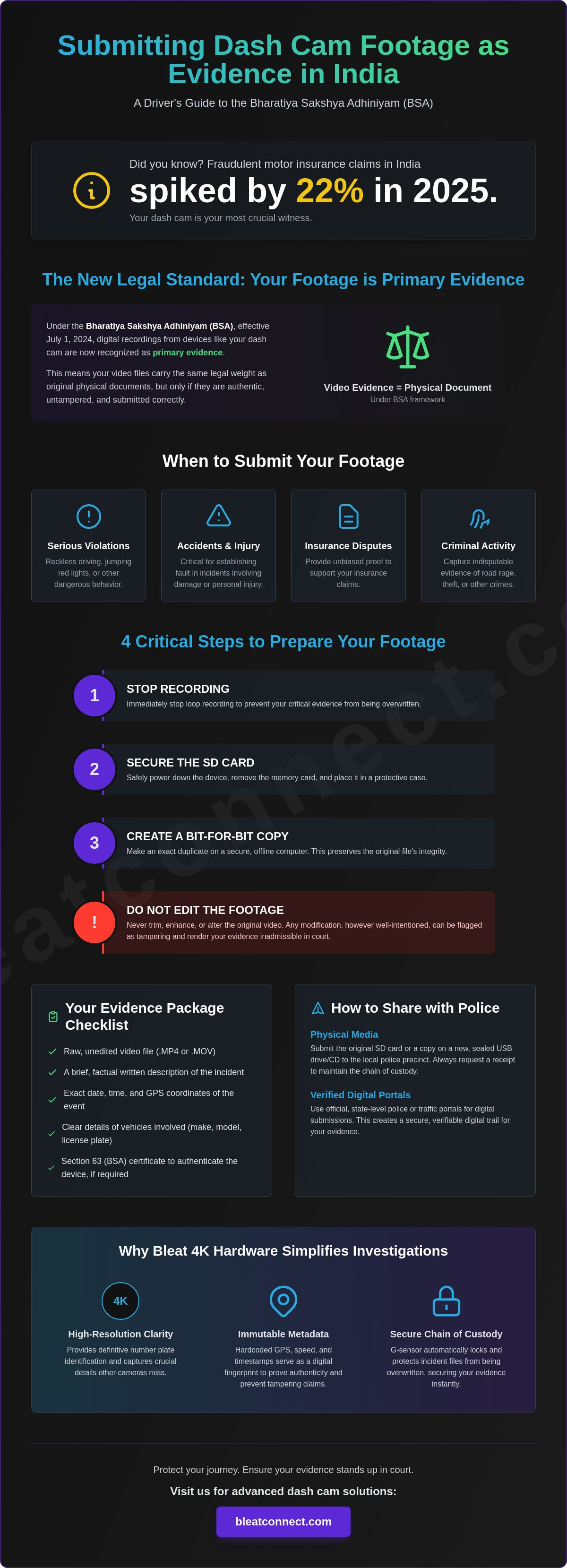
Did you know that fraudulent motor insurance claims in India spiked by 22% in 2025? You've likely installed a high-resolution device to protect your journey, but simply hitting record isn't enough when an incident occurs. It's stressful to worry that your critical evidence might be rejected due to a technicality or a misunderstanding of local procedures. You need to know exactly how to share dash cam video with police to ensure your footage stands up as primary evidence in a court of law.
We understand the confusion between physical and digital submissions and the anxiety that comes with navigating Indian police stations. This guide masters the exact process of submitting your files so they remain authentic and untampered. You'll learn how to comply with the Bharatiya Sakshya Adhiniyam, 2023, and the Digital Personal Data Protection Act to keep your rights secure. We provide a clear roadmap for protecting your original files while meeting every legal requirement for a successful evidence submission. From understanding the Section 63 certificate to handling local precinct protocols, we've got you covered.
Key Takeaways
- Understand the Bharatiya Sakshya Adhiniyam (BSA) framework to ensure your digital recordings qualify as primary evidence in Indian courts.
- Learn exactly how to share dash cam video with police using secure storage media or verified state-level digital portals.
- Preserve critical files by immediately stopping loop recording and safely removing the SD card from your Bleat 4k car dashcamera.
- Leverage advanced sensor technology to provide authorities with the high-resolution clarity required for definitive number plate identification.
- Maintain a secure chain of custody while protecting your personal privacy under the Digital Personal Data Protection Act.
Is Dash Cam Footage Legal Evidence in India?
Your dash cam is your most reliable witness on Indian roads. Under the Bharatiya Sakshya Adhiniyam (BSA), which replaced the Indian Evidence Act on July 1, 2024, digital recordings are now recognized as primary evidence. This legal shift means your video files carry the same weight as physical documents in a court of law. However, admissibility isn't automatic. For your footage to hold up, it must be authentic, relevant, and completely untampered. Understanding how to share dash cam video with police within this new legal framework is essential for every modern driver.
The BSA introduces strict requirements for digital proof. Specifically, a certificate under Section 63 of the BSA is often required to authenticate the device and the recording process. This certificate confirms that the electronics were functioning correctly and that the data hasn't been manipulated. When you use Dashcam footage as evidence, you're providing a digital record that must remain pristine from the moment of the crash to the moment it reaches the investigator's desk. Any gap in this chain of custody can lead to the evidence being suppressed.
When to Submit Footage to the Police
Not every minor traffic disagreement requires a formal police submission. Focus on incidents where legal clarity is paramount. Serious traffic violations like reckless driving or jumping red lights are primary candidates for evidence. If an accident involves property damage or personal injury, your footage becomes a critical tool for establishing fault. You should also submit recordings during insurance claim disputes or when you capture clear evidence of road rage and criminal activity. Your Bleat 4k car dashcamera acts as an unbiased observer, documenting facts that human memory might blur or distort under stress.
The Role of Metadata in Legal Validity
Metadata serves as the digital fingerprint of your video file. GPS coordinates and hardcoded timestamps provide the essential context of "where" and "when" that investigators need to verify your claim. If you're wrongly accused of speeding, hardcoded speed data embedded in the file can prove your innocence by showing your exact velocity at the time of impact. Immutable metadata effectively prevents evidence tampering in court by creating a permanent, verifiable link between the physical location and the digital file. This data ensures that your defense is backed by hard science rather than just a visual narrative.
How to Prepare Your Dash Cam Video for Submission
Preserving the integrity of your digital files starts the moment the incident ends. Most modern devices, including your Bleat 4k car dashcamera, utilize loop recording to manage storage space. This means the oldest footage is automatically overwritten by new data as you continue to drive. To prevent losing your critical evidence, you must stop recording immediately and power down the device. Safely remove the SD card and place it in a protective case. This simple step ensures that the most important seconds of your journey remain intact and untouched by the camera's internal processing cycle.
Once you've secured the card, create a bit-for-bit copy on a secure, offline computer. This isn't just a simple copy-paste operation; it's about mirroring the data exactly as it exists on the hardware. Never use video editing software to 'enhance' the lighting or 'trim' the clip to just the interesting parts. While you might think you're helping the investigation, any alteration can be flagged as tampering under the BSA. You want to show the court the raw, unadulterated truth. Learning how to share dash cam video with police effectively means delivering a file that is beyond technical reproach.
Technical Export Requirements
Authorities require files in their native containers to verify authenticity. Export your footage in the original file format, which is typically .MP4 or .MOV. Maintain the highest possible resolution to ensure every pixel of detail is preserved for the investigators. While some international systems like the National Dash Cam Safety Portal have specific upload requirements, Indian authorities generally expect the original file name and timestamp metadata to remain unchanged. This metadata acts as a digital seal that proves the video hasn't been moved or modified.
Organising Your Evidence Package
A professional, organized submission increases the likelihood of swift police action. Create a dedicated folder containing the raw video and a brief written description of the incident. Your package should include:
- The exact date, time, and GPS coordinates of the event.
- A clear summary of the vehicles involved and the sequence of events.
- A secondary file with a zoomed-in screenshot of the number plate for quick reference.
- A strict log of everyone who has handled the digital file to maintain the chain of custody.
Methods for Sharing Video with Police Authorities
Submitting your footage is the moment your digital protection becomes a legal reality. While some might suggest simply showing a police officer the video on your smartphone or the dash cam's built-in screen, this lacks formal weight. For an investigation to proceed, you must provide the evidence in a format that the justice system can process and archive. Understanding how to share dash cam video with police ensures your evidence is logged correctly, creating a clear path toward resolution. You aren't just showing a video; you're providing a sworn digital record.
Physical submission remains the most robust method for serious incidents. You should use a dedicated, low-cost USB drive or a new SD card for this purpose. Never hand over your only copy or your primary high-capacity card from your Bleat 4k car dashcamera. By providing a formatted card containing only the relevant clips, you protect your other data while giving authorities exactly what they need. This method is particularly effective for major accidents where a physical chain of custody is required for court proceedings.
Physical Submission via SD Cards
When you prepare a physical card for the police, ensure it is a new, formatted piece of media. This prevents any confusion with unrelated files or personal data. When you hand over the media at the police station, always request a written acknowledgement or a 'Panch Nama'. This official document serves as your proof that the evidence was received and is now part of the case file. It's a critical step in maintaining the integrity of your evidence under the BSA framework.
Online Portals and Social Media Reporting
Digital submission is becoming the standard for traffic violations across many Indian states. Many metropolitan areas have launched 'Citizen Sentinel' apps, allowing users to upload footage of signal jumping or reckless driving directly to the traffic department. While there is currently no single national portal for the direct upload of dash cam evidence by the public, local traffic police handles on platforms like Twitter/X are highly active. Tagging the official handle with a clear, high-resolution clip often leads to swift action, such as the issuance of an e-challan. For crime-related complaints, the national Digital Police portal can be used to file the initial report, though you will likely be directed to your local precinct for the actual file transfer. In cities like Pune, where 121 cases of vehicle vandalism were recorded over a 17-month period, combining online reporting with physical follow-up ensures your high-tech hardware delivers real-world results.
Protecting Your Privacy and Legal Rights
Digital evidence is a double-edged sword. While the Bharatiya Sakshya Adhiniyam (BSA) empowers you to use your recordings in court, the Digital Personal Data Protection Act (DPDPA) ensures your personal life remains private. You aren't legally required to share footage of unrelated private moments or conversations captured inside the cabin. When you're determining how to share dash cam video with police, focus strictly on the incident window. This precision protects your privacy while fulfilling your civic duty. However, be aware that your own driving behavior is also under the microscope. If the video shows you were speeding or driving recklessly before the impact, that data becomes part of the official record.
The balance between the 'Right to Privacy' and 'Public Interest' is a delicate one. In India, the law generally favors the public interest when a crime or serious accident has occurred. This means your right to keep a recording private may be overridden if it contains essential evidence of a felony. For incidents involving serious criminal charges or significant liability, we strongly recommend seeking legal counsel before making a formal submission. Secure your legal standing and capture every critical detail with a Bleat 4k car dashcamera designed for maximum forensic clarity.
Maintaining the Chain of Custody
A chain of custody is a chronological paper trail that records the movement and handling of your digital evidence. It starts the moment you remove the card from your camera and ends when the police log it into their system. To bolster your case, you can 'hash' your files using free software to create a unique digital fingerprint. If a single frame is edited, the hash value changes instantly, proving the file's integrity. A broken chain of custody creates reasonable doubt regarding the video's integrity, frequently resulting in the dismissal of evidence by the court.
Dealing with Counter-Claims
In severe cases involving fatalities or major crimes, the police have the legal authority to seize your entire dash cam unit as part of the investigation. Your Bleat 4k car dashcamera protects you from false accusations by providing an objective, high-resolution account of the facts. This eliminates "he-said-she-said" scenarios that often plague Indian road accident disputes. If a local officer refuses to accept your digital evidence, don't argue. Instead, request to speak with the Station House Officer (SHO) or submit the evidence via a formal written complaint to the Superintendent of Police (SP) office. This ensures your evidence is officially documented regardless of initial resistance at the precinct level.
Why Bleat 4K Hardware Simplifies Official Investigations
High-definition hardware is the foundation of a successful legal claim. The Bleat 4k car dashcamera provides unmatched clarity, ensuring that small but vital details like number plates and facial features are visible even from a distance. In the chaotic environment of Indian traffic, where dust and high-speed movement can blur traditional footage, 4K resolution is a forensic necessity. This level of detail eliminates ambiguity during police investigations. When you understand how to share dash cam video with police, you quickly realize that the quality of the file determines the speed of the justice process. Clearer evidence leads to faster resolutions and fewer disputes.
Lighting conditions in India vary wildly, from the harsh glare of the afternoon sun to poorly lit rural stretches. Bleat hardware features superior night vision technology that maintains evidence usability in low-light conditions. While standard cameras often produce grainy or "blown out" footage when hit by headlights, our sensors balance exposure to keep details sharp. For drivers seeking a balance between storage efficiency and high detail, the Bleat 3k car dashcamera offers a powerful alternative. It provides the resolution needed for official investigations while maximizing the recording time on your SD card, making it an ideal companion for long-distance travel.
Hardware intelligence is built into every device to protect your data automatically. Integrated G-sensors detect sudden impacts or emergency braking, instantly triggering a file lock. This prevents the system from overwriting the incident during loop recording. It acts as an automated safeguard, ensuring the most critical seconds of your journey are preserved without manual intervention. This feature is your first line of defense in maintaining a clean chain of custody.
Reliability in High-Stress Situations
Bleat hardware is engineered to withstand the unique challenges of the Indian climate and road conditions. Our cameras are tested against extreme heat and constant road vibration, ensuring they don't fail when you need them most. Simple mobile app integration allows for rapid on-site video review. You can verify your footage immediately after an incident, giving you confidence before you begin the formal process of how to share dash cam video with police. This immediate access can be vital when dealing with on-site traffic authorities.
The Bleat Commitment to Driver Safety
We provide more than just gadgets. We provide digital security for the modern traveler. Our mission is to keep you connected, protected, and legally secure on every road you take. Your journey deserves a witness that never blinks and a record that never fails. Upgrade your vehicle's intelligence and secure your legal standing today. Take the first step toward total protection and secure your journey today with the Bleat 4k car dashcamera.
Secure Your Digital Defense
Navigating Indian roads requires more than just defensive driving; it demands a solid legal strategy. You've learned that the Bharatiya Sakshya Adhiniyam makes your digital recordings primary evidence, provided you maintain file integrity. Success hinges on preserving unedited footage and following a strict chain of custody from the moment of impact. Master how to share dash cam video with police to transform a simple recording into a powerful tool for justice. By using secure submission methods and protecting your privacy, you ensure your version of events is the one that counts.
As the Indian market leader in high-resolution automotive technology, we provide the hardware standards needed for forensic clarity. Our proprietary G-sensor integration offers automatic evidence protection by locking critical files the moment a collision is detected. We back every journey with national support and hardware designed to survive local conditions. Don't leave your protection to chance or memory. Protect your legal rights with a Bleat 4k car dashcamera and drive with the confidence that your witness is always active and your evidence is secure.
Frequently Asked Questions
Can the police seize my dash cam if I show them the video?
Police have the legal authority to seize your hardware if the incident involves a serious crime or a fatality. This ensures the original, raw data is preserved for forensic analysis without any risk of tampering. For minor traffic violations, providing a high-quality digital copy on a separate drive is usually sufficient to satisfy investigative requirements.
Is dash cam footage enough to prove I was not at fault in an accident?
Dash cam footage serves as primary evidence but is evaluated alongside other factors like witness statements and road marks. It provides an objective account of the sequence of events, which often clarifies fault immediately. While highly persuasive in court, it remains one part of a comprehensive police investigation under the Bharatiya Sakshya Adhiniyam.
What should I do if the police officer refuses to look at my video?
If an officer on the scene refuses to review your footage, remain calm and request to speak with the Station House Officer (SHO) at the precinct. You can also submit the evidence through a formal written complaint to the Superintendent of Police (SP) office. This ensures your digital record is officially acknowledged and logged into the case file.
Do I need to give the police my original SD card?
You don't need to surrender your original SD card for most routine traffic reports. It's better to provide a copy on a secondary, formatted card or a USB drive. Keep the original card from your Bleat 4k car dashcamera as your master backup to verify the file's integrity and metadata if the evidence is challenged.
How long do police keep dash cam footage as evidence?
Retention periods depend entirely on the severity of the legal case. For simple traffic challans, the data may be archived for only a few months. In criminal proceedings or serious accidents, the police will keep the footage as evidence until the case is fully resolved in court, which can often take several years.
Can I be fined if my dash cam shows me speeding while recording someone else's accident?
Yes, you can be penalized if the footage clearly documents your own traffic violations. The camera acts as an unbiased witness to everything within its field of view, including your vehicle's speed and lane discipline. When you're learning how to share dash cam video with police, understand that the entire clip becomes part of the public record.
What is the best file format for submitting dash cam video to the police?
The most effective formats are .MP4 or .MOV because they are universal standards compatible with all government workstations. These formats maintain the high-resolution detail and hardcoded metadata necessary for legal validation. Avoid using proprietary players or unusual codecs that might require the police to install additional software to view your evidence.
How do I prove that my dash cam video has not been edited?
You can prove your video is authentic by providing the original file with its native metadata intact or by using a digital hash. A hash creates a unique digital fingerprint for the file. If even a single pixel is altered, the hash value changes, providing an immediate and scientifically verifiable way to prove the footage hasn't been edited.