

Dash Cam with Parking Mode Explained: The Ultimate Security Guide for 2026
Bleat
Imagine returning to your car in a busy Delhi parking lot only to find a fresh, deep scratch across the door. No note was left, and the CCTV didn't catch a thing. It's a helpless feeling that often ends in a ₹20,000 repair bill. This is exactly why getting a dash cam with parking mode explained is the most critical upgrade for any vehicle owner in India. You need a witness that never blinks, even when the engine is off.
We understand the anxiety of leaving your car unattended. You worry about hit-and-runs and the fear that a constant camera might drain your battery. This guide clears the confusion. You'll master the technical workings, power requirements, and essential features of dash cam parking mode to protect your vehicle 24/7. We'll explore how to balance high-end hardware like the Bleat 4K with smart power management. We cover everything from hardwiring logic to voltage cut-offs so you can choose your security setup with total confidence.
Key Takeaways
- Transform your vehicle into a 24/7 surveillance hub that captures hit-and-runs and vandalism even while you are away.
- Differentiate between G-sensor impact triggers and lens-based motion detection to optimize your security coverage and power efficiency.
- Master the technical logic of hardwiring with our dash cam with parking mode explained, ensuring constant power without risking your vehicle's battery health.
- Discover why supercapacitors are mandatory for India's extreme climate to prevent hardware failure and ensure reliable long-term performance.
- Explore how the Bleat 4K Dashcam integrates proprietary hardware logic for seamless, high-resolution evidence recording in any environment.
What is Dash Cam Parking Mode and Why Do You Need It?
A dash cam with parking mode explained in the simplest terms is a surveillance system that remains active while your engine is off. Standard recording stops the moment you pull the key from the ignition. Parking mode bridges that gap. It transforms your Dashcam from a driving assistant into a 24/7 sentry. This feature is the "Silent Witness" your vehicle needs in high-traffic Indian cities. Whether it's a hit-and-run in a mall basement or a scratch in your society's parking lot, this technology ensures you aren't left paying for someone else's mistake.
Standard loop recording isn't designed for stationary vehicles. Without a dedicated parking feature, your camera won't have the power or the logic to save footage when the car is parked. This leads to a massive security gap. By the time you discover a dent the next morning, the evidence is long gone. Parking mode solves this by using intelligent triggers to capture only what matters, saving both battery life and storage space. It provides the psychological relief of knowing your investment is protected in unmonitored public spaces.
The Reality of Unattended Vehicle Safety
Urban parking in India is often a chaotic game of inches. Low-speed impacts and door dings are almost guaranteed. Without video evidence, insurance claims for these "minor" incidents are often rejected or result in a loss of your No Claim Bonus (NCB). A visible, active system like the Bleat 4K acts as a powerful deterrent. Vandals and thieves are less likely to target a vehicle that's clearly recording. If they do, you have high-resolution evidence ready for police reports and insurance adjusters. With passenger vehicles holding 66.4% of the market share in 2025, the need for individual vehicle security has never been higher.
Parking Mode vs. Driving Mode: Key Differences
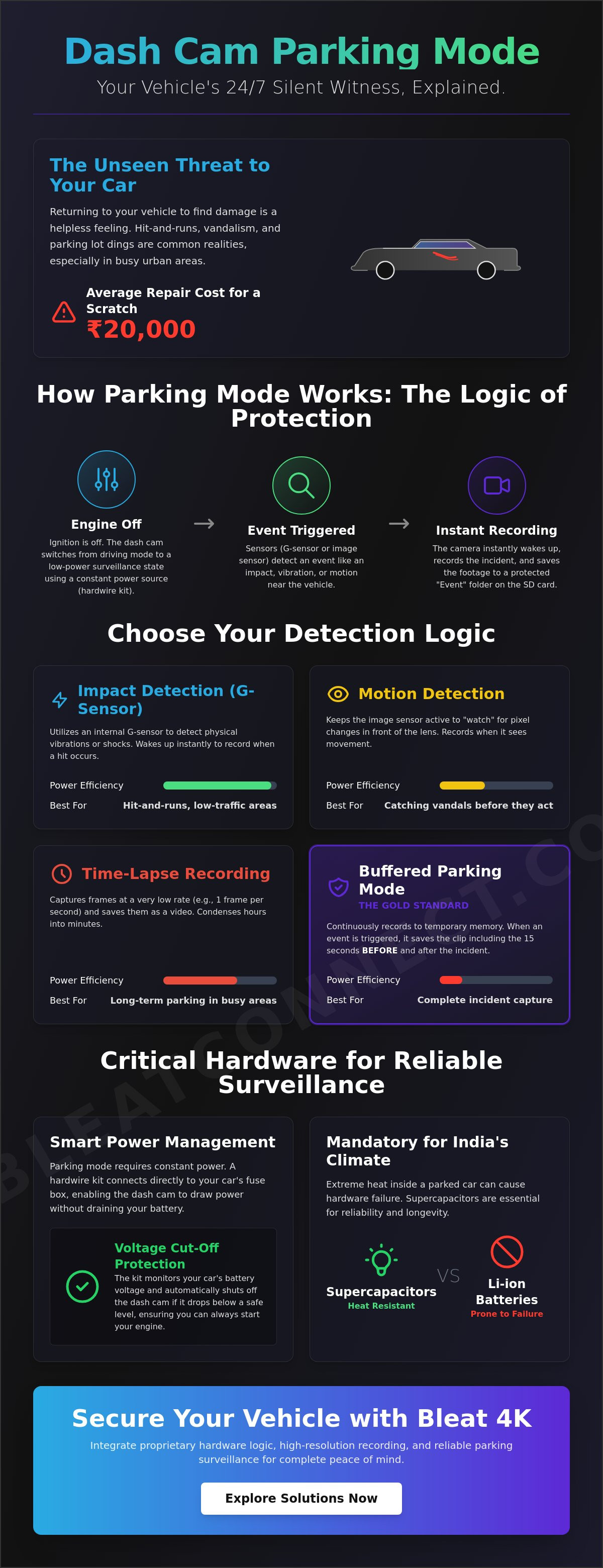
The transition from driving to parking mode involves a fundamental shift in how the hardware operates. While driving, the camera relies on ignition-switched power. In parking mode, it switches to a constant power source, usually through a hardwire kit connected to the fuse box. Storage management also changes. Instead of continuous loop recording, the camera uses "Event" folders to lock footage triggered by the G-sensor. This prevents critical evidence from being overwritten by hours of footage of an empty street. Detection sensitivity is also dialed up. The G-sensor becomes more alert to catch even slight vibrations that wouldn't matter while the car is in motion.
How Parking Mode Works: Understanding Detection Types
Technical logic varies across different surveillance modes. To truly have a dash cam with parking mode explained, you must understand how the hardware decides when to record. Most systems rely on a tiered detection strategy. This ensures that you capture critical evidence without exhausting your car's battery or filling up your SD card with hours of empty footage. Modern processors manage these triggers with millisecond precision to ensure no event goes unrecorded.
Impact Detection is the foundation of vehicle security. It utilizes an internal G-sensor to monitor for physical vibrations or sudden movements. When the sensor detects a hit, the camera instantly wakes from its low-power state to record. It's the most energy-efficient method. Motion Detection, by contrast, keeps the image sensor active to "watch" for pixel changes. This is superior for catching vandals who might not touch the car. Time-lapse recording takes a different route. It captures one frame per second, creating a high-speed summary of hours of footage. For those seeking absolute protection, Buffered Parking Mode is the gold standard. It continuously records to temporary RAM. When a trigger occurs, the camera saves the 15 seconds before and after the event, ensuring you see exactly how the incident started.
Choosing the Right Detection Logic for Your Environment
Your parking environment dictates your settings. In a busy Mumbai street, standard motion detection might trigger every 30 seconds due to passing pedestrians. This drains power rapidly. In such high-traffic areas, time-lapse is often more effective. Quiet residential garages in Bangalore are better suited for high-sensitivity impact detection. You must calibrate your G-sensor carefully. Setting it too high leads to "false positives" from heavy monsoon rain or wind. Low sensitivity might miss a soft door ding from a neighboring car. Finding this balance is key to reliable surveillance.
The Role of the Image Processor
The image processor is the brain of your security system. Even when not writing to the SD card, "always-on" sensors consume a steady stream of milliamps to monitor the environment. High-end processors, like those in the Bleat 4K car dashcamera, manage this thermal load efficiently. Night vision is equally critical. Most parking incidents happen in low-light conditions. A superior processor utilizes advanced algorithms to pull detail from the shadows. Buffered recording utilizes temporary RAM to capture pre-impact footage, ensuring the seconds leading up to a crash are never lost. This hardware integration is what separates a basic camera from a professional security tool.
Powering Your Dash Cam: Hardwiring vs. External Batteries
Reliable surveillance requires a stable power ecosystem. While the detection logic determines when to record, your power source determines how long that protection lasts. Getting a dash cam with parking mode explained means looking beyond the standard cigarette lighter plug. You need a solution that stays live when the engine dies. Most users choose between a dedicated hardwire kit or an external battery pack to maintain this 24/7 vigil. Each method has distinct technical implications for your vehicle's electrical health.
The hardwire kit is the industry standard for professional setups. It connects directly to your vehicle's fuse box using a three-wire configuration: Constant (VCC), Ignition (ACC), and Ground. The ACC wire acts as a communication signal. It tells the camera exactly when you've turned off the engine. Once that signal drops, the camera's internal logic switches from driving mode to parking mode. For those seeking a simpler path, OBD-II power cables offer a plug-and-play middle ground. These draw power from the onboard diagnostics port, bypassing the need for complex fuse box access while still providing the necessary constant power.
Voltage Cutoff Protection is the most critical fail-safe in this system. It's a dedicated circuit built into the hardwire kit that monitors your car battery in real-time. Lead-acid car batteries aren't designed for deep discharge. If the voltage drops too low, the battery can suffer permanent damage known as sulfation. A smart hardwire kit will cut power to the camera immediately if the battery hits a pre-set limit. This ensures you always have enough juice to crank the engine the next morning, even after a long weekend of surveillance.
Demystifying the Hardwire Kit
Proper installation relies on the ACC signal to trigger the mode shift. This wire senses the electrical state of the vehicle's ignition system. In India's varied climate, battery health can fluctuate significantly. You should select a voltage threshold of 12.0V or 12.4V for newer vehicles to ensure long-term battery longevity. A lower setting like 11.8V might be necessary for older batteries but carries a higher risk of a non-start in cold weather or after long periods of inactivity.
Battery Packs vs. Car Battery: A Longevity Analysis
Car batteries are designed for short bursts of high current, not the steady, low-current draw of a dash cam. Frequent drainage can reduce a standard battery's lifespan from four years to less than two. Premium external LiFePO4 (Lithium Iron Phosphate) battery packs are the superior alternative. These independent units charge while you drive and power the camera while you're parked. They handle thousands of charge cycles and remain chemically stable in the high-heat environments of a car parked in the Indian summer. Many owners worry about warranty issues. Using fuse taps is a non-invasive method that avoids cutting or splicing original wires, preserving your vehicle's electrical integrity and warranty status.
Critical Hardware Features for Reliable Parking Surveillance
Hardware reliability is the silent pillar of 24/7 security. Understanding the physical components behind a dash cam with parking mode explained reveals why some units fail while others endure. A camera recording while parked faces much harsher conditions than one used only during driving. It lacks the cooling airflow from the car's air conditioning and must survive the stagnant heat of a closed cabin. To ensure your evidence is actually there when you need it, you must prioritize specific hardware standards designed for high-stress environments.
Supercapacitors are the most critical internal component for parking surveillance. Traditional lithium-ion batteries are a liability in a car parked under the direct Indian sun. They can swell, leak, or even catch fire when internal cabin temperatures soar. Supercapacitors handle extreme heat gracefully and provide just enough power to save the final file when the camera shuts down. High-endurance design also extends to the body of the unit. Metal housings and ventilated frames help dissipate heat away from the sensitive image processor. This prevents the "thermal throttling" that causes budget cameras to stop recording during the hottest parts of the day.
Storage management is the final piece of the hardware puzzle. Low bitrate recording is a sophisticated feature that reduces the file size of parked footage without sacrificing the narrative of an event. Instead of capturing every frame at maximum quality, it records at a lower data rate to extend the life of your SD card. This is vital for 24/7 use, as it reduces the frequency of "write cycles" that eventually wear out flash memory. For the ultimate in thermal resilience and 4K clarity, upgrade to the Bleat 4K car dashcamera to ensure your vehicle is protected by hardware built for the toughest conditions.
Thermal Resilience in the Indian Summer
When a dash cam overheats, it doesn't just stop working. It often corrupts the most recent file, which is usually the footage of the incident that caused the heat spike. Supercapacitors are mandatory because they lack the volatile chemicals found in standard batteries. A reliable parking camera must operate within a temperature range of -20°C to 70°C to survive the extreme internal heat of a vehicle parked in direct sunlight. Without this thermal overhead, your surveillance system will likely fail during the peak summer months when you need it most.
Storage Optimization for 24/7 Use
Standard microSD cards will fail within months if used for constant parking surveillance. You must use "High Endurance" or "Max Endurance" cards designed specifically for thousands of hours of continuous writing. Most advanced cameras partition the card into separate folders for "Driving," "Parking," and "Events." This logic ensures that a minor door ding captured in parking mode isn't accidentally overwritten by the next hour of driving footage. While 4K resolution provides unmatched detail, it also consumes storage four times faster than 1080p, making high-capacity, high-endurance cards a non-negotiable requirement.
The Bleat 4K Solution: Advanced Protection for Your Vehicle
Bleat represents the pinnacle of localized vehicle security. We have taken the technical complexities of a dash cam with parking mode explained and distilled them into a high-performance ecosystem. The Bleat 4K is not just a camera; it is an intelligent sensor suite engineered for the specific challenges of Indian roads. It bridges the gap between passive recording and active surveillance. You get a system that thinks for itself, ensuring your vehicle remains protected while you sleep.
Our proprietary hardwire kit provides the critical foundation for this security. It integrates seamlessly with your vehicle's electrical system, offering built-in voltage protection that prevents battery drain. This is not a generic accessory. It is a precision-engineered component that communicates directly with the camera's processor. You can monitor this entire system through the Bleat mobile app. The interface allows you to change parking mode settings, adjust G-sensor sensitivity, and view incident alerts on your smartphone instantly. This connectivity ensures you are always in control of your car's digital well-being.
Build quality is where Bleat truly leads the market. Our hardware is designed to withstand the vibrations of national highways and the stagnant heat of urban parking. We use high-grade materials that resist thermal deformation, ensuring the lens focus remains sharp even after years of sun exposure. This commitment to reliability makes our products essential companions for the modern traveler. You don't just buy a camera; you invest in a long-term security partner.
Intelligent Power Management with Bleat
Customization is core to our power logic. You can set specific voltage cutoffs through the Bleat interface to match your vehicle's battery health. Our supercapacitor technology ensures safety during peak summer temperatures, eliminating the risks associated with traditional batteries. When the light fades, our 4K sensors excel. The extreme resolution allows for clear license plate identification in low-light parking scenarios where budget cameras only see shadows. This level of clarity is the difference between a successful insurance claim and an expensive out-of-pocket repair.
Getting Started with Bleat Security
Selecting the right hardware is the first step toward total peace of mind. You can choose between the flagship Bleat 4K for maximum forensic detail or the Bleat 3K for a high-performance, balanced alternative. Both models integrate with our smart parking ecosystem. If you have questions about hardware compatibility, our national support network is ready to assist. Protect your investment with technology that never blinks.
Secure your vehicle today with the Bleat 4K Dashcam
Take Command of Your Vehicle's Security
Protecting your car in a high-traffic urban environment requires a complete surveillance ecosystem. You now understand how detection logic and power management work together to provide a 24/7 silent witness. From calibrating G-sensor settings to ensuring your car battery is protected by a smart voltage cutoff, you have the technical knowledge to secure your investment. Having a dash cam with parking mode explained ensures you don't just buy a gadget; you deploy a professional-grade security solution.
The Bleat 4K Dashcam offers the ultimate defense for the modern traveler. It utilizes market-leading 4K Sony Starvis sensors for forensic-level clarity even in low-light basement parking. Our supercapacitor-powered design ensures extreme heat resilience for the Indian summer, while our intelligent hardwire kits provide precise voltage control. Stop leaving your vehicle's safety to chance and embrace the power of advanced technology.
Upgrade to 24/7 Security with the Bleat 4K Dashcam
Drive with absolute confidence knowing your car is shielded by the region's market leader. Your journey deserves this level of protection.
Frequently Asked Questions
Will a dash cam with parking mode drain my car battery?
No, a properly installed system will not drain your battery to the point of failure. Modern hardwire kits include an intelligent voltage cutoff feature that monitors your battery's health in real-time. Once the battery hits a pre-set safety threshold, such as 12.0V, the kit automatically cuts power to the camera. This ensures you always have enough charge to start your engine even after long periods of parking.
Do I need a special cable for parking mode to work?
Yes, you require either a dedicated hardwire kit or an OBD-II power cable to enable this feature. Standard cigarette lighter ports in most Indian vehicles lose power the moment you turn off the ignition. A hardwire kit connects directly to your fuse box to draw constant power. This specialized connection allows the camera to remain alert while the rest of the vehicle is powered down.
Can I use parking mode without hardwiring the camera?
You can use parking mode without traditional hardwiring by opting for an external dash cam battery pack or an OBD-II cable. Battery packs are a premium solution that charges while you drive and powers the camera independently while you are parked. This setup is ideal for luxury car owners who want to avoid any connection to the vehicle's primary electrical system while maintaining 24/7 security.
How long can a dash cam record in parking mode?
Recording duration typically ranges from 12 to 48 hours depending on your power source and recording mode. If you rely on the car's lead-acid battery, the voltage cutoff will usually trigger within 24 hours to protect the battery's health. Using an external LiFePO4 battery pack or switching to low-bitrate time-lapse mode can significantly extend this duration, allowing for multi-day surveillance during long airport stays.
Is hardwiring a dash cam safe for my car's warranty?
Hardwiring is safe for your vehicle warranty provided you use non-invasive fuse taps. These components allow the camera to draw power from an existing fuse slot without cutting, splicing, or stripping any original factory wires. Most dealerships in India won't object to this method because it doesn't alter the car's permanent wiring loom. It is always best to use the manufacturer's official hardwire kit for the most secure integration.
Does parking mode work in total darkness?
Parking mode functions in low-light conditions, but its effectiveness depends on the camera's image sensor. High-end sensors like the Sony STARVIS 2 found in Bleat cameras are designed to pull forensic detail from near-total darkness. While the camera can't see in pitch-black voids without any light source, it can utilize the faint glow from streetlamps or distant security lights to produce usable evidence.
What is the difference between buffered and non-buffered parking mode?
Buffered parking mode saves the seconds leading up to an incident, whereas non-buffered only starts recording after the impact is detected. A dash cam with parking mode explained often highlights buffered recording as the gold standard. It keeps a continuous temporary loop in the camera's RAM, ensuring that when someone hits your car, you see the approach and the impact rather than just the aftermath.
Will the dash cam record if someone hits my car while it's parked?
Yes, the internal G-sensor will detect the physical vibration of the impact and trigger an emergency recording. The camera instantly locks this footage into a protected folder on your SD card so it isn't overwritten by newer files. This automated response provides the essential video evidence you need to identify the offending vehicle and file a successful insurance claim in India's busy parking environments.