

Dash Cam with GPS: The Ultimate Guide to Smarter Road Safety in 2026
Bleat
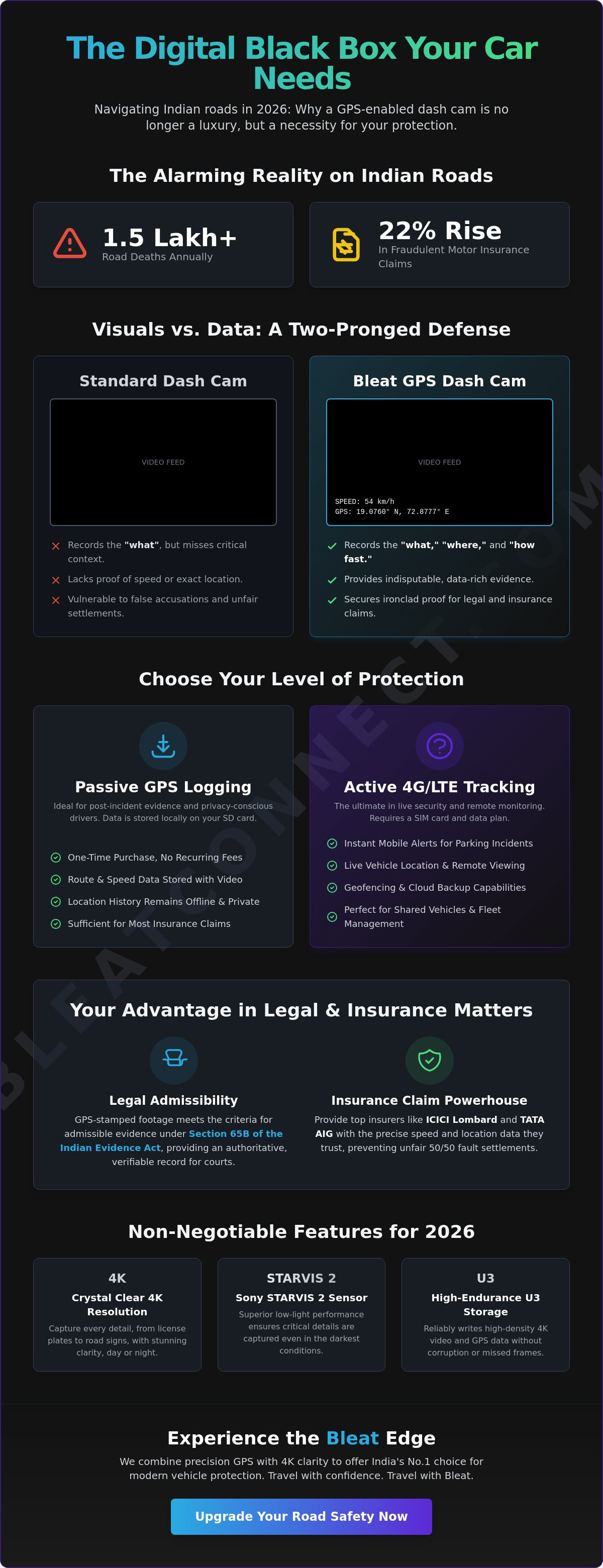
With over 1.5 lakh road deaths annually and a 22% rise in fraudulent motor insurance claims reported in late 2025, your car needs more than just a lens. It needs a high-precision black box. A standard camera records the "what," but a premium dash cam with gps records the "where" and "how fast" with absolute authority. This data is no longer a luxury. It is a critical requirement for navigating the legalities of the Digital Personal Data Protection Act 2023 and ensuring your footage is admissible under Section 65B of the Indian Evidence Act.
You likely feel the daily pressure of Indian traffic and the fear of being wrongly blamed for an accident you didn't cause. We agree that protecting your family and your vehicle should be simple, not a technical chore. This guide promises to clear the confusion between GPS logging and real-time tracking while showing you how to secure ironclad proof for insurers like ICICI Lombard or TATA AIG. We will preview the latest 4K Starvis2 technology, explain how to handle data privacy, and help you choose the ultimate smart companion for your journey. It's time to upgrade your road safety and travel with Bleat, India's No.1 name in connected protection.
Key Takeaways
- Learn why a dash cam with gps is your most powerful tool for providing the speed and location stamps that top Indian insurers trust during claims.
- Distinguish between passive GPS logging and active 4G connectivity to determine which tracking level fits your vehicle's security requirements.
- Master the legal mandates of Section 65B to ensure your GPS-stamped footage serves as admissible evidence in Indian courts.
- Identify why 4K resolution and U3-rated storage are non-negotiable for capturing the high-density data needed for smart road safety in 2026.
- Explore how Bleat’s integrated ecosystem combines precision GPS with 4K clarity to offer India’s No.1 choice for modern vehicle protection.
What is a Dash Cam with GPS and Why is it Essential?
A modern dash cam with gps is much more than a simple video recorder. It is a high-precision digital black box for your vehicle. By integrating satellite-based telemetry directly into your video files, these devices record your exact longitude, latitude, and speed in real-time. In 2026, basic loop recording is no longer enough to navigate the complexities of Indian roads. You need a device that provides an indisputable record of your journey, ensuring you have the "where" and "how fast" to back up the "what" captured on camera. This is the difference between a gadget and a professional safety tool.
The evolution of car security has shifted from grainy 1080p visuals to data-rich 4K environments. While a standard Dashcam might show a collision, it often acts as an "Invisible Witness" because it lacks the context of speed and location. Without this data, you might face false accusations of speeding or find it impossible to prove you were in a specific lane during a highway incident. High-precision telemetry is now the gold standard for road safety, providing the technical weight needed for legal and insurance verification.
The Core Components of a GPS-Enabled Camera
Reliable data starts with high-sensitivity chipsets. These modules are designed for rapid satellite acquisition, often locking onto a signal in under 30 seconds. This speed is critical for maintaining accuracy when driving through urban canyons or immediately after exiting tunnels. Bleat devices utilize integrated internal modules to maintain a sleek profile while delivering cutting-edge signal stability. Key technical features include:
- Synchronized Metadata: Speed and coordinates are stamped directly onto 4K footage frames for immediate verification.
- High-Sensitivity Chipsets: Ensures consistent tracking even in high-density metro areas like Mumbai or Bangalore.
- Precision Mapping: Pairs with mobile apps to visualize your entire travel route on a digital map.
Visuals vs. Data: A Two-Pronged Defense
Visual evidence alone can be deceptive. Wide-angle lenses often distort perceived distances, making a tailgating car look further away than it actually is. A dash cam with gps solves this by providing a secondary layer of objective proof. If an accident occurs, your speed log proves you were adhering to traffic laws, while the G-Sensor ensures the footage is immediately locked and protected from being overwritten. This dual approach is essential for preventing unfair 50/50 fault settlements by insurance companies. It provides the technical clarity needed to protect your license and your finances. Travel with Bleat and experience the peace of mind that comes with India's No.1 smart tracking technology.
GPS Logger vs. Real-Time GPS Tracking: Choosing the Right Tech
Choosing the right hardware depends entirely on your specific security goals. You don't always need a live data connection to benefit from a dash cam with gps. For many drivers, a passive GPS logger provides the essential evidence required for legal disputes without the recurring cost of a data plan. However, if you manage a fleet or frequently lend your vehicle, active 4G/LTE connectivity offers a superior level of remote oversight. Understanding this technical divide ensures you invest in the features that actually enhance your lifestyle. It's about matching the technology to your daily driving reality.
How GPS Logging Works
GPS logging is a passive system. It records your coordinates and speed directly to the microSD card alongside your video files. You can retrieve this data later using a desktop player to view your route on a map next to the footage. This is a one-time purchase with no hidden fees. It's the ideal choice for privacy-conscious users who want to keep their location history offline. Citing the benefits of using a dash cam, major publications emphasize that having this data stored locally is often sufficient for verifying insurance claims after a road incident. It provides the "where" and "how fast" without requiring a constant internet connection.
The Power of Real-Time 4G Tracking
Active tracking requires a SIM card and a monthly data subscription. This technology transforms your camera into a live security hub. You get instant mobile alerts if your car moves while parked, which is a critical feature given the 22% rise in fraudulent motor insurance claims reported in late 2025. Geofencing allows you to set virtual boundaries; if the car crosses them, your phone rings immediately. Cloud backup is another major advantage. In the event of a severe crash, the camera uploads the clip to the cloud instantly. This prevents data loss if the device is damaged or the SD card is tampered with during the incident.
Daily commuters usually find a GPS logger perfectly adequate for personal protection. It provides the speed stamps needed to avoid "50/50 fault" settlements during traffic disputes. For those needing maximum connectivity, a 4G-enabled system is the ultimate upgrade for total vehicle control. To find the right balance of performance and data security, you can explore the latest smart dash cam options from India's No.1 brand. Whether you choose passive logging or active tracking, ensure your device supports high-endurance U3 cards to handle the dense data streams of 4K recording. Travel with Bleat and stay connected to what matters most on the road.
Legal and Insurance Benefits of GPS Evidence in India
Indian roads are notoriously unpredictable. With 1.5 lakh road deaths reported annually and a 22% rise in fraudulent motor insurance claims as of late 2025, a visual record is no longer sufficient. You need a digital shield that carries legal weight. A dash cam with gps provides this by embedding immutable telemetry data into your 4K footage. This isn't just about recording a crash; it's about providing the procedural mandates required under Section 65B of the Indian Evidence Act. When your footage includes precise speed and location stamps, it transforms from a simple video into high-integrity evidence that law enforcement and courts can verify with absolute confidence.
The "Speeding Trap" defense is a primary reason for the surge in GPS adoption. It's common for drivers to be falsely accused of overspeeding during a traffic dispute. Without data, it's your word against theirs. With a GPS-integrated system, you have a real-time log proving you were within legal limits at the exact second of the incident. This level of transparency is why top insurers like ICICI Lombard, TATA AIG, and Bajaj Allianz now accept dash cam footage to expedite claims. By removing the ambiguity of "50/50 fault" settlements, you protect your No Claim Bonus (NCB) and ensure your insurance premiums don't skyrocket due to someone else's negligence.
Simplifying the Claims Process
Insurance adjusters prioritize objective data. A dash cam with gps allows you to generate a comprehensive incident report that includes a digital map of the accident site. This is particularly vital for proving non-involvement. If a claim is filed against you for a hit-and-run, your GPS logs can prove your vehicle was stationary or in an entirely different sector at the time of the reported event. This data-driven approach slashes the time spent in premium disputes and provides a clear record of your safe driving habits.
Deterring Theft and Vandalism
Visibility is the first line of defense. A visible, high-tech dash cam acts as a powerful psychological deterrent for potential thieves. When paired with an active GPS system, the protection extends even when you aren't in the car. Parking mode utilizes the G-Sensor to trigger recordings during a hit-and-run, while the GPS tracks the exact location of the event. In the unfortunate case of vehicle theft, live tracking becomes your most valuable asset for rapid recovery. You can provide real-time coordinates to local authorities, significantly increasing the chances of a successful retrieval. Travel with Bleat and leverage India's No.1 security ecosystem to stay one step ahead of road harassment and vehicle crime.
What to Look for in the Best GPS Dashcam
Resolution isn't just a marketing gimmick. In 2026, capturing high-speed incidents at 80 km/h requires the 3840 x 2160 precision of a 4K sensor. This allows you to zoom into license plates without losing the digital integrity of the GPS speed stamp. A dash cam with gps that lacks 4K clarity often fails when you need to identify a vehicle in a hit-and-run scenario. High resolution ensures that every coordinate and speed reading is paired with a crystal-clear visual, creating a comprehensive evidence package that stands up to scrutiny.
Storage and connectivity are equally critical. Data-rich 4K files combined with continuous GPS logging demand high-endurance U3 microSD cards. These cards are designed to handle the rapid write speeds required for modern telemetry. To manage these large files, look for devices with 5GHz Wi-Fi. This standard is roughly three times faster than traditional 2.4GHz connections, allowing you to download incident footage to your smartphone in seconds. Efficiency matters when you're on the side of the road and need to share data with authorities immediately.
Durability is a non-negotiable factor for Indian drivers. Standard lithium-ion batteries often fail or swell when exposed to 50°C Indian summer temperatures. You should prioritize super-capacitor models. These components are engineered to withstand extreme heat and provide a reliable power-down sequence, ensuring your last GPS coordinate is saved even if the power is cut during a collision. It's the difference between a gadget that works in a lab and a safety tool that works in the real world.
Advanced Features for 2026
Modern sensors like Sony Starvis 2 have revolutionized night vision by enhancing dynamic range. This ensures your GPS data is paired with clear footage even on unlit rural highways. Furthermore, GPS enables Advanced Driver Assistance Systems (ADAS). By analyzing your real-time position and speed, the camera can provide lane departure warnings and forward collision alerts. Voice control rounds out the smart experience, letting you lock a video file or toggle the microphone without taking your hands off the wheel. Safety should always be hands-free.
Installation and Power Management
The best hardware is only effective if it's powered correctly. Many users worry about complicated DIY setups, but OBD-based connectivity solutions offer the cleanest installation path. This method draws power directly from your vehicle's diagnostic port, avoiding the need to cut any factory wires. For 24/7 protection, use a hardwiring kit with built-in battery discharge protection. This allows your dash cam with gps to monitor your car in parking mode without draining your battery. Ready to upgrade your vehicle's intelligence? You can view India's No.1 dash cam lineup to find the perfect fit for your car. Travel with Bleat and experience the peak of connected road safety.
Experience the Bleat Edge: 4K Clarity Meets Precision GPS
Bleat is more than a brand. It is a standard for the modern Indian traveler. As the market for vehicle security is projected to exceed $350 million by 2032, the need for integrated intelligence has never been higher. The Bleat 4k car dashcamera represents the pinnacle of this shift. It combines 8.29-megapixel visual precision with high-velocity GPS tracking to create a seamless safety net. This is why we are India's No.1 choice for drivers who refuse to compromise on digital well-being. We don't just sell gadgets. We provide essential upgrades for a connected lifestyle.
Our smart ecosystem transforms how you interact with your vehicle data. Most cameras treat GPS as an afterthought, but we treat it as a core pillar of your defense. Through the Bleat app, you can manage your travel logs and 4K footage with a single tap. This connectivity allows you to overlay your exact route onto high-definition video, making it easy to share precise incident reports with insurers or family members. It is about total control. Whether you are using our flagship 4K model or the Bleat 3k car dashcamera, you are backed by an innovative design built for the rigors of national travel. You join a community of thousands of protected drivers across the country. Travel with Bleat and experience the confidence of owning cutting-edge technology.
Why Bleat 4K Leads the Market
Bleat leads through technical superiority and user-centric innovation. Our dash cam with gps features high-sensitivity logging that stays accurate even in the dense traffic of Tier-1 cities. We understand that Indian drivers value efficiency. That is why we pioneered OBD based Connectivity. This allows for a professional-grade setup that is entirely DIY-friendly. You don't need to cut wires or risk your car's warranty. You simply plug in and secure your journey. Our smart ecosystem enhances your digital lifestyle by ensuring your safety tools work in harmony with your smartphone and your habits.
Reliability You Can Trust
Road conditions in India demand hardware that can handle heat, vibration, and dust. Every Bleat device undergoes rigorous testing to ensure thermal stability during 50°C summers and peak performance on rugged highways. We back our hardware with comprehensive after-sales support, ensuring every tech owner has a reliable expert to turn to. We are passionate about your protection. Don't settle for "good enough" when it comes to your road safety evidence. Upgrade your vehicle security with the Bleat 4K Dashcam today and secure your place in the future of smart driving. It is time to protect your vehicle with the precision it deserves.
Take Command of Your Road Safety
Road safety in 2026 is no longer about luck; it's about leveraging high-precision data. You now understand how a dash cam with gps acts as an immutable digital witness, providing the speed and location stamps required for Section 65B legal compliance. By choosing between passive logging and active 4G tracking, you've taken the first step toward preventing fraudulent claims and ensuring rapid insurance settlements. Don't let your safety be a matter of debate when you can have 4K proof at your fingertips.
Bleat provides the ultimate edge with India's No.1 tech ecosystem. Our devices combine 4K Ultra-HD clarity with Starvis 2 night vision and seamless OBD-based smart connectivity. This ensures your vehicle remains protected even in the harshest conditions. It's time to upgrade your digital lifestyle and drive with the confidence of a professional. Secure your journey with Indias No.1 GPS Dashcam and join thousands of drivers who trust our cutting-edge protection. Your next journey deserves the best companion. Travel with Bleat and stay ahead of the curve.
Expert Answers to Common GPS Dashcam Questions
Does a GPS dashcam require a monthly subscription fee?
No, a standard dash cam with gps does not require a monthly fee for basic satellite logging. The camera records speed and coordinate data directly onto your microSD card for free. However, if you choose a 4G-enabled model for real-time remote tracking and cloud backups, you will need a SIM card with an active data plan from a provider like Jio or Airtel.
Can I turn off the speed display on my GPS dashcam footage?
Yes, you can toggle the speed stamp off through the camera's settings menu or the mobile app. Many drivers prefer to record the data in the background metadata while keeping the visual video clean. This allows you to provide the speed evidence to authorities only when necessary while maintaining a more cinematic 4K view for your travel vlogs.
Is the GPS data accurate enough to be used as evidence in court?
Modern GPS modules with a 5Hz or 10Hz refresh rate provide high-precision data that is widely accepted in legal proceedings. To ensure admissibility, your footage must remain untampered and follow the procedural requirements of the Indian Evidence Act. The precision of these coordinates is accurate within 2 to 5 meters, making them a reliable record of your exact vehicle position during an incident.
How does a GPS dashcam handle areas with poor satellite reception?
High-sensitivity chipsets are designed to maintain a signal lock even in "urban canyons" or under heavy tree cover. If you enter a basement or a long tunnel, the dash cam with gps will typically show your last known coordinate until you exit. Most premium modules reacquire a satellite lock within 10 to 15 seconds of regaining a clear view of the sky.
What is the difference between built-in GPS and a GPS-ready dashcam?
Built-in GPS means the satellite receiver is integrated directly into the camera's housing for a sleek, wire-free setup. A "GPS-ready" camera has the software capability but requires you to purchase and plug in an external antenna module. Bleat focuses on internal modules to ensure a cleaner aesthetic and a faster DIY installation process for all vehicle types.
Will a GPS dashcam drain my car battery when the engine is off?
Your battery will remain safe if you use a smart power management system. When using our OBD-based connectivity, the camera monitors the vehicle's voltage in real-time. If the battery level drops below a safe threshold, typically 11.8V or 12V, the system automatically cuts power to the camera. This ensures your car always has enough energy to start the next morning.
Can I track my car in real-time with a basic GPS logger dashcam?
No, a basic GPS logger only records data for post-incident review on a computer or smartphone. Real-time tracking is a premium feature that requires an active 4G/LTE connection to transmit live location data to your phone. If your goal is to monitor your car's live movement from a distance, you must choose a model with cloud connectivity and a SIM slot.
How do I view the GPS route data recorded by my Bleat dashcam?
Viewing your data is simple via the Bleat mobile app or our dedicated desktop player. Simply connect your smartphone to the camera's 5GHz Wi-Fi to see your speed and route overlayed on a map instantly. For a deeper analysis, insert the microSD card into your computer to view synchronized 4K video alongside a detailed Google Maps travel log. Travel with Bleat and keep your journey data organized with a single tap.