

Dash Cam Placement Laws in India 2026: The Ultimate Compliance Guide
Bleat
With fraudulent motor insurance claims in India rising by 22%, your dash cam is no longer a luxury; it's your most reliable witness. However, failing to understand dash cam placement laws India mandates can quickly turn your safety tech into a legal liability. If your device obstructs your line of sight or violates the Motor Vehicle Act, you're risking heavy fines and compromising the admissibility of your footage in court.
It's stressful to deal with the ambiguity of the law or the fear of having your memory card seized at a checkpoint. You need the security of an expert, compliant setup that protects you without attracting the wrong attention. This guide helps you master the "Invisible Install" to keep your road safety tech 100% legal. We'll break down the specific safe zones for mounting your Bleat 4k car dashcamera, explain how the DPDP Act 2023 affects footage sharing, and give you the confidence to use your recordings for insurance settlements. Master the legal nuances today and ensure your journey remains connected and protected.
Key Takeaways
- Identify the "Safe Zone" behind the rear-view mirror to ensure your setup remains 100% compliant with dash cam placement laws India.
- Navigate the nuances of the DPDP Act 2023 to understand your rights regarding public recording and digital privacy.
- Avoid "Dangerous Driving" fines by mastering clean cable routing to eliminate visibility obstructions and dangling wires.
- Learn how the ultra-compact design of Bleat 4k car dashcameras ensures an "Invisible Install" that preserves your full field of view.
- Understand the legal admissibility of high-resolution footage for accelerating insurance claims and proving innocence in traffic disputes.
Are Dash Cams Legal in India? Understanding the 2026 Legal Framework
As of May 2026, no specific provision in Indian law prohibits the installation of a dashboard camera in private vehicles. You're legally permitted to record your journey for safety and security. However, the legality of your device depends entirely on how it's installed. While the camera itself is legal, improper mounting can lead to fines under the Motor Vehicles Act, 1988. Specifically, Section 177 acts as a catch-all for "dangerous driving" and "obstruction of view" violations. If your setup blocks your line of sight, a legal tool becomes a liability.
The Ministry of Road Transport and Highways (MoRTH) has increasingly recognized the value of these devices. Notification G.S.R. 575(E) legitimizes dash cams as electronic enforcement tools, provided they don't impede the driver’s control. You can record freely on public highways and city streets. Just remember that restricted government zones, military installations, and certain high-security areas remain off-limits for filming. Your right to record ends where national security begins. Outside of those zones, your camera serves as a tech-forward protector for every kilometer you drive.
The Motor Vehicles Act and "Clear Vision" Standards
Decoding dash cam placement laws India requires a deep dive into "clear vision" standards. The law demands that a driver must have an unobstructed view of the road at all times. Traffic police often interpret large suction mounts or bulky devices placed directly in the driver's line of sight as a safety hazard. If a mounting bracket creates a significant blind spot, you're technically in violation of Section 177. Compliance is defined as the absence of a "blind spot" created by the device. Modern, compact hardware like the Bleat 4k car dashcamera is engineered to minimize this footprint, ensuring you meet these visibility requirements without sacrificing recording quality.
Dash Cams as Admissible Evidence in Indian Courts
Recording is only half the battle; the footage must be legally sound to protect you. Under Section 65B of the Indian Evidence Act, digital recordings are admissible in court as secondary evidence. This makes your dash cam an essential upgrade for settling disputes quickly. High-resolution 4K footage provides the clarity needed to identify license plates and facial features, which can significantly accelerate insurance claim settlements. To maintain the validity of your evidence, always keep the unedited, original files on the memory card. Any digital tampering or editing can render the footage useless in a legal setting. A reliable Bleat 3k car dashcamera provides the timestamped, high-fidelity data points required to prove your innocence during road incidents.
The Safe Zone: Best Dash Cam Placement for Legal Compliance
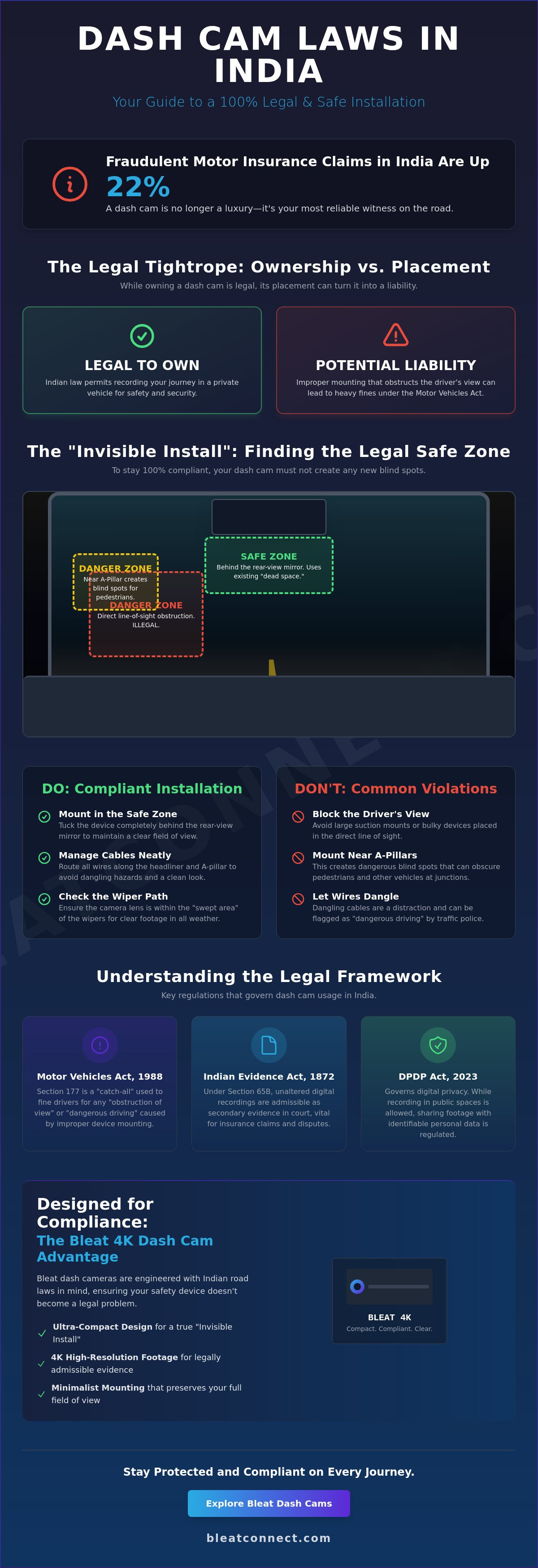
Achieving total legal compliance starts with the "Invisible Install." While Indian regulations don't specify coordinates, the safest legal harbor is directly behind the internal rear-view mirror (IRVM). This placement utilizes the "dead space" already blocked by the mirror from the driver's perspective. By tucking your device here, you ensure it doesn't create new blind spots, keeping you on the right side of dash cam placement laws India enforcement. Traffic police prioritize a clear field of view; if they can't see the camera from your seated position, it's unlikely to be flagged as an obstruction.
Placement choice often comes down to the windshield versus the dashboard. Dashboard mounts might seem convenient, but they frequently reflect the sun's glare and can block your view of the car's hood or low-lying obstacles. Windshield mounting is superior, provided you avoid the A-Pillars. Mounting a camera near the A-Pillar creates a dangerous diagonal blind spot that obscures pedestrians at junctions. RTO officers specifically look for these violations during routine checks. For a truly compliant setup, choose a compact device like the Bleat 4k car dashcamera, which is designed to disappear behind your mirror while capturing every detail.
Don't ignore the "Wiper Path" factor, especially during the intense Indian monsoon. If you mount the camera too high or in a corner where the wipers don't reach, your 4K footage becomes a useless blur of raindrops during an accident. Legally, blurry footage is harder to authenticate in court. Always ensure the lens sits within the "swept area" of your windshield wipers to maintain crystal-clear evidence regardless of the weather.
Step-by-Step Compliant Mounting Strategy
Precision installation prevents legal headaches. Follow these steps to ensure your mounting is functional and compliant:
- The 4-Inch Rule: Position the lens within the top 4 inches of the windshield, ideally within the area of the manufacturer's tint strip if one exists.
- Centering for FOV: Center the device to maximize its 140-170 degree field of view, ensuring both front fenders are visible in the frame.
- The Seated Test: Sit in the driver’s seat and adjust your position. If any part of the camera body is visible beyond the IRVM's silhouette, move it higher.
Rear Dash Cam Placement and Privacy
Rear-facing cameras require a different legal strategy. In hatchbacks, mount the camera on the glass just below the high-mount stop lamp. For sedans, the top center of the rear windshield is ideal. Ensure the unit doesn't obstruct your view through the internal mirror; a blocked rear view is a punishable offense. While trailing drivers might claim "privacy invasion," recording in public spaces for safety is legally protected in India. As long as your rear camera is focused on the road and not peering into other vehicles' cabins, you're within your rights.
Privacy Laws and the DPDP Act: Recording vs. Sharing Footage
While dash cam placement laws India focus on your physical setup, the Digital Personal Data Protection (DPDP) Act 2023 governs the digital data your device captures. As of May 2026, this legislation is in a critical implementation phase. It's no longer just about where you mount the camera; it's about how you manage the resulting data points. For the modern driver, the DPDP Act acts as a regulatory framework that balances your need for security with the privacy rights of others on the road. Understanding this distinction is vital to staying protected from both road accidents and legal litigation.
Recording on Indian roads is generally protected under the "Public Space" doctrine. Since license plates and vehicle movements occur in plain view, there is a lower expectation of privacy for those captured in your 4K frame. However, internal audio recording is a different beast. If you're a taxi or ride-share operator, you must provide clear notice to passengers that audio is being recorded. In private vehicles, recording conversations without the consent of your passengers can lead to civil privacy claims. Always prioritize transparency to maintain your status as a tech-savvy protector of your vehicle's digital ecosystem.
The biggest legal trap lies in "Naming and Shaming." Posting unedited footage of a traffic violator on social media might feel like justice, but it can trigger defamation or privacy lawsuits under the new regulations. If you intend to share footage publicly, you must blur faces and license plates to avoid identifying individuals without their consent. The DPDP Act exempts data processed for personal or domestic use. This means keeping the footage on your device for insurance or personal records is perfectly legal, but broadcasting it to the world requires a much higher standard of data hygiene.
Sharing Footage Safely with Authorities
When an incident occurs, your high-fidelity recordings are your best defense. Most major Indian cities now offer official traffic police apps where you can upload evidence of violations or accidents directly. This is the legally sanctioned method for reporting. If a police officer requests to see your footage on the spot during a traffic stop, you can show them the screen of your device. However, remember your rights: police cannot seize your memory card without a warrant or a specific legal order. Keep your original files secure; they are the core evidence required for Section 65B compliance.
Social Media and Public Privacy Risks
There is a massive legal difference between "Evidence Collection" and "Public Broadcast." Evidence is for courts and insurance companies; broadcasts are for the public. To safeguard yourself, follow these protocols before uploading to social media:
- Anonymize the Subject: Use video editing tools to obscure identifiable human features.
- Mask the Plate: License plates are considered personal data in many legal interpretations; mask them to prevent harassment claims.
- Context over Identity: Focus the narrative on the driving behavior rather than the individual driver.
By following these steps, you leverage the power of your Bleat 4k car dashcamera as a safety tool without crossing into the territory of digital harassment.
Installation Best Practices: Cables, Hardwiring, and Warranty
A messy installation isn't just an eyesore; it's a legal liability. Many drivers leave cables hanging from the mirror directly to the 12V socket. This creates a physical obstruction that traffic officials often categorize as "Dangerous Driving." Under the same dash cam placement laws India that govern device mounting, a dangling wire can be cited as a safety hazard. It can snag your gear shifter or block your view of the instrument cluster during critical maneuvers. You must ensure every centimeter of cable is secured and hidden from view.
Tucking cables is the gold standard for a compliant, "Invisible Install." Start from the device and push the wire into the gap between the headliner and the windshield. Follow the roofline to the A-pillar. Here, you must exercise extreme caution. Modern Indian cars often house side-curtain airbags within the A-pillar trim. Never run a cable over the airbag cover. Instead, route it behind the weatherstripping or follow the existing factory wiring looms. This ensures that in an accident, your safety systems deploy without interference from your tech upgrades.
Choosing between a 12V socket and hardwiring depends on your protection needs. The 12V socket is a simple plug-and-play solution, but it occupies your primary charging port and usually shuts off with the engine. Hardwiring is superior for those who want 24/7 parking mode. To do this safely, use "Fuse Taps." These small connectors plug directly into your fuse box without cutting or splicing any original wires. It's a non-invasive method that maintains the electrical health of your vehicle while providing constant power to your sensors.
Protecting Your Vehicle Warranty
Car owners often fear that adding electronics will void their vehicle warranty. In India, the general rule is that as long as you don't cut into the original factory wiring harness, your warranty remains intact. This is why fuse taps and 12V adapters are the preferred choice for new car owners. They are completely reversible and leave no trace if you need to remove the device. If you're looking for hardware that integrates seamlessly with your car's power system without complications, explore the Bleat 4k car dashcamera for a professional-grade setup.
DIY vs. Professional Routing
You don't need an engineering degree for a compliant install, but you do need the right tools. A simple plastic pry tool and a few adhesive cable clips are essential for a clean finish. These tools help you seat the wire deeply into the trim without scratching your dashboard or damaging the headliner. A professional-looking installation doesn't just look better; it reduces scrutiny from traffic officials. When your setup looks like a factory-fitted component, it signals that you are a responsible driver who prioritizes both safety and legal compliance. Focus on a clean, tucked finish to ensure your road safety tech remains a silent, legal guardian.
Bleat 4K Dash Cams: Designed for Indian Road Compliance
Hardware design is the final piece of the legal compliance puzzle. While bulky competitors struggle with "unobstructed view" requirements, the Bleat 4k car dashcamera features an ultra-compact form factor. It disappears behind your internal rear-view mirror. This ensures you stay perfectly aligned with dash cam placement laws India standards without sacrificing sensor size or processing power. A smaller footprint means zero blind spots and zero reasons for traffic officials to flag your setup during a routine check. It's the ultimate "Invisible Install" for the modern driver.
Indian road conditions demand more than just standard electronics. Our high-temperature resistance prevents mounting failure during extreme summers. A camera that falls off the windshield becomes a dangerous projectile and a legal violation under dangerous driving rules. Bleat devices are engineered to stay secure when the mercury rises. Beyond physical stability, the 4K clarity transforms vague shapes into legally admissible evidence. You won't just see a car; you'll capture the exact license plate digits required for insurance claims and court proceedings. Every pixel serves as a digital witness for your protection.
Retrieving footage shouldn't be a struggle during a roadside crisis. Seamless app integration allows for fast footage retrieval on-the-spot. Whether you're proving your innocence to an officer or documenting a fender bender, your evidence is seconds away on your smartphone. This instant connectivity is the hallmark of a tech-savvy protector. It ensures that your road safety tech remains a functional tool rather than a forgotten gadget. With a Bleat 3k car dashcamera or 4K model, you're always one tap away from total legal transparency.
Why Bleat 4K is the Professional Choice
Proprietary hardware minimizes the windshield footprint while maximizing your protection. Loop recording ensures you never run out of storage space, while G-sensor technology automatically locks files during a collision. This preserves your legal evidence from being accidentally overwritten. With a 170° wide-angle lens, you capture the full road perspective without the fish-eye distortion that can confuse legal analysis. It's a professional-grade solution built for the complexity of Indian traffic.
Your Next Step for Road Safety
Choosing a brand that understands the nuances of Indian roads is essential. Bleat supports your journey from the moment of purchase through to a compliant installation by providing hardware that naturally fits within legal "Safe Zones." Our tech enhances your lifestyle by providing security, connectivity, and peace of mind. Don't leave your legal standing to chance with bulky, inferior hardware that blocks your view. Take control of your road safety with the market leader in intelligent vehicle protection.
Upgrade to Bleat 4K for legally-compliant, high-definition road protection
Take Command of Your Road Safety Today
You now have the blueprint for total compliance. By mastering the "Invisible Install" behind the rear-view mirror and adhering to the DPDP Act's privacy standards, you shield yourself from both road hazards and legal scrutiny. Staying informed about dash cam placement laws India is the first step toward a safer, more connected lifestyle. You've learned how to eliminate dangling wire risks and why high-resolution 4K footage is essential for admissible court evidence.
Don't settle for bulky hardware that compromises your visibility. Join over 10,000+ Indian drivers who trust our 4K Ultra-HD Sony Sensor technology to capture every critical detail. Our proprietary hardware is specifically designed for extreme Indian weather conditions, ensuring your protection never fails. It's time to upgrade your vehicle with a companion that is as intelligent as it is reliable.
Secure your drive with the Bleat 4K Dash Cam; Legal, Compact, and Powerful
Drive with the confidence of a tech-savvy protector on every journey you take.
Frequently Asked Questions
Is it illegal to have a dash cam in India?
No, it is entirely legal to own and operate a dash cam in India for both private and commercial vehicles. No specific provision in the Motor Vehicles Act 1988 prohibits these devices. However, you must ensure the camera is installed in a way that doesn't obstruct your view of the road. Compliance depends on keeping your windshield clear to satisfy safety standards.
Can the Indian police seize my dash cam memory card?
Indian police cannot seize your memory card without a specific legal order or a warrant. If an officer asks to see the recording during a traffic stop, you can show the footage directly on the device's screen or via your smartphone app. Always keep your original memory card secure; it's your primary piece of evidence for legal or insurance disputes.
Does a dash cam void my car warranty in India?
A dash cam won't void your vehicle warranty as long as you use a non-invasive installation method. Avoid cutting, splicing, or tampering with the original factory wiring harness. Using a 12V power socket or a fuse tap ensures your car's electrical integrity remains intact. Most dealerships accept these "plug-and-play" setups without any impact on your warranty coverage.
Where is the best place to mount a dash cam to avoid fines?
The best location is directly behind the internal rear-view mirror to satisfy dash cam placement laws India visibility requirements. This placement uses the mirror's existing silhouette to hide the camera from the driver's direct line of sight. Ensure the lens sits within the swept area of your windshield wipers. This ensures your 4K evidence remains crystal clear during the heavy Indian monsoon.
Is audio recording in a dash cam legal in India?
Audio recording is legal, but it's subject to the privacy expectations of your passengers. In commercial vehicles like taxis or ride-shares, you're legally required to provide notice that audio is being captured. For private cars, informing your guests is a best practice to avoid civil privacy claims. Transparency ensures you remain a responsible and tech-savvy protector of your vehicle's environment.
Can I use dash cam footage to challenge a traffic challan?
Yes, you can use high-resolution footage to challenge a traffic challan through official police apps or in court. Digital recordings are admissible as secondary evidence under Section 65B of the Indian Evidence Act. Timestamped 4K footage provides the undeniable data points needed to prove your innocence or highlight errors in a manual traffic citation.
Do I need to inform passengers that I am recording inside the car?
You should inform passengers if your device records the cabin interior, particularly for audio. While the DPDP Act 2023 provides exemptions for personal and domestic use, transparency prevents potential disputes. A simple verbal mention or a small notification sticker is sufficient to meet ethical standards. This practice protects your digital well-being and maintains trust with those you carry.
Is it legal to post dash cam footage of accidents on YouTube in India?
Understanding dash cam placement laws India is only the first step; you must also follow digital privacy rules when sharing footage online. It's legal to post recordings only if you anonymize identifiable personal data like faces and license plates. Under the DPDP Act, failure to blur these details could lead to defamation or privacy lawsuits. Always edit your videos to focus on the incident rather than the individuals involved.