

Dash Cam Evidence Admissibility in Indian Court: The 2026 Legal Guide
Bleat
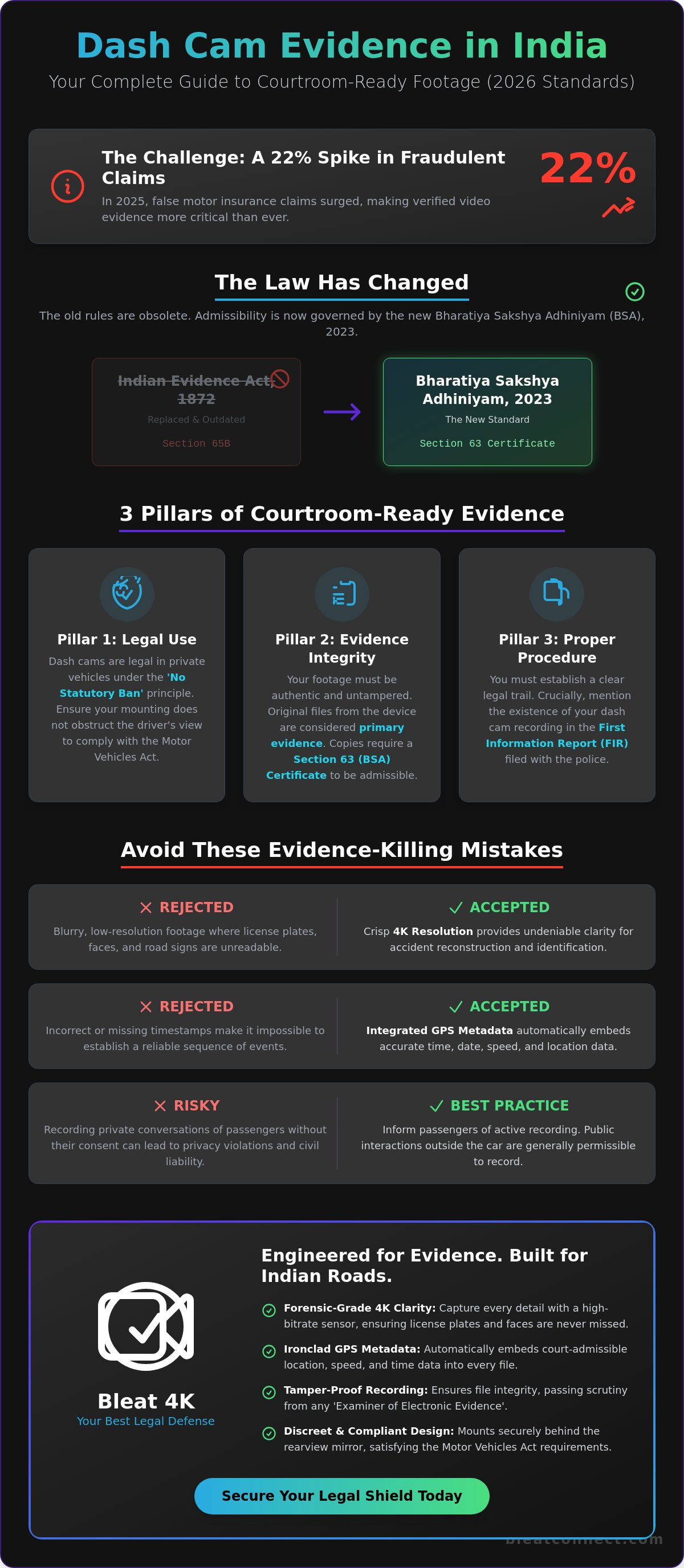
In 2025, fraudulent motor insurance claims in India spiked by 22%, leaving thousands of honest drivers to pay for accidents they didn't cause. If you're relying on video to protect your assets, understanding dash cam evidence admissibility in Indian court isn't just a tech hobby; it's a legal necessity. You've likely felt that surge of anxiety during a near-miss, wondering if your word would stand up against a false accusation or a rejected insurance claim.
The transition to the Bharatiya Sakshya Adhiniyam (BSA) 2023 has fundamentally shifted how digital records are treated. We'll help you master these latest regulations so your Bleat 4K car dashcamera serves as an ironclad shield rather than just a gadget. This guide provides a clear roadmap through the Section 63 (BSA) certificate requirements, ensuring your high-resolution footage meets the 2026 standards for primary evidence.
We'll break down the actionable steps to keep your files courtroom-ready and explain why 4K clarity is now the baseline for legal protection. Your journey deserves a tech-savvy protector that bridges the gap between recording a moment and winning a legal battle. It's time to transform your dash cam from a passive observer into a professional witness.
Key Takeaways
- Confirm that dash cam usage remains fully legal for private vehicles in India under the latest 2026 'No Statutory Ban' principle.
- Master the transition to Section 63 (BSA) certificates to ensure dash cam evidence admissibility in Indian court under the new legal framework.
- Avoid common pitfalls like blurry footage or incorrect timestamps that lead to evidence being rejected by judges or insurance providers.
- Learn the precise method for mentioning digital recordings in your First Information Report (FIR) to establish a clear legal trail.
- Discover how 4K resolution and integrated GPS metadata from a Bleat 4K car dashcamera provide the technical weight needed for accident reconstruction.
The Legal Status of Dash Cams on Indian Roads in 2026
As of June 2026, Indian road regulations remain clear: no statutory law prohibits the installation or use of dash cameras in private vehicles. This "No Statutory Ban" principle is the foundation of your digital defense. While some drivers worry about legal gray areas, the reality is that the government hasn't restricted these devices. Instead, the legal focus has shifted toward how you use the data. Establishing dash cam evidence admissibility in Indian court begins with understanding that your right to record the public road is protected. This is your digital defense.
This protection stems from the fact that road recording doesn't typically violate the "Right to Privacy" under Article 21. Public roads are, by definition, public spaces where there's no reasonable expectation of total privacy. Historically, the Indian Evidence Act, 1872 laid the groundwork for evidence, but the new BSA 2023 regulations have modernized the process for the digital age. Your recordings are now recognized as essential electronic records, provided you follow specific technical guidelines. Tech-forward drivers use this to their advantage.
Obstruction of View and Traffic Compliance
Legal status doesn't mean you have total freedom in placement. Placement matters. Section 125 of the Motor Vehicles Act 1988 prohibits any obstruction that hinders the driver's control or view. If a traffic officer deems your camera setup a hazard, you could face fines. Bulky, poorly mounted units are often the culprit. We recommend choosing professional-grade, compact designs like the Bleat 4k car dashcamera. These units sit discreetly behind the rearview mirror, ensuring a clear line of sight. Always mount your device within the "wiped" area of the windshield to maintain visibility during rain, but keep it outside the primary field of vision.
Audio Recording and Privacy Concerns
Recording the road is one thing; recording conversations inside the cabin is another. While dash cam evidence admissibility in Indian court is usually centered on the video of the crash, audio can be a double-edged sword. Legally, you don't need consent to record public interactions outside the car. However, recording private conversations of passengers without their knowledge can lead to civil liability. Best practices involve placing a small notification sticker on the window or informing guests that the vehicle is equipped with active recording for safety. By being transparent about your tech-forward security measures, you turn a potential liability into a trust signal. Your dash cam is a lifestyle upgrade that protects everyone inside the vehicle.
Admissibility Under the Bharatiya Sakshya Adhiniyam, 2023
The legal environment for drivers changed forever on July 1, 2024. The Bharatiya Sakshya Adhiniyam, 2023 (BSA) replaced the outdated Indian Evidence Act, 1872, bringing digital records into the modern era. While many outdated guides still reference Section 65B, they're providing obsolete advice. Today, dash cam evidence admissibility in Indian court is governed by the BSA, which gives electronic records the same evidentiary weight as physical paper documents. This is a total overhaul that recognizes the digital reality of 2026.
Under the BSA, your digital files can be classified as primary evidence if you present the original device or the storage media directly to the court. This is a massive win for tech-forward drivers who want immediate validation of their version of events. If the original isn't available, the footage is treated as secondary evidence, which triggers a strict certification process. Having a high-performance Bleat 4k car dashcamera ensures your files have the resolution and metadata required to survive expert scrutiny.
For high-stakes cases, the court may appoint an 'Examiner of Electronic Evidence'. This expert's role is to verify the file's integrity and ensure no frames were dropped or modified. This level of verification makes the quality of your hardware more important than ever before. Using a device that records consistent, high-bitrate video ensures that forensic analysis doesn't find anomalies that could discredit your defense.
Section 63 Certificate Requirements
The Section 63 certificate is the new legal gatekeeper. This mandatory document must identify the electronic record and describe the process used to create it. It has to be signed by someone in a position of authority over the device. The document confirms that the dash cam was functioning correctly and that the data's integrity remained intact. If you don't provide this certificate, your footage is legally invisible.
Proving Authenticity and Non-Tampering
Indian courts in 2026 analyze 'hash values' and embedded metadata to verify that a video hasn't been digitally altered. To guarantee dash cam evidence admissibility in Indian court, your footage must provide the full context of the event. Continuous loop recording is vital here. It establishes a clear timeline before and after the collision. By presenting the raw, unedited stream, you provide the ironclad proof required under the BSA 2023.
Why Your Footage Might Be Rejected (And How to Prevent It)
Owning the hardware is only half the battle. If your footage fails to meet technical scrutiny, it won't matter how many certificates you sign. Dash cam evidence admissibility in Indian court often hinges on the smallest details. A blurry license plate or a missed second of footage can turn an ironclad defense into a dismissed claim. Precision is your best protection.
Clarity is king. In 2025, standard 1080p dash cams held 55% of the market, but many of these units are now being rejected in legal settings. They fail to capture the high-speed motion of a hit-and-run or the specific facial features of a driver at night. Without clear visibility, your evidence is legally "ambiguous." Judges require certainties, not guesses. If the court can't read the plate of the vehicle that hit you, the video loses its primary value.
Reliability challenges often stem from timestamp errors. This is the fastest way to lose a case. If your camera resets to a default date, the opposition will argue the footage is from a different event entirely. Syncing with Indian Standard Time (IST) is non-negotiable. Additionally, you must maintain a clear "Chain of Custody." You must prove the file wasn't tampered with from the moment of the crash to the moment it enters the courtroom. Gaps caused by low-tier SD cards can imply you deleted unfavorable parts of the recording, creating a "reliability" challenge that's hard to overcome.
The Critical Role of Metadata
Metadata is your silent witness. GPS coordinates prove your exact location within meters. This prevents the other party from lying about the intersection where the accident occurred. Speed data is equally powerful. If you're accused of over-speeding, your dash cam's embedded speed log acts as a digital speedometer that's hard to refute. Ensure your device is configured to overlay this data directly onto the video stream for maximum impact.
Hardware Reliability as a Legal Factor
Hardware is your legal insurance. Low-resolution sensors produce digital "noise" that masks license plates. Upgrading to a Bleat 4k car dashcamera provides the pixel density needed for legal clarity. Night vision is another pillar of admissibility. Most accidents happen in low light; if your sensor can't resolve details in the dark, the court won't accept it. G-Sensors add another layer of protection. They detect impacts and "lock" the current file. This ensures your most critical evidence isn't overwritten by the loop recording during the chaos following a collision.
Practical Steps to Secure Admissible Evidence After an Accident
The shock of an impact is intense, but the minutes following a collision are critical for your legal defense. To ensure dash cam evidence admissibility in Indian court, you must act with the precision of a forensic investigator. Treating your digital files as legal assets from the moment of impact prevents the procedural errors that often dismantle accident claims in 2026. Your behavior at the scene is just as important as the resolution of your sensor.
Your immediate priority is stopping the recording cycle. Even with advanced G-sensors, the risk of a loop-recording overwrite remains if the camera stays powered during post-accident discussions or while the vehicle is being towed. Eject the SD card as soon as your vehicle is safely positioned. This creates a "Master Copy" that remains untouched by further system operations, preserving the original hash values required for courtroom verification. Tech-savvy drivers know that preserving the original storage media is the fastest way to achieve primary evidence status under the BSA 2023.
Reporting to the Police and FIR
When law enforcement arrives, your communication must be deliberate. Avoid the common mistake of simply showing the video on your smartphone screen to an officer. While this provides immediate clarity, it doesn't establish a formal legal record and could lead to the unauthorized seizure of your phone. Instead, state explicitly: "My vehicle is equipped with a dash camera that has recorded the incident, and I intend to submit this as evidence."
Ensure the officer records the presence of your dash cam in the panchnama, which is the formal record of the scene. If the police require the physical SD card for the investigation, do not hand it over without a formal seizure memo. This receipt must document the card's brand, storage capacity, and the specific file names related to the incident. Establishing this paper trail early is non-negotiable for maintaining the chain of custody. Without it, the opposition can easily challenge the integrity of your files.
Managing the SD Card and Backups
Redundancy is your best protection in a high-stakes legal battle. Before handing over any physical media to authorities, use the integrated Wi-Fi on your Bleat 4k car dashcamera to sync the incident clip directly to your smartphone. This serves as your "Working Copy" for your legal counsel and insurance provider. While the police hold the Master Copy, your cloud-synced backup ensures you aren't left vulnerable if the physical hardware is misplaced or delayed in forensic processing.
- Eject the SD card: Stop the recording cycle to prevent data loss.
- Declare the tech: Ensure the dash cam is mentioned in the FIR and panchnama.
- Request a memo: Never hand over hardware without a formal seizure receipt.
- Sync instantly: Use mobile apps to create an immediate off-site backup of the collision.
Why Bleat 4K Dash Cams are Your Best Legal Defense
High-quality hardware is the bridge between a recorded incident and a successful legal outcome. To guarantee dash cam evidence admissibility in Indian court, your device must capture details that are beyond dispute. While entry-level cameras provide a general view, they often fail the "forensic test" when license plates or faces appear blurry. Bleat's advanced imaging technology ensures your evidence is clear, credible, and courtroom-ready. It's your digital witness that never blinks.
Our systems aren't just cameras; they are intelligent data recorders. With integrated GPS and G-Sensor technology, every frame is backed by irrefutable metadata. This data proves your location, speed, and the exact moment of impact. In a legal system that now values digital records as primary evidence under the BSA 2023, having this level of technical detail is your strongest defense against false accusations. You don't just tell the court what happened; you show them the data to prove it.
Superior Clarity for Courtroom Verification
Courtrooms demand "clear and convincing" proof. A 4K sensor provides four times the detail of standard 1080p units, allowing you to zoom into distant license plates without losing legibility. This resolution is critical for multi-vehicle collisions where the responsible party might be several meters away. Our industry-leading night vision ensures this protection doesn't end at sunset. Whether it's a poorly lit highway or a dark city alley, the clarity remains consistent. A wide-angle lens captures the full context of the road, leaving no room for the opposition to invent "out-of-frame" scenarios. Precision matters when your reputation is on the line.
Built-in Protection for Critical Files
The moment of impact is chaotic. You shouldn't have to worry about saving files while dealing with an emergency. The Bleat 4K car dashcamera features a precision G-Sensor that detects sudden movements or collisions. It automatically locks the current recording, moving it to a protected folder that loop-recording cannot overwrite. This ensures your most vital evidence is safe from accidental deletion. It's a fail-safe for the modern traveler.
Reliability is a legal factor. Our hardware is engineered to survive the extreme Indian climate, where cabin temperatures can exceed 60 degrees Celsius. Standard electronics often fail or corrupt data under these conditions. Bleat uses high-endurance components and supports professional-grade SD cards to ensure long-term data integrity. Combined with seamless mobile integration for instant cloud backups, you have a tech-forward companion that protects your journey and your legal rights. Secure your digital well-being with the market leader in automotive safety technology.
Command the Road with Legal Certainty
The legal landscape of 2026 demands digital precision. You've seen how the Bharatiya Sakshya Adhiniyam, 2023, has elevated electronic records to primary evidence, provided you follow the Section 63 certification process. From maintaining a strict chain of custody to ensuring your device is synced with Indian Standard Time, every detail counts. Ensuring dash cam evidence admissibility in Indian court is about bridging the gap between high-tech recording and stringent legal requirements.
Don't leave your protection to chance with inferior hardware. Our ecosystem provides 4K Ultra-HD Resolution for undeniable clarity, Integrated GPS Logging for location proof, and G-Sensor Impact Locking to safeguard your most critical files. With India-Wide Support, we're your reliable expert for every journey across the subcontinent.
Secure your legal shield with the Bleat 4K Car Dashcamera today. You're now equipped to turn every drive into a protected, connected, and legally secure experience. Drive safe, knowing your digital witness is always ready.
Frequently Asked Questions
Is dash cam footage allowed in Indian courts under the new BSA 2023 law?
Yes, dash cam footage is fully admissible as an electronic record under the Bharatiya Sakshya Adhiniyam, 2023. The law treats digital files with the same evidentiary weight as physical documents. To maintain dash cam evidence admissibility in Indian court, the footage must be authentic and untampered. It serves as primary evidence if the original device is presented, or secondary evidence if submitted as a certified copy.
Do I need a special certificate to submit dash cam video as evidence?
You must provide a Section 63 (BSA) certificate for any digital footage submitted as secondary evidence. This document identifies the record and describes the device used to create it. It must be signed by a person in a position of authority over the hardware. Without this specific certification, even high-resolution 4K footage may be deemed inadmissible during legal proceedings. It's a critical step for validating your digital defense.
Can the police seize my dash cam after an accident in India?
Police officers have the authority to seize your dash cam or its SD card as part of an ongoing investigation. This usually happens to preserve evidence at the scene of a serious collision. If this occurs, always insist on a formal seizure memo or receipt. This document should detail the device's make and the card's capacity. Establishing this chain of custody ensures your hardware is tracked correctly through the legal system.
Is it illegal to record audio inside my car without telling passengers?
Recording audio inside your vehicle is legally complex and typically requires the consent of your passengers. While recording public roads is permissible, private conversations inside the cabin carry a higher expectation of privacy. To stay protected, it's best to place a small notification sticker on your window. This simple step informs guests they're being recorded, effectively mitigating potential privacy liability and keeping your tech-forward security measures transparent.
Will my insurance company accept dash cam footage for a claim?
Most Indian insurance providers actively encourage the use of dash cam footage to streamline the claims process. With the documented rise in fraudulent motor insurance claims, video evidence provides the clarity needed to resolve disputes quickly. High-resolution footage from a Bleat 4k car dashcamera can prevent claim rejections by proving you weren't at fault. It acts as an undeniable visual record that speeds up your settlement while protecting your no-claim bonus.
Can dash cam footage be used against me if I was at fault?
Yes, dash cam footage is a neutral record of events and can be used against you if it reveals traffic violations. If the police seize the device, all data on the card becomes part of the evidence pool. This is why maintaining legal compliance on the road is essential. However, the same footage often provides the context needed to show that your actions were a necessary response to another driver's negligence.
What features make a dash cam 'court-ready' in India?
A court-ready device must offer high resolution, integrated GPS, and reliable G-sensors. 4K clarity is vital for reading license plates at a distance, while GPS coordinates provide an irrefutable location and speed log. G-sensors are equally important because they automatically lock files during an impact. These features ensure that dash cam evidence admissibility in Indian court is supported by strong metadata and clear visual data that survives expert scrutiny.
Is a front-only dash cam enough for legal protection in India?
While a front-facing camera provides significant protection, a dual-channel system is superior for full legal coverage. Rear-end collisions are common on Indian roads, and a front-only unit might miss the crucial moments leading up to a tailgating incident. Capturing the full 360-degree context of your surroundings provides a more complete narrative for judges. Investing in a multi-camera setup ensures you have a comprehensive shield against every possible angle of accusation.