

Car Dash Camera Front and Rear India: The Ultimate 2026 Safety Guide
Bleat
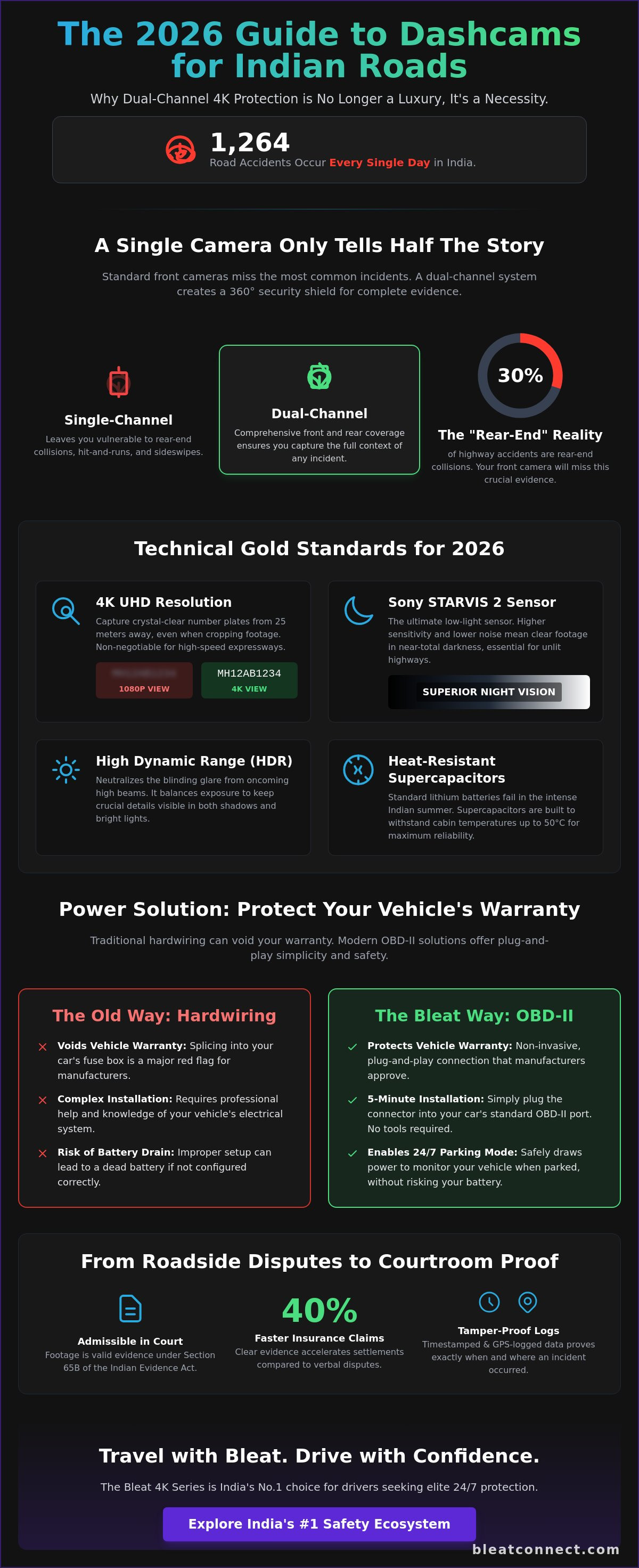
In a country where 1,264 road accidents occur every single day according to the Ministry of Road Transport and Highways, relying on luck is a dangerous strategy. You already understand that Indian traffic is a unique beast. From the blinding glare of high beams on unlit highways to cabin temperatures hitting 50 degrees Celsius, your hardware faces extreme stress. Securing a high-performance car dash camera front and rear india is the only way to guarantee evidence when it matters most.
We're here to help you master the technical essentials of dual-channel protection for 2026. You'll learn how to achieve crystal clear number plate recognition with Starvis2 sensors and secure 24/7 parking protection without risking your vehicle's warranty. This guide breaks down the shift toward OBD-based connectivity and heat-resistant supercapacitors. Travel with Bleat. Discover how to turn every drive into a documented, secure journey with India's No.1 safety ecosystem.
Key Takeaways
- Understand why dual-channel systems are vital for Indian roads, providing essential evidence for the 30% of accidents that occur from behind.
- Identify the technical gold standards, including Sony STARVIS 2 sensors and 4K resolution, for capturing clear footage during high-speed night drives.
- Protect your vehicle’s warranty by switching from traditional hardwiring to modern, non-invasive OBD-II plug-and-play power solutions.
- Ensure your hardware survives the intense Indian summer by choosing supercapacitor-based systems and high-endurance SD cards for maximum durability.
- Explore why the Bleat 4K Series is the top-rated car dash camera front and rear india choice for drivers seeking elite 24/7 protection.
Why Front and Rear Dash Cameras are Essential for Indian Roads
Indian roads are unpredictable. A standard front camera only tells half the story. A dual-channel system records the road ahead and the traffic behind simultaneously, creating a 360-degree security shield. For anyone searching for a car dash camera front and rear india, the goal is total visibility. This setup ensures that whether it's a tailgater on the Mumbai-Pune Expressway or a bumper-to-bumper scrape in Bengaluru, every angle is covered in 4K clarity. It's about capturing the full context of the driving environment, not just the view through the windshield.
The "Rear-End" reality is a major concern for Indian drivers. Data from the Ministry of Road Transport and Highways (MoRTH) indicates that nearly 30% of highway accidents involve rear-end collisions. Without a rear-facing lens, you lack the evidence to prove you weren't at fault. This comprehensive overview of dashcam technology highlights how dual systems have become the gold standard for modern vehicle safety. Beyond the tech, there's a psychological benefit. Constant monitoring reduces road rage anxiety. You drive with the confidence that your Bleat system is watching your back. It's an essential upgrade for a safer, more connected lifestyle.
The Legal Validity of Dashcam Footage in India
Digital evidence is now a cornerstone of Indian law. Under Section 65B of the Indian Evidence Act, dashcam footage is admissible in court as electronic records. To ensure your car dash camera front and rear india footage stands up to scrutiny, it must be timestamped and GPS-logged. This data proves exactly when and where an incident occurred. Providing clear, logged evidence to local authorities can accelerate insurance claim settlements by 40% compared to verbal disputes. It turns a "he-said, she-said" argument into an open-and-shut case. Bleat’s OBD based Connectivity ensures these logs are accurate and tamper-proof.
Dual-Channel vs. Single-Channel: A Cost-Benefit Analysis
Choosing a single-channel camera is a risk. It misses the most common hit-and-run scenarios that happen from behind. In multi-lane highway driving, side-swipes and rear impacts are frequent. A dual-channel ecosystem offers comprehensive coverage that a front-only unit cannot match. The investment in a rear sensor pays for itself the moment you avoid an unfair insurance hike.
- Comprehensive Protection: Captures license plates of vehicles fleeing from the rear after an impact.
- Vandalism Deterrent: Monitors the vehicle's perimeter during parking using G-Sensor triggers.
- Future-Proofing: High-resolution Starvis2 sensors ensure your tech stays relevant as road conditions evolve.
- Smart Integration: Seamlessly connects to your smartphone for instant footage retrieval.
Travel with Bleat to ensure your vehicle is equipped with India's No. 1 security tech. Our dual-channel systems provide the cutting-edge protection required for the chaotic beauty of Indian transit.
Technical Specifications: 4K Clarity, HDR, and Night Vision
Modern Indian roads demand elite hardware. A standard 1080p setup no longer cuts it when you need to identify a fast-moving vehicle on the Mumbai-Pune Expressway. For 2026, 4K UHD resolution is the non-negotiable benchmark. With 8.3 million pixels, a high-end car dash camera front and rear india allows you to crop into footage and still read license plates clearly from 25 meters away. This level of detail is the difference between a rejected insurance claim and a closed case.
- Sony STARVIS 2 Sensors: This is the gold standard for 2026. It offers higher sensitivity and lower noise than previous generations, specifically designed to see in near-total darkness.
- HDR (High Dynamic Range): Essential for neutralizing the "high-beam glare" from oncoming trucks on unlit highways. It balances exposure to keep details visible in both shadows and highlights.
- Field of View (FOV): A 150-degree lens captures four lanes of traffic plus the sidewalk. This range provides maximum coverage without creating "fish-eye" distortion that warps distance perception.
Mastering Night Vision in High-Glare Environments
Driving at night in India presents unique challenges, from pitch-black rural stretches to blinding LED headlights. Super Night Vision technology utilizes advanced image signal processing to isolate license plate numbers against bright light sources. An F1.8 aperture lens is critical here. It lets in 20% more light than an F2.0 lens, ensuring clarity on unlit roads. Sony Starvis 2 stands as the ultimate low-light sensor for 2026, delivering unparalleled clarity in the most challenging Indian driving conditions.
Frame Rates and Fluidity: 30FPS vs 60FPS
Fluidity matters as much as resolution. While 30FPS is standard for city stop-and-go traffic, 60FPS is the preferred choice for highway cruising. Higher frame rates reduce motion blur by 50%. This makes it easier to freeze a frame and see a clear image of a vehicle merging aggressively at high speeds. You must balance your settings based on your storage capacity. Recording in 4K at 60FPS consumes roughly 600MB per minute of footage. A 128GB SD card will provide about 180 minutes of rolling footage before it begins to overwrite the oldest files. To ensure your hardware is always ready for the journey, you can Travel with Bleat and experience the peak of Indian road safety technology.
OBD-II Connectivity vs. Hardwiring: Protecting Your Warranty
The fear of voiding a new car's warranty stops many Indian drivers from installing advanced safety tech. Traditional hardwiring requires tapping into the fuse box or stripping wires. This invasive process often leads to disputes with dealerships over electrical malfunctions. Bleat eliminates this risk through innovative OBD-based connectivity. It's the cleanest way to power your car dash camera front and rear india without compromising your vehicle's integrity.
Our OBD-II power cables provide a constant 12V supply directly from the diagnostic port. This method ensures your car’s electrical system remains untouched. It’s a professional-grade solution that offers the same 24/7 surveillance benefits as hardwiring but with zero technical baggage. You get the protection you need while keeping your manufacturer’s warranty fully intact. India's No.1 choice for dashcam power avoids the mess of traditional fuse taps.
Why OBD-Based Connectivity Wins in the Indian Market
Indian car owners value efficiency and reliability. OBD-II connectivity delivers both. Most vehicles sold in India after 2010 feature a standardized OBD-II port, usually located under the steering column. This makes the setup truly universal. You don't need a mechanic or an electrician. The DIY installation takes less than 10 minutes. Just plug, route the cables, and secure. It’s the perfect match for luxury brands like BMW, Mercedes-Benz, or Audi, where electrical sensitivity is high. Travel with Bleat knowing your car’s brain is safe.
Parking Mode: 24-Hour Surveillance for Public Spaces
Public parking in India is often high-risk. From tight spots in malls to street-side parking, the threat of hit-and-runs is constant. A high-quality car dash camera front and rear india uses its built-in G-Sensor to act as a silent sentry. When the sensor detects a physical impact or vibration, it triggers an emergency recording. This footage is locked and protected from being overwritten. You get visual evidence of the incident from both angles.
- Time-Lapse Recording: Captures one frame per second to save storage while providing a full overview of the parking duration.
- Impact Detection: Instantly wakes the camera to record high-bitrate video when a collision is felt.
- Low-Voltage Cutoff: Our smart dashcams monitor your battery levels constantly. If the voltage hits a safe threshold like 11.8V, the system cuts power. You'll never be stranded with a dead battery.
This intelligent power management means you never have to choose between security and a reliable start. It's the cutting-edge standard for the modern Indian traveler. The combination of front and rear coverage ensures that even if a vandal strikes the back of your car, the evidence is secured.
Selection and Maintenance: Durability in the Indian Climate
Indian summers are brutal. Cabin temperatures often exceed 60°C when parked in direct sunlight. A standard dashcam will fail under these conditions. You need hardware engineered specifically for the subcontinent. Selecting a high-performance car dash camera front and rear india requires looking beyond the lens. Durability and thermal management are the real priorities for long-term reliability.
Surviving 50°C: The Importance of Thermal Management
Cheap cameras rely on lithium-ion batteries. These components swell, leak, and fail when exposed to the intense heat of May and June. They often trigger random reboots or permanent sensor damage during long highway drives. Premium models utilize supercapacitors and ventilated housing to dissipate heat effectively. Supercapacitors are safer than batteries in parked cars because they don't carry the risk of explosion or chemical leakage under extreme thermal stress. They provide just enough power to save the final video file before the device shuts down safely. This ensures your evidence is never corrupted by a sudden power loss.
Choosing the Right Storage for 4K Dual Recording
Dual recording creates massive data streams that can choke standard memory cards. A 4K front and 1080p rear setup consumes approximately 25GB per hour of footage. You must calculate your storage needs based on your driving habits:
- 128GB Card: Holds roughly 5 hours of 4K dual-channel footage before looping.
- 256GB Card: Holds roughly 10 hours of high-bitrate evidence.
Don't settle for basic SD cards. You need "High Endurance" Class 10 U3 cards designed for constant write cycles. The Loop Recording feature manages your memory by overwriting the oldest unprotected files automatically. To maintain peak performance, format your SD card every 30 days. This simple maintenance task clears file system errors and prevents recording gaps.
Connectivity and GPS Integration
Modern safety requires more than just video. Integrated 5GHz Wi-Fi allows for 4x faster downloads to your mobile app. This enables instant sharing of evidence with traffic authorities or insurance providers. GPS logging provides the final layer of protection. It embeds your precise speed and coordinates directly into the video metadata. This data is vital for proving your innocence in "he-said, she-said" scenarios. Bleat remains India's No.1 choice for these advanced features, combining Starvis2 sensors with robust OBD based connectivity. Our systems are built to be your tech-savvy protector on every road.
Upgrade your vehicle with the latest in smart road protection. Travel with Bleat and experience the peak of Indian automotive safety technology.
Bleat 4K Series: Indias No.1 Front and Rear Protection
Bleat has solidified its position as the leader in the Indian automotive safety market. The Bleat 4K Series offers the most advanced car dash camera front and rear india has ever seen. This system provides ultra-clear dual-channel recording that captures every detail on the road. Whether it's a license plate at 50 meters or a low-light incident in a parking lot, the 4K clarity ensures you have undeniable evidence. It's the ultimate tool for road safety in 2026.
The signature Bleat feature is the OBD-based connectivity. Most traditional dashcams require complex hardwiring or fuse-box tapping that can void your vehicle warranty. Bleat solves this with a plug-and-play OBD cable. It's a hassle-free installation that takes minutes, not hours. This connection provides constant power for 24-hour parking monitoring without risking battery drain. It's smart, efficient, and designed for modern vehicle electronics.
- 4K Ultra HD: 3840 x 2160p resolution for the front sensor | Starvis2 technology.
- OBD Integration: Safe, warranty-friendly power management | No wire cutting.
- Smart App: Instant Wi-Fi connectivity | Real-time footage management.
- Heat Resistance: Built with supercapacitors | Operates up to 75°C.
The hardware is engineered specifically for local conditions. Indian roads are known for high vibrations and extreme dust. Bleat uses reinforced mounting brackets and industrial-grade internals to maintain stability. The Smart App Ecosystem allows you to manage footage effortlessly. You don't need to pull out the SD card every time you want to check a clip. Just connect, view, and share via the app. It's a seamless bridge between your car and your smartphone.
The Bleat Advantage: Innovation Meets Reliability
Professionals across India trust Bleat as the No.1 dashcam brand because it delivers consistency. The technical highlight is the seamless integration of front 4K and rear 1080P or 2K sensors. This creates a 360-degree safety bubble around your vehicle. The premium build quality uses high-grade polycarbonate that doesn't warp under the harsh sun. When you choose to Travel with Bleat, you're investing in a lifestyle of security and cutting-edge technology.
Getting Started with Your Bleat Dashcam
The 4K Pro premium kit arrives with everything you need for a professional setup. Inside the box, you'll find the 4K front unit, the rear camera, the signature OBD power cable, and a high-end endurance SD card. If you need help, the national support network offers technical assistance across major Indian cities like Delhi, Mumbai, and Bangalore. It's time to secure your journey with the best in the business.
Upgrade your vehicle safety with the Bleat 4K Front and Rear Dashcam today.
Drive Into the Future with Total Road Certainty
Navigating Indian traffic in 2026 requires more than just defensive driving; it demands high-tech evidence. A premium car dash camera front and rear india provides the dual-channel coverage needed to resolve insurance claims and road disputes instantly. You can't compromise on visual data. Bleat's Sony Starvis 2 sensors deliver ultra-clear 4K night vision, capturing critical details even in the dimmest 0.1 lux environments. It's about smart power too. Our advanced OBD-II connectivity allows for a 5-minute plug-and-play setup that protects your vehicle's factory warranty. Traditional hardwiring is a risk you don't need to take. As India's No.1 dashcam brand, we've tested our hardware to ensure 100% reliability in extreme heat reaching 50 degrees Celsius. You're not just buying a gadget; you're investing in a tech-savvy protector for every kilometer. Secure your vehicle with the industry leader and experience the peace of mind that comes with cutting-edge innovation. Travel with Bleat and stay connected to what matters most.
Explore the Bleat 4K Dashcam Series - Indias No.1 Choice
Your journey deserves the highest standard of digital security and modern performance.
Frequently Asked Questions
Is a front and rear dashcam legal in India for insurance claims?
Yes, dashcam footage is legal and highly effective for insurance claims in India. The Motor Accidents Claims Tribunal and various Indian courts accept video evidence to settle disputes and determine liability during accidents. Having a car dash camera front and rear India ensures 360 degree proof, often reducing claim processing time by up to 40 percent. It's your digital witness against fraudulent claims and road rage incidents on busy highways.
Will installing a dashcam void my new car warranty?
Installing a dashcam won't void your new car warranty as long as you don't cut or splice the original factory wires. Bleat's signature OBD based Connectivity ensures a plug and play setup that maintains your vehicle's electrical integrity. Most manufacturers like Maruti Suzuki, Tata, and Hyundai only flag warranties if the factory wiring harness is modified. Stick to OBD or 12V socket power to keep your 5 year warranty intact.
How much does a good front and rear dash camera cost in India in 2026?
A reliable car dash camera front and rear India in 2026 typically costs between ₹8,000 and ₹35,000 depending on the sensor technology. Entry level dual channel systems start at ₹8,500, while premium models featuring 4K resolution and Starvis2 sensors reach ₹28,000 or more. Investing in high end hardware ensures your device survives 50 degree Celsius Indian summers without performance drops or battery swelling.
Can I install a front and rear dashcam myself using the OBD port?
You can definitely install a front and rear dashcam yourself using the OBD port in under 15 minutes. This method eliminates the need for professional hardwiring or complex fuse box tampering. Simply plug the Bleat OBD cable into the port, usually located under the driver side dashboard, to get instant power and parking mode functionality. It's the smartest way to upgrade your car's tech without visiting a mechanic.
Do I need a special SD card for a 4K dual-channel dashcam?
Yes, 4K dual channel systems require a high endurance microSD card with U3 or V30 speed ratings. Standard cards fail under the constant 30MB per second write speeds required for 4K clarity. We recommend cards specifically labeled High Endurance, which are designed to handle 5,000 plus write cycles. A 128GB or 256GB card is ideal to store several hours of dual lens footage before the loop recording overwrites old files.
Does the dashcam record when the car is parked and the engine is off?
Your dashcam records while parked if it's connected via an OBD power cable or a dedicated hardwire kit. This triggers Parking Mode, which uses a G-Sensor to detect impacts or motion around the vehicle. Travel with Bleat knowing your car is monitored 24/7. The system automatically saves a locked video file if someone bumps your car in a parking lot, providing clear evidence for police reports.
How does the rear camera connect to the front unit?
The rear camera connects to the front unit via a single coaxial or USB-C cable that runs along the car's roofline or floor mats. This 6 meter cable provides both power to the rear lens and data transmission back to the main processor. It ensures synchronized recording, so both front and back files have identical timestamps. High quality cables prevent signal interference from your car's FM radio or GPS systems.
Can a dashcam drain my car battery if left on overnight?
A dashcam won't drain your battery if it features a built-in low voltage cutoff. Bleat devices monitor your car's battery levels and automatically shut down if the voltage drops below 11.8V. This safety feature ensures you always have enough power to crank the engine in the morning. Modern systems draw less than 5W of power, making them highly efficient for overnight monitoring even in older vehicles.