

4K Dash Cam Video Quality Comparison: The Definitive 2026 Buyer’s Guide
Bleat
What if the 4K label on your dash cam box is actually a digital illusion designed to fail when you need it most? Many drivers realize too late that high resolution doesn't always equal high clarity, especially when high-speed highway driving turns license plates into a smeared mess. This 4k dash cam video quality comparison cuts through the marketing noise to reveal why native 8MP sensors and H.265 compression are non-negotiable in 2026.
We know you're tired of grainy night footage that fails as insurance evidence and SD cards that crash under the weight of poorly optimized data. You deserve the peace of mind that comes from owning a tech-forward protector. In this guide, we'll break down the performance of elite 2026 models like the Sony STARVIS 2 equipped VIOFO A229 Pro and our own Bleat Q9 Pro Dual Channel. You'll discover how to identify true Ultra HD, manage high data rates, and choose a future-proof device that secures your journey for the next 5 years. Travel with Bleat and get the technical truth.
Key Takeaways
- Verify true 4K resolution by identifying native 8.3-megapixel sensors that eliminate motion blur during high-speed highway travel.
- Use our 4k dash cam video quality comparison to understand why high bitrate is more critical for clarity than simple pixel counts.
- Learn to evaluate night vision excellence by comparing how Sony STARVIS 2 sensors balance light sensitivity with digital noise reduction.
- Ensure long-term reliability by matching your 4K device with high-endurance U3 or V30 microSD cards designed for heavy data loads.
- Discover why India’s No.1 dash cam brand uses premium glass optics and innovative connectivity to secure your modern lifestyle.
The 2026 Standard for 4K Dash Cam Video Quality
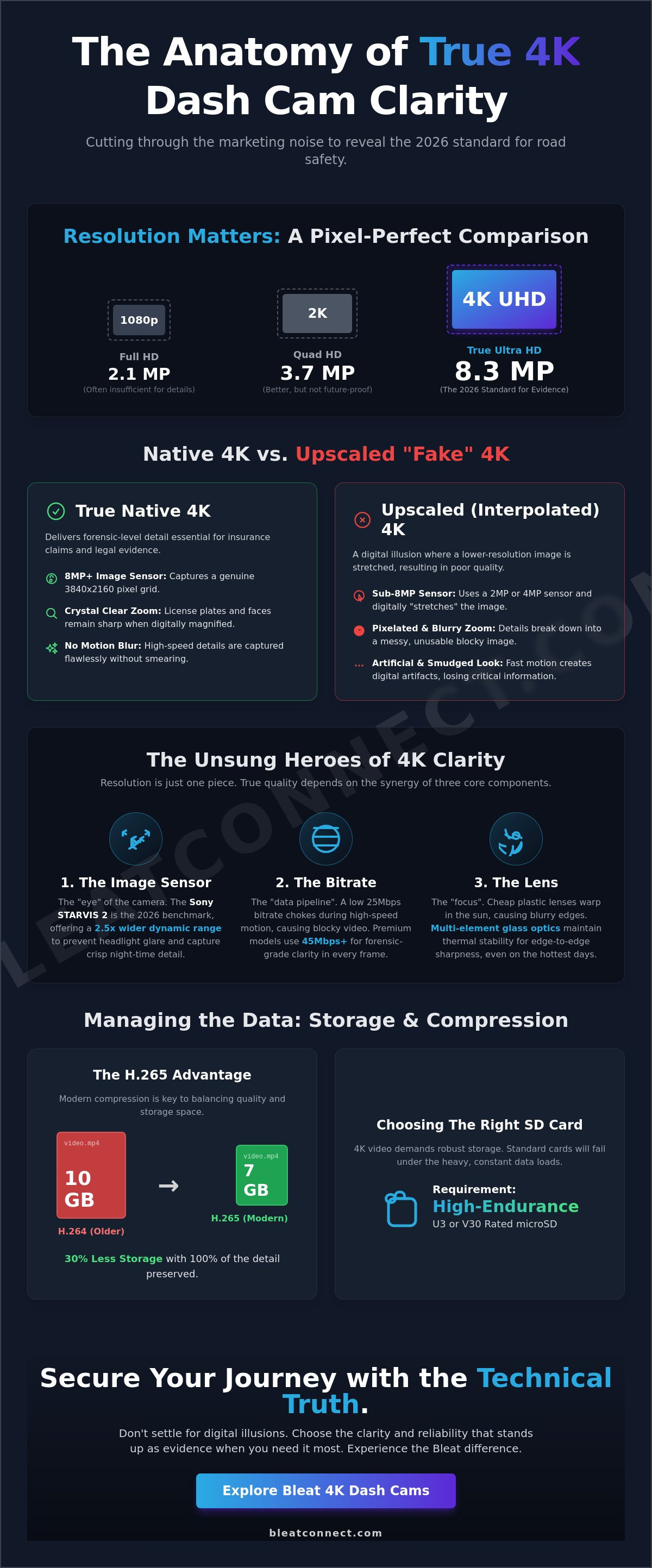
Native 4K is no longer a luxury; it's the non-negotiable baseline for road safety in 2026. A true 3840 x 2160 resolution provides exactly 8.3 million pixels of data. This density is essential for capturing high-speed details that lower resolutions simply smudge. While 1080p (2.1MP) and 2K (3.7MP) were acceptable years ago, they often fail the modern insurance test. If you can't read a license plate from 30 feet away while traveling at 80 km/h, your footage isn't evidence. It's just a movie.
Insurance adjusters now look for "usable evidence" rather than just "viewable video." This means the clarity must hold up under digital zoom. Modern Dashcam technology has evolved to prioritize this forensic detail. A 4k dash cam video quality comparison quickly reveals that 8.3 million pixels allow you to crop into a frame and identify the driver of a hit-and-run vehicle. Without this pixel count, zooming in only results in a pixelated mess that won't stand up in court or during a claim dispute.
Why Resolution Alone is Not Enough
A high pixel count is useless without a powerful image processor to handle the massive 4K data stream. Cheap cameras often use "upscaling," where they stretch a 2K image to 4K, creating a blurry, artificial look. True clarity requires a high-bitrate processor that can write data to your card at 30 or 60 frames per second without stuttering. We focus on the synergy between the lens and the processor. A premium glass lens reduces wide-angle distortion, ensuring that objects at the edge of your frame are just as sharp as those in the center. License plate recognition remains the ultimate benchmark for any 4K system.
The Evolution of Automotive Imaging
The shift from 1080p to 4K mirrors the evolution of the smartphone. What started as a gadget for enthusiasts is now a critical safety tool for every modern traveler. By 2026, AI-enhanced image sharpening has become standard in elite models, helping to distinguish between shadows and actual road hazards. These systems use neural networks to clean up digital noise in real-time. As India’s No.1 tech-forward brand, we've integrated these advancements to ensure your security is never compromised. True 4K dash cam quality is the synergy of a native 8MP sensor, premium glass optics, and a high-bitrate processor. Travel with Bleat and experience the technical truth of the road.
Decoding the Tech: Sensors, Bitrate, and Native vs. Upscaled 4K
Don't fall for the 4K sticker on the box. True clarity starts with the silicon inside. The Sony STARVIS 2 is the 2026 benchmark for automotive imaging. It offers a 2.5x wider dynamic range than the older IMX sensors found in budget models. This technology prevents headlights from washing out license plates during night driving. While older sensors provide 4K resolution, they lack the sensitivity to handle complex lighting. You need a sensor that sees in the dark as clearly as it does in high noon.
Bitrate is the real engine behind your video. A 4k dash cam video quality comparison shows that resolution is just the frame; bitrate is the paint. A low-bitrate 4K camera at 25Mbps often looks worse than a high-quality 2K camera. Blocky artifacts appear during fast motion, turning a clear road into a digital mess. High-end devices use 45Mbps or higher to keep every frame crisp. You can see this technical precision highlighted in PCMag's top dash cam picks, where processing power is a key metric for reliability.
The lens matters just as much as the sensor. Cheap cameras use plastic lenses that warp under the intense Indian sun. This leads to blurry edges and "soft" 4K footage that loses detail where you need it most. Professional grade cameras utilize multi-element glass lenses. These maintain thermal stability even when your dashboard temperature hits 70 degrees Celsius. Check out the Bleat 4K Pro lineup to see how premium optics transform your security. Travel with Bleat and trust the hardware.
Bitrate: The Unsung Hero of 4K Clarity
Bitrate is measured in Megabits per second (Mbps). It determines how much data the camera saves every second. Standard 4K streams often choke at 25Mbps, causing significant motion blur. Premium 2026 models push this to 45Mbps or higher for forensic clarity. To manage these massive files, we use the H.265 compression standard. This codec preserves 100% of the detail while using 30% less storage space than older H.264 formats. It's the only way to balance quality and capacity.
How to Spot a Fake 4K Dash Cam
Spotting "Interpolated 4K" is easy once you know the tricks. First, check the sensor model. If the sensor is not at least 8MP, it's not native 4K. A 2MP sensor upscaling to 4K is a digital lie. Second, analyze the file size. A true three-minute 4K clip at a high bitrate should exceed 1GB. Finally, perform a zoom-in test on your computer. If the image looks like an oil painting when you zoom 200%, it's a fake. Real 4K stays sharp and detailed. Accept no substitutes for your safety.
Real-World Comparison: Daytime Sharpness vs. Night Vision Excellence
Real-world performance isn't found in a laboratory. It's found at 2:00 PM on a dusty highway or at midnight on an unlit bypass. A 4k dash cam video quality comparison reveals that daytime sharpness often struggles with harsh sunlight and dashboard glare. High Dynamic Range (HDR) is the critical technology here. It balances extreme light and shadow, ensuring that you don't lose details when exiting a dark tunnel into blinding noon light. Without effective HDR, the "blooming" from the sun or oncoming high beams can turn a crucial license plate into a white void.
Motion handling is the second pillar of daytime excellence. At speeds of 60km/h and above, standard cameras often suffer from "rolling shutter" effects or motion blur. 2026's elite 4K models prioritize high frame rates and fast shutter speeds to freeze the action. This ensures that every frame of your 8.3MP footage is a sharp, usable photograph. As noted in PCMag's 2026 dash cam tests, the ability to maintain clarity during rapid movement is what separates a professional tool from a toy. You need a device that treats every second of your journey as a series of high-resolution forensic captures.
Surviving the Sun: Thermal Throttling and Glare
The Indian climate presents a unique challenge for high-performance electronics. 4K processing generates significant heat. When combined with a 70-degree Celsius dashboard temperature, many cameras "throttle." This reduces their processing power and causes immediate video softness or unexpected shutdowns. To combat this, we use supercapacitors instead of lithium batteries. Supercapacitors handle extreme heat without swelling or failing, ensuring your device lasts 5+ years. Windshield glare is another clarity killer. Circular Polarizing (CPL) filters are essential for 2026; they act like sunglasses for your lens, cutting out dashboard reflections and deepening color saturation.
Night Vision Benchmarks for Indian Roads
Night driving in India is a battle against unlit highways and aggressive high beams. Many competitors claim night vision through infrared LEDs, but these are useless for long-range road capture. True night vision requires a large sensor aperture (f/1.8 or better) to pull in every available photon. Starvis 2 technology excels here by maintaining color reproduction in near-total darkness. It manages the "blooming" effect of headlights, allowing you to read the license plate of an oncoming vehicle even in the glare. Travel with Bleat and see the night as clearly as the day.
Storage and Connectivity: The 4K Infrastructure Challenge
4K video is a data monster. A 4k dash cam video quality comparison often ignores the invisible hardware behind the lens. You need the digital pipes to support 8.3 million pixels per frame. Standard Class 10 cards, often recommended by budget competitors, fail under the intense pressure of 4K data rates. They lead to frequent card errors and corrupted evidence. High-endurance microSD cards with U3 or V30 ratings are mandatory for 2026. These cards handle the sustained 30MB/s write speeds required for premium 45Mbps bitrates. Without the right card, your 4K investment is just a paperweight.
Connectivity is the final bridge between your camera and your smartphone. Downloading a 1.5GB file over 2.4GHz Wi-Fi is a slow, painful process. It's not acceptable for a modern, fast-paced lifestyle. High-speed 5GHz Wi-Fi is the new standard. It allows you to transfer 4K evidence to your phone in under 30 seconds. This rapid access is vital during a roadside dispute where speed and clarity matter most. You need your evidence now, not ten minutes from now.
Managing Large 4K Files
1080p footage consumes about 7GB per hour. 4K footage jumps to nearly 28GB per hour. If you run a dual-channel 4K setup, your storage fills up four times faster than older systems. Loop recording works much harder now. It overwrites data every few hours on smaller cards, which significantly shortens the lifespan of your storage media. We recommend at least 256GB for any native 4K system to ensure longevity. Bleat’s smart app optimizes this experience by generating instant video previews. You get a low-latency look at your journey without waiting for massive file downloads.
Stable Power for High-Resolution Recording
High-resolution processors demand stable, high-wattage power. Traditional cigarette lighter ports are often loose or provide fluctuating voltage. This causes 4K processors to reboot or drop frames during peak heat stress. We solved this with our signature OBD-based Connectivity. This unique selling proposition ensures your 4K dash cam receives consistent voltage directly from the vehicle’s diagnostic port. It's essential for 24/7 parking monitoring. The system includes an intelligent voltage cut-off to prevent car battery drain. It’s a professional, plug-and-play solution that avoids the risks of traditional hardwiring. Secure your vehicle with a Bleat 4k car dashcamera and experience the peak of automotive tech. Travel with Bleat.
Why Bleat 4K Dash Cameras Lead the Indian Market
Bleat stands as India’s No.1 choice for automotive security because we design for the reality of Indian roads. Our 4k dash cam video quality comparison reveals a stark truth: generic global models often fail under local stress. We don't just sell gadgets; we provide essential upgrades for a safer lifestyle. Every Bleat 4K Pro unit features native 8MP sensors and six-element premium glass optics. This hardware combination ensures that 8.3 million pixels of data remain sharp even during the vibration of monsoon-damaged highways. We prioritize forensic clarity over marketing gimmicks.
Durability is our core promise. Indian weather ranges from 50-degree desert heat to high-humidity coastal zones. Our cameras are engineered with high-thermal-stability components that prevent the "focus drift" common in plastic-lens competitors. While others use basic internal batteries that swell and fail, we utilize advanced supercapacitors. This ensures your device lasts 5+ years without a drop in performance. It’s the reliable expert you need for your modern journey.
The Bleat Tech Advantage
The secret to our superior image lies in custom ISP (Image Signal Processor) tuning. We've optimized our algorithms to handle the specific lighting challenges of Indian cities, from yellow streetlights to high-beam glare. This isn't just about resolution; it's about the smart nature of our ecosystem. Our integrated GPS and G-Sensor provide a complete security layer by embedding precise speed and location data into every 4K file. This creates a bulletproof digital footprint for insurance claims. The "Travel with Bleat" philosophy means your security never compromises your lifestyle. It’s cutting-edge protection that works silently in the background.
Future-Proof Your Journey
Modern Indian travelers demand a clutter-free experience. Our signature OBD-based connectivity is the technical answer to messy wiring. This unique selling proposition allows for a smart installation that powers your 4K processor with stable, consistent voltage directly from your car's diagnostic port. It’s the most innovative way to ensure 24/7 parking monitoring without draining your battery. We support every purchase with a comprehensive national warranty and local support teams who understand your needs. Don't settle for "viewable" video when you can have "usable" evidence. Secure your future on the road today.
Upgrade to Bleat 4K Clarity Today
Secure Your Journey with Native 4K Clarity
Choosing the right road security means looking beyond the 4K sticker on the box. This 4k dash cam video quality comparison has proven that true forensic clarity depends on the synergy of native 8.3MP sensors and high-bitrate processing. You now have the technical truth to avoid the "upscaling trap" and prioritize essential infrastructure like U3-rated storage and stable power delivery. 2026 demands more than just a viewable image; it requires usable evidence that stands up under scrutiny.
Bleat delivers the technical edge necessary for modern Indian roads. As India’s No.1 Dashcam Brand, we lead the market with Sony STARVIS 2 sensor integration and advanced OBD-based connectivity. These innovations provide 24/7 protection and crystal-clear night vision without compromising your vehicle's electrical integrity. It's a professional grade solution for the tech-savvy protector. Travel with Bleat and experience the peace of mind that comes with owning cutting-edge security.
Secure your vehicle with India’s No.1 4K Dash Cam at Bleat and turn every drive into a secured journey.
Frequently Asked Questions
Is 4K dash cam video quality really better than 2K?
Yes, 4K resolution provides 8.3 million pixels, which is a 124% increase over the 3.7 million pixels found in 2K cameras. This massive jump in pixel density is the difference between seeing a blurry shape and reading a license plate at 30 feet. It provides the forensic detail required for legal evidence in 2026.
Do I need a special SD card for a 4K dash cam?
You must use a high-endurance microSD card with a U3 or V30 speed rating to handle 4K data. These cards are designed for sustained write speeds of 30MB/s, preventing the frame drops and file corruption common with standard Class 10 cards. 4K recording puts immense stress on storage media, so don't cut corners here.
How much storage does 1 hour of 4K dash cam footage take?
One hour of native 4K footage at a 45Mbps bitrate typically consumes between 20GB and 25GB of space. This is nearly four times the storage requirement of 1080p video. Because of this high data consumption, we recommend a minimum card size of 128GB to ensure you have several hours of footage before the loop recording overwrites old files.
Can I view 4K dash cam footage on my phone if it only has a 1080p screen?
You can view the footage on any modern smartphone, but the screen will downscale the image to its native resolution. The real advantage appears when you pinch-to-zoom. Because the source file has 8.3 million pixels, you can zoom into distant objects without the immediate pixelation you'd experience with a 1080p file. It's about detail retention, not just screen resolution.
What is the best sensor for a 4K dash cam in 2026?
The Sony STARVIS 2 is the premier sensor for 2026 due to its 2.5x wider dynamic range compared to older models. It excels at suppressing noise in low-light environments while maintaining high-speed clarity. This sensor is the gold standard for any driver who prioritizes night vision and license plate recognition in challenging conditions.
Does a 4K dash cam drain more car battery than a 1080p one?
4K processors consume approximately 35% more power than 1080p units because they process four times the visual data every second. This increased power draw makes stable connectivity essential. Our OBD-based systems manage this load efficiently, providing a dedicated power path that includes an automatic voltage cut-off to protect your car's battery from draining during parking mode.
What is the difference between native 4K and interpolated 4K?
Native 4K uses a sensor with a minimum of 8.3 million physical pixels to capture a true 3840 x 2160 image. Interpolated 4K is a marketing trick where a 2MP or 4MP sensor uses software to stretch the image, resulting in a blurry, "oil painting" effect. Any honest 4k dash cam video quality comparison will show that only native 4K provides the sharpness needed for insurance claims.
How does HDR improve 4K dash cam video quality at night?
HDR combines multiple exposures into one frame to balance extreme light and dark areas instantly. This technology is vital for preventing "blooming," where bright headlights or street lamps turn license plates into white, unreadable boxes. High-quality HDR ensures your 4k dash cam video quality comparison remains consistent even when driving through high-contrast environments like tunnels or unlit rural roads.